A link insertion (also called a niche edit) adds your link to an article that already exists, while a guest post is a new article written to carry your link. In the link insertion vs guest post choice, insertions are usually cheaper and faster, and guest posts give you more control over context. Which one is right depends on four conditions, and the verdict below names them.
Last updated: November 9, 2026
The verdict below is the one we'd give a friend over coffee, including the cases where neither product is worth your money.
What is a niche edit, and how does a link insertion work?
A niche edit is a link added to an existing, already-published article on another site, usually inside a sentence that fits your page. "Niche edit" and "link insertion" mean the same thing.
The process is short. Four steps, and when you've done one, you've seen them all:
- Find the article. You or the seller pick an article on a relevant site that already covers your topic.
- Send the brief. You send the target URL and anchor text.
- Edit the page. The publisher edits one sentence, or adds one, to include your link.
- Keep the history. The updated page stays live at its old URL, with its old history.
No new article gets written. That one fact explains nearly everything about niche edits: why they're quick, why they're cheap, and why you get so little say over the words around your link.
How is a guest post different from a niche edit?
A guest post differs from a niche edit because the whole article is new, written for the host's readers with your link placed where it fits best. You control the topic, the angle and the paragraph around the link.
It also takes longer. Much longer. Most people underestimate this. Someone drafts 1 article, an editor reviews it, revisions bounce back and forth, and then Google has to discover, crawl and index a brand-new URL before your link counts for anything. If you want the full basics, our guide to what guest posting is covers the process step by step.
Why do niche edit vs guest post comparisons get it wrong?
Most niche edit vs guest post comparisons get it wrong because they compare price per link and DR, when the real deciders are the page the link sits on and how much context you control.
That's the trap. Price and DR describe the seller and the domain, yet they tell you nothing about the single URL your link will live on, which is the thing that actually gets crawled, read and clicked. An insertion into a page with 2,000 monthly visits that already ranks is a different product from an insertion into a page nobody has opened since 2019. The same goes for guest posts: a new article buried 6 clicks deep in an archive passes far less than one linked from the homepage.
So judge the page. Not the label.
Link insertion vs guest post: how do they compare?
Link insertions win on price, speed and page age; guest posts win on context, anchor control and freshness. Risk is close to even, and it depends on the site more than the format.
| Criterion | Link insertion (niche edit) | Guest post | Winner, and why |
|---|---|---|---|
| Price | No writing cost; BuzzStream's average is $179 | $295 direct or $461 via a vendor, on BuzzStream's averages | Insertion, by about $100 to $280 |
| Speed | Often days, since only a sentence changes | Weeks, since writing and editing come first | Insertion |
| Link age and indexation | Page is already indexed and may already rank | New URL must be crawled and indexed | Insertion, if the page has traffic |
| Control over context | One sentence, inside someone else's article | Whole article built around your topic | Guest post |
| Anchor flexibility | Must fit the existing text | Can be written in naturally | Guest post |
| Risk | Paid link; worse if the page is stuffed with insertions | Paid link; worse at scale with keyword anchors | Tie; site quality decides |
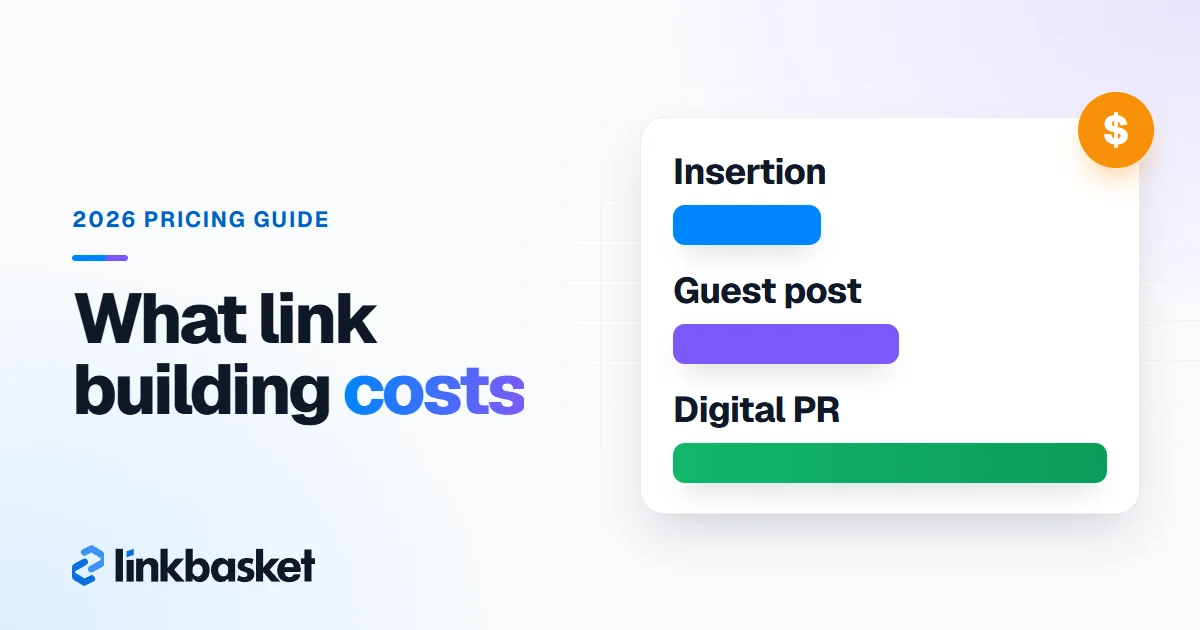
The prices come from BuzzStream's link building pricing research, with prices as of October 20, 2026. BuzzStream based the insertion figure on 62,916 sites in a link marketplace database and the guest post figures on 257,267 sites. Treat them as market averages, not quotes. If you've seen far lower prices elsewhere, ask what you're giving up. The chart puts the three averages side by side.
Which costs less, a niche edit or a guest post?
A niche edit usually costs less than a guest post, because nobody has to write a fresh article. On BuzzStream's averages, an insertion runs $179 and a guest post $295 direct, as of October 2026.
Writing decides the real gap. Draft the guest post yourself and the cash difference is only the publisher's fee, though your hours aren't free. Pay a writer and that cost lands on top. On LinkBasket, content writing is an add-on, and its price shows before you add it to the cart. Our breakdown of link building costs covers the other pricing models.
Do niche edits get indexed and pass value faster?
Niche edits often pass value faster, because the page is already indexed, may already rank and often has internal links and backlinks of its own. A new guest post starts from zero.
Honestly, that head start only holds when the host URL is healthy. Check three things before you pay:
- Indexed: search the exact page URL in Google.
- Traffic: the page itself, not just the domain, should get organic visits.
- Crowding: count the outbound links. If 12 other businesses already sit in one 800-word post, yours is number 13.
A page that fails these checks is old, not aged. Skip the page, even when the domain looks strong, because most people don't realise a dead URL on a big site passes almost nothing.
Which gives more control over context and anchor text?
A guest post gives far more control over context and anchor text, because you write the paragraph around the link. A link insertion has to fit text someone else wrote, often years ago.
That matters when your page needs a specific frame. In practice, it matters most for guides. Say you sell payroll software for restaurants, with 400 customers. A guest post on "how restaurants cut payroll errors" can link to you with a natural partial-match anchor. An insertion into a general "small business tips" article can only add one line. The anchor bends to fit. Readers barely notice it.
Are niche edits riskier than guest posts?
Niche edits are not riskier than guest posts by format. Both are paid links, and both carry the same policy risk. The site, the page and the pattern decide how risky a given link is.
Google wants paid links marked rel="sponsored" or nofollow, as its guide to qualifying outbound links explains. A sponsored tag keeps you inside the rules but passes little ranking credit.
Each format has its own warning sign, and you'll spot both in under 5 minutes when you know where to look:
- Insertions: pages crammed with unrelated commercial links, and sellers who edit dozens of old posts on one domain each week.
- Guest posts: the same exact-match anchor on every post, and articles spun across many sites.
What lowers the risk for both: relevance, real traffic, an editorial site, a natural anchor and a sponsored tag where the publisher adds one. Don't call either one safe. Neither is.
Worked example: splitting a $1,000 budget
Every number in this worked example is hypothetical. Say you have $1,000 a month and two pages to promote: a product page and a new long-form guide.
Option A spends nearly everything on insertions at $150 each: 6 links for $900. Option B spends it all on guest posts at $250 each: 4 links for $1,000. Option C mixes them: 3 insertions into ranking pages for the product page ($450), plus 2 guest posts written around the guide's topic ($500), for $950.
Option C usually fits best. Why? The trick is matching format to target. Insertions point aged, indexed URLs at the product page, where one sentence of context is plenty, while the guest posts wrap the guide in a whole article of supporting argument, examples and related terms that a single edited line could never carry. Can't tell which page needs which? Start with the product page and insertions, then watch Search Console for 8 to 12 weeks before you spend the next round.
The verdict: link insertion or guest post?
Link insertions are better for product and service pages on established sites, because an aged, indexed page passes value faster for less money. However, if you need context, a new topic or tight anchor control, then guest posts are correct.
The four conditions that decide it:
- The target page. Product pages need a mention. Guides and new topics need context.
- The host page's health. Insertions only win when that page is indexed and gets traffic.
- Your anchor needs. Branded anchors fit anywhere. Descriptive anchors fit guest posts better.
- Time. If you need the link live this week, insertions usually win.
When unsure, use both. Insertions go to the money page; guest posts go to the content you want to rank. Don't skip the checks on either.
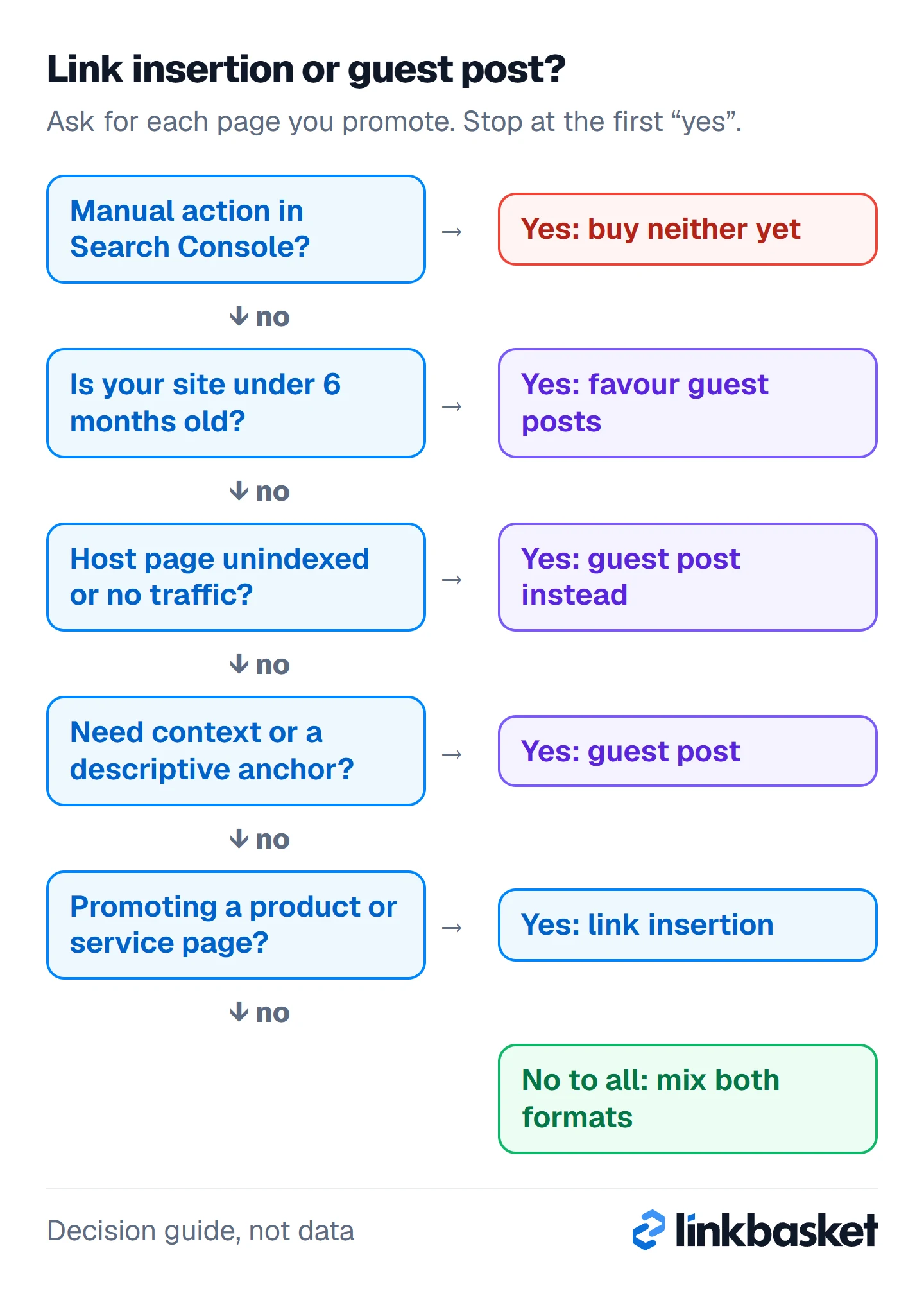
Run each page you promote through the flow below, top to bottom, and stop at the first "yes".
When does the answer flip?
The answer flips in four situations: a brand-new site, a page with no traffic, a topic no existing article covers, and a niche where editors refuse insertions.
- If your site is under 6 months old, lean on guest posts. Fresh, relevant articles look natural for a new brand. A dozen insertions into old pages? Looks bought.
- If the host page gets no traffic, a guest post on the same site, linked from its blog index, is often better.
- If no existing article fits your topic, an insertion would read as forced. Write a guest post.
- If you're in health, finance or law, some editors won't edit old articles for outside links. Guest posts with credentials are the realistic route.
When should you use neither?
Use neither a link insertion nor a guest post when you're facing either of two problems: when your site has a manual action for unnatural links, or when the page you want to promote is thin and can't keep the visitors a link sends.
Fix the page first. Don't bother buying links to a page that can't convert. If Search Console shows a manual action, hire an independent auditor who sells no links, and pause all paid placements until the review is done. Our dofollow vs nofollow links guide explains the attributes you'll see during that cleanup.
FAQ
Are niche edits better than guest posts?
Not always. Niche edits are cheaper and faster and sit on aged, indexed pages, which suits product pages. Guest posts give more context and anchor control, which suits guides and new topics. Many campaigns use both.
Do niche edits still work in 2026?
They can, when the page is relevant, indexed and gets real traffic. They don't work when sellers stuff unrelated links into old posts. Google's SpamBrain system can neutralise unnatural links, so a bad insertion often just wastes money.
How long do link insertions last?
There's no fixed lifespan. When you buy one, assume it can change. Publishers can edit or remove old content at any time, which is why ongoing checks matter. LinkBasket checks every live link weekly for 12 months and restores, moves or refunds a link that disappears or turns nofollow.
Is a link insertion the same as a niche edit?
Yes. "Link insertion" and "niche edit" both mean adding your link to an existing article. Some sellers also call it a "curated link". When you talk to a seller, ask them to name the exact page before you pay. If they won't, walk away.
Next step: compare both on real sites
Browse publisher sites in the LinkBasket inventory and filter by "accepts insertions" to see which sites offer both formats. Then order through our niche edit service for existing pages, or our guest posting service for new articles. Before you scale either, read our guide to link velocity.