Guest posting is writing an article for another website, which publishes it under your name and usually lets you link back to your own site. Done well, it puts you in front of a new audience and earns a relevant backlink. Done at scale with keyword-stuffed links, it is what Google calls link spam. So what is guest posting worth today? That depends on how you do it, and this guide shows both sides.
Last updated: November 9, 2026
What is guest posting in SEO, in plain terms?
Guest posting in SEO means publishing an article on someone else's site so that it carries a link to yours. People also call it guest blogging, and the two terms mean the same thing.
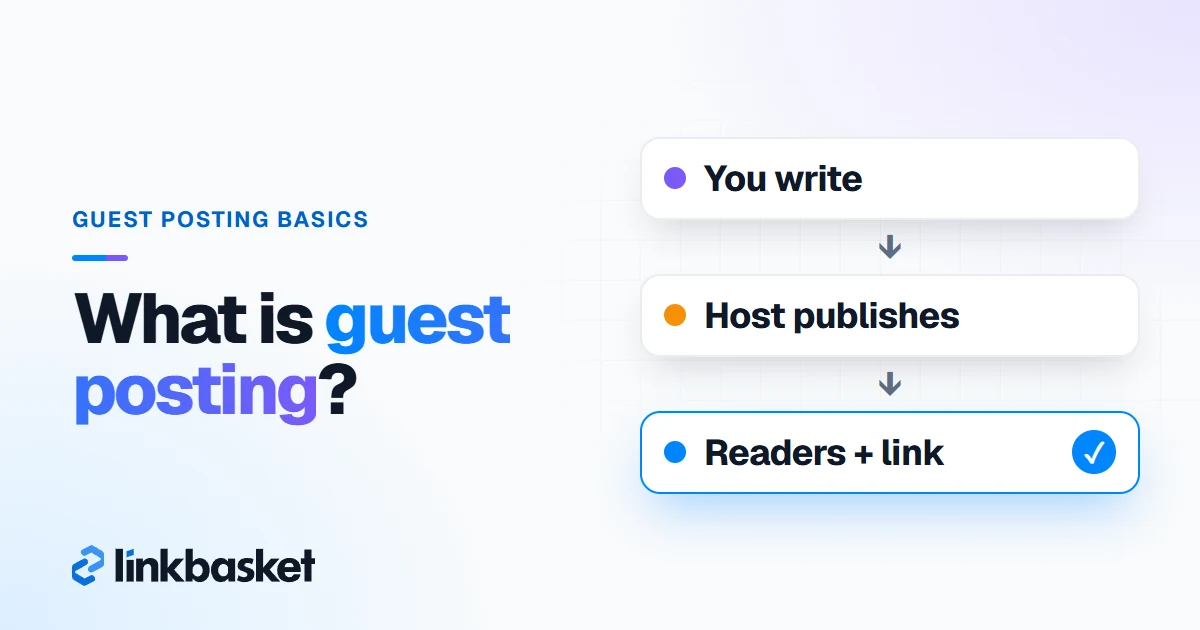
Three parties take part:
- You, the guest author. You bring the idea, the article and the expertise.
- The host site. An editor decides whether to publish, edits the piece and sets the link rules.
- The readers. If they don't get value, the post fails for everyone, links included.
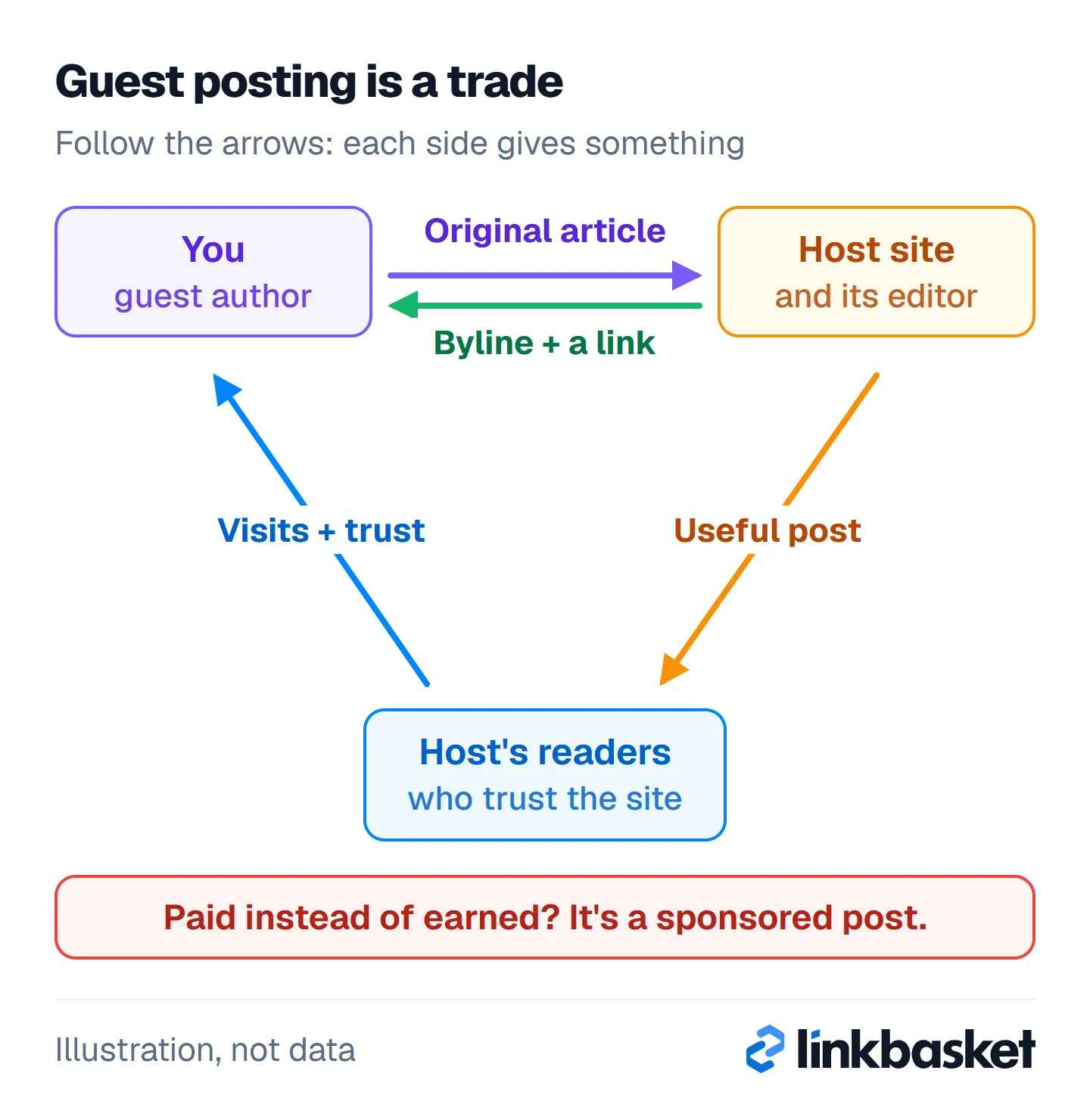
The host gets free content. You get a byline, readers and, in most cases, a link. That trade is the whole model. When money changes hands instead of expertise, it becomes a paid or sponsored post, which Google treats differently. We cover that below.
Follow the arrows in the diagram: each side gives something and gets something back.
How does a guest post work from start to finish?
A guest post goes through seven steps: pick a target site, check it, pitch, agree terms, write, publish and check the live link. Skip a step and the link is usually the thing that suffers.
- Pick targets. List sites your buyers already read. Our guest posting sites list guide shows how to find them with search operators and competitor backlinks.
- Check each site. Look for real organic traffic, topic fit and a clean set of outbound links.
- Pitch. When you write to the editor, send 2 or 3 topic ideas that fit the host's readers, not your sales page.
- Agree terms. Confirm word count, number of links, link type (dofollow or nofollow) and whether the editor adds a sponsored tag.
- Write. Follow the host's style guide and length rules to the letter. Don't recycle a post you already published.
- Publish. The editor schedules it. That can take days or months.
- Check the live link. Confirm the anchor, the URL, the attribute and that Google indexes the page.
Step 7 is the one most people skip. Links get edited, moved or switched to nofollow after publication, and nobody emails you when it happens.
What SEO value do guest post links bring?
Guest post links bring three kinds of SEO value: a backlink that can pass ranking signals, referral visitors who click through, and brand exposure to an audience that already trusts the host.
The backlink is the part most people chase. Its value depends on the same things that decide any link: relevance, real traffic, placement in the body and a natural anchor. Our guide to what makes a good backlink runs through 8 checks.
Referral traffic is the part people underrate. In practice, a post on a site with 50,000 monthly readers in your niche can send buyers for years. A post on a site with 300 readers sends almost no one, whatever its DR says.
Brand exposure compounds. Editors and journalists read niche sites too, and a good post can lead to mentions you never asked for.
Don't expect one guest post to move a competitive keyword, and don't trust anyone who promises it will. In practice, guest post link building works as one input among several: strong pages on your own site, internal links and links you earn without asking.
What does Google say about guest posting for links?
Google says guest posts are fine when they inform readers, but links in large-scale guest post campaigns built to manipulate rankings break its spam policies. It has said this in writing more than once.
On May 25, 2017, the Google Webspam Team published a reminder about links in large-scale article campaigns. The post says Google does not discourage these articles when they inform users or educate another site's audience. It then lists five warning signs when they are taken to an extreme. The right-hand card shows those five; the left-hand card shows the habits that keep a guest post on the helpful side.
Guest posting that helps
- Informs the host's readers
- A relevant host with real traffic
- Brand or natural anchor text
- Written by someone who knows the topic
- An original article for each host
Warning signs Google listed
- Keyword-rich links stuffed into the articles
- The articles spread across many different sites
- Writers who don't know the topic
- The same or similar content across articles
- Full copies of articles from your own site
The current rules say the same. Google's spam policies list "links with optimized anchor text in articles, guest posts, or press releases distributed on other sites" as link spam, as of November 2026. They also list buying or selling links for ranking purposes, including "exchanging money for links, or posts that contain links."
Google's fix for paid placements is a link attribute. Its guide to qualifying outbound links asks sites to mark paid placements with rel="sponsored", and says links marked this way "will generally not be followed."
Is a paid guest post the same as guest blogging?
No. A paid guest post and editorial guest blogging differ in what you trade: money for the placement, or expertise that an editor chooses to publish for free.
Here is the honest part, and we'd rather you hear it from us than from a seller.
What lowers it is how the link looks and where it lives:
- A relevant site with genuine readers
- A page an editor actually reviewed
- A natural anchor, usually your brand or a plain phrase
- A sponsored tag, where the publisher adds one
- No link farms that sell to every niche
LinkBasket is a marketplace for paid guest posts and link insertions on publisher sites. Each site page shows the link type and whether a sponsored tag is added before you pay. If you want the comparison between those two products, read link insertion vs guest post.
Guest posting benefits and risks: which matters for you?
Guest posting benefits outweigh the risks when the host is relevant, the article is genuinely useful and the links are few and natural. The table below shows how that shifts with your goal.
| Your goal | Guest posting fit | Main benefit | Main risk |
|---|---|---|---|
| Reach a new audience | Strong | Readers who already trust the host | Low, if the host is real |
| Build topical authority | Strong | Relevant backlinks from your niche | Thin sites with no readers |
| Rank fast for one money keyword | Weak | Possible link value | Exact-match anchors look manipulative |
| Earn links at volume (50+ a month) | Poor | Speed | The "many sites, same content" pattern Google warned about in 2017 |
| Recover from a manual action | Not now | None until cleanup ends | More unnatural links on the pile |
Worked example: what does one guest post take?
Every number in this worked example is hypothetical. Say you run a project-management app with 2,000 paying users and want one guest post on a productivity blog.
You build a list of 40 blogs. After checks, 15 have real traffic and topic fit. You pitch all 15 and 4 reply. One editor accepts a 1,500-word post with 1 link in the body and 1 in the author bio. Writing takes 5 hours and editing back-and-forth takes 2 more. The post goes live 5 weeks after your first pitch.
Now price your time, because most people forget this part. Say research and pitching took 8 hours, plus the 7 for writing. At $50 an hour, that is 15 hours and $750 for one placement on a blog with, say, 20,000 monthly visits. A marketplace changes the maths: you skip pitching, pay the publisher's listed price and write the article (or pay for writing). Neither route is free. For a breakdown of the pricing models, see our guide on how much link building costs.
How do you build a guest posting strategy that lasts?
A guest posting strategy that lasts sets a goal, picks sites by audience, plans topics and anchors in advance and tracks every link after it goes live. Five parts:
- Goal. Referral traffic, topical links or brand reach. Pick one per quarter.
- Target list. 20 to 50 sites your buyers read, checked for traffic and relevance.
- Topics. One idea per site, written for that site's readers. Never spin one article across 10 hosts.
- Anchor plan. Mostly brand names and plain phrases. Use exact-match keywords rarely.
- Tracking. Log the URL, anchor, attribute, publish date and indexation for every post.
Keep the pace believable when you scale up. A brand that never wrote for anyone and then appears on 30 blogs in 2 weeks looks like a campaign, because it is one. Our guide to safe link velocity covers pacing in detail.
Which edge cases change the guest posting answer?
Five situations change how guest posting works for you: a brand-new site, a sensitive niche, a local business, a host that bans promotional links and content you want to republish.
- New site (under 6 months): a handful of relevant guest posts beats a big batch. Start with 2 to 4 good hosts.
- Health, finance or legal: editors ask for credentials and sources. Expect stricter reviews and, on paid sites, surcharges.
- Local business: a city news site or a local association blog often beats a national blog with more traffic.
- Hosts with no-link rules: big publications often allow no promotional links at all. Write for them for authority and readers, not for links.
- Republishing your own article: Google's 2017 post flags duplicating full articles from your own site. If you must syndicate, ask for a
rel="canonical"pointing back to your original.
When should you skip guest posting or call a specialist?
Skip guest posting when your own site can't convert the visitors it would bring, or when Search Console shows a manual action for unnatural links. Fix the site, or clean up first.
Call in an independent SEO auditor when:
- Search Console shows a manual action for unnatural links to your site
- Rankings dropped sharply right after a Google spam update
- You inherited hundreds of old guest post links with exact-match anchors
Don't trust a link seller with that job. Us included. You want someone with no stake in the answer.
FAQ
Is guest posting still worth it in 2026?
Yes, when the host is relevant and has real readers. A single post on a trusted niche site can bring referral visitors, a good backlink and brand recognition. Mass guest posting across low-quality sites is not worth it, because Google's systems can neutralise those links.
Are guest post links dofollow?
Some are, some aren't. Many big publications mark contributor links nofollow or allow none. Paid placements should carry rel="sponsored" under Google's rules. When you agree terms, confirm the link type in writing, and check the live link afterwards.
What is guest blogging compared with guest posting?
They are the same thing. "Guest blogging" is the older term, from when most hosts were personal blogs. "Guest posting" covers any site that publishes outside contributors, from niche blogs to trade magazines.
How many guest posts should I publish a month?
There's no fixed number. Match your pace to your capacity to write genuinely useful articles and to your site's normal link growth. For a small site, 2 to 4 good guest posts a month is a realistic start, as a rule of thumb rather than a rule from Google.
Next step: find your first guest post sites
To order a placement on a site you can check first, see our guest posting service, or open the LinkBasket inventory with a free account and no card. Domain names, DR, DA, traffic, top country and price all show before you pay. To compare platforms, read our review of the main guest post marketplaces.