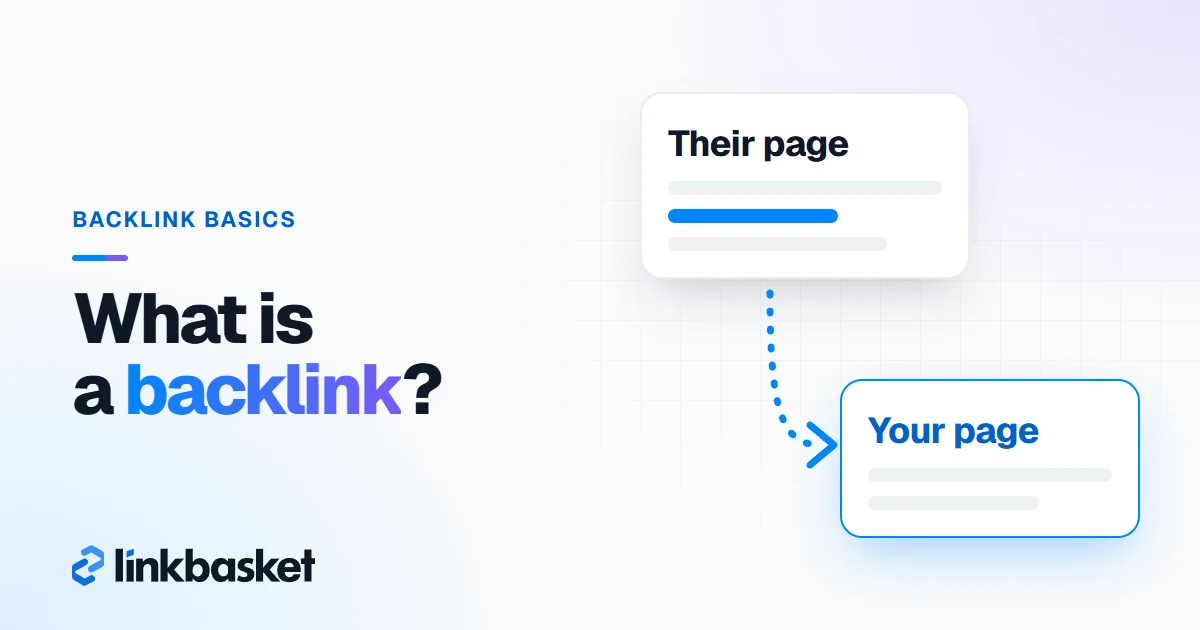
A backlink is a link on another website that points to a page on your website. Google reads it as a reference: it uses links to find new pages and as one signal when it judges which pages are relevant to a search. So, what is a backlink worth? It depends on the site, the page and the link itself.
Last updated: November 9, 2026
That short answer covers 90% of what people mean. The rest of this guide shows how a backlink works inside Google, the 4 parts of a link you can read in any page's HTML, and where backlinks sit next to internal and outbound links.
What is a backlink in SEO?
In SEO, a backlink is a hyperlink from one website to a different website, seen from the side that receives it. You'll also hear inbound link or incoming link. They mean the same thing.
Three quick examples make it concrete, and if you've ever cited a source, you've made one:
- A food blog writes "this cast iron care guide" and links to your guide. That is a backlink to you.
- You link from your home page to your pricing page. That is an internal link, not a backlink.
- You link from your post to Google's documentation. That is an outbound link from you, and a backlink for Google.
So one link has two names, which is the detail most people miss. Your outbound link is the other site's backlink. SEO tools count backlinks two ways: every single link, and the number of separate websites that link to you, called referring domains. If one blog links to you in 10 posts, that is 10 backlinks from 1 referring domain. Our guide to backlinks vs referring domains explains why the second number usually tells you more.
How do backlinks work in Google?
Backlinks work in Google in two ways: Google follows them to discover pages, and it uses them as one signal of which pages are relevant and useful. The original idea behind this is PageRank.
Google's own documentation is plain about both jobs. Its guide to crawlable links says, as of November 2026, "Google uses links as a signal when determining the relevancy of pages and to find new pages to crawl." Its ranking systems guide calls PageRank "one of our core ranking systems used when Google first launched" and says it "continues to be part of our core ranking systems," though it has "evolved a lot" since then.
What is the PageRank idea, in plain terms?
PageRank treats a link as a vote, and a vote from a page that itself has many votes counts for more. Each page shares some of its weight with the pages it links to, so weight flows through the web along links.
Here is a worked example where every number is hypothetical: page A holds 100 units of weight and links out to 4 pages. In the simple model, each of those 4 pages gets about 25 units from A. Page B has only 20 units and links out to 2 pages, so each of its targets gets about 10. A link from A is worth roughly 2.5 times a link from B, even though both are "one backlink."
Real ranking is far messier. Honestly, the toy model hides most of it: Google weighs many signals, PageRank has changed since 1998, and nobody outside Google knows its current weights. In practice, the model still explains two things you'll see every day:
- A link from a strong, popular page tends to help more than a link from a page nobody links to.
- A page that links out to 200 sites passes less to each one than a page that links out to 3.
What are the parts of a backlink?
Every backlink has 4 parts you can read in the page's HTML: the source page, the target URL, the anchor text and the rel attribute. A fifth thing, the sentence around the link, gives it context.
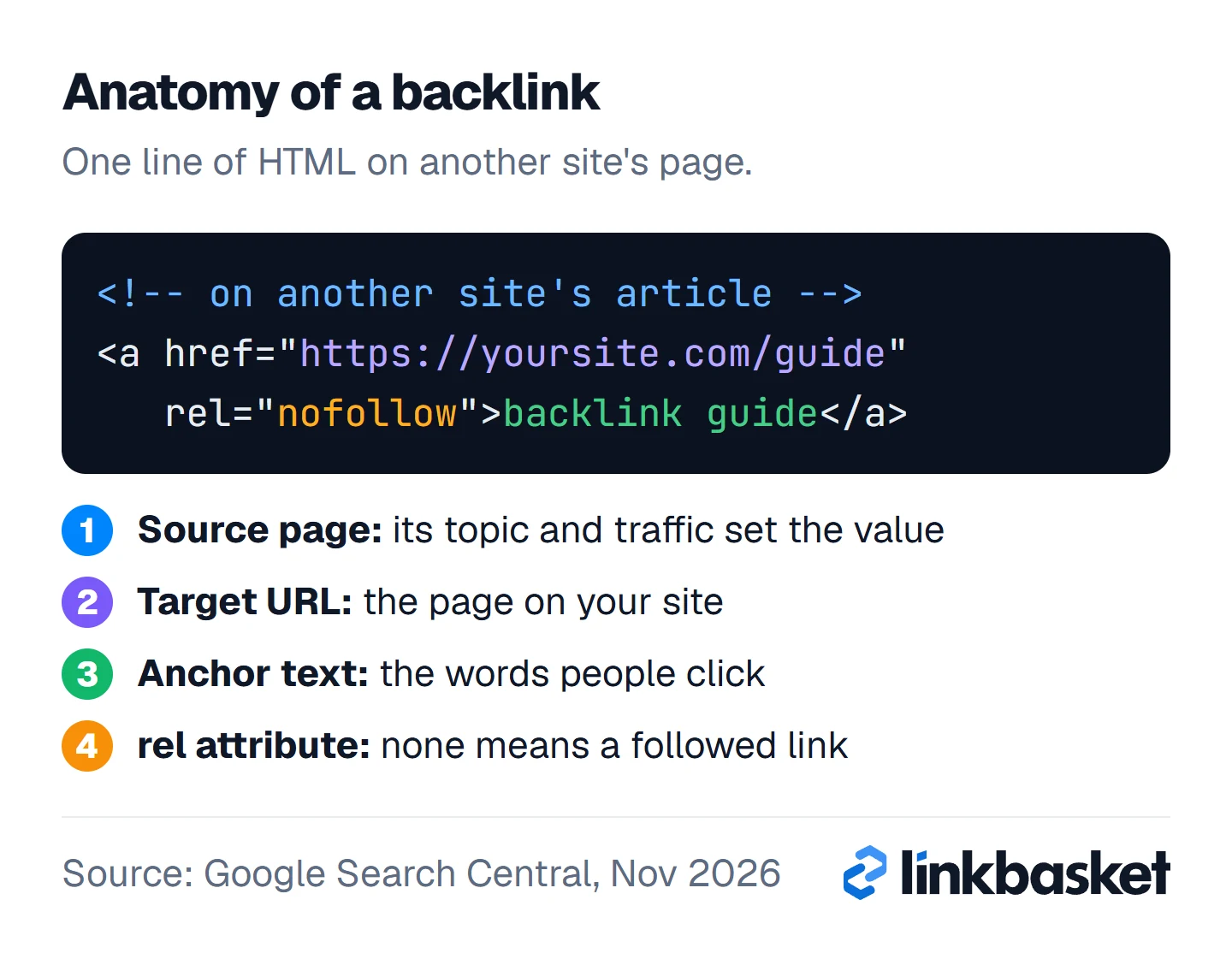
When you read the code, match each colour to its number. Here is the same link as plain code:
<a href="https://yoursite.com/guide" rel="nofollow">backlink guide</a>
- Source page: the page on the other website that holds the link. Its topic, traffic and links decide most of the value.
- Target URL: the
hrefvalue, the page on your site the link points to. - Anchor text: the clickable words, here "backlink guide." Google's link guidance asks for anchor text that is "descriptive, reasonably concise, and relevant."
- rel attribute: an optional label such as
nofollow,sponsoredorugc. No label means a normal, followed link.
Two details trip people up when you build or buy links. Google says it can generally crawl a link only if it is an <a> element with an href, so links built only with JavaScript click handlers may not count. And when an image is the link, Google uses the image's alt text as the anchor text.
What do dofollow and nofollow mean on a backlink?
A dofollow backlink is a plain link with no rel value, and it can pass ranking credit. A nofollow backlink carries rel="nofollow", sponsored or ugc, and Google says such links "will generally not be followed."
Google's guide to qualifying outbound links sets out the three values:
sponsoredfor ads and paid placementsugcfor user content such as comments and forum postsnofollowwhen the other two don't apply
On September 10, 2019, Google said it would treat all three as hints rather than strict rules, and from March 1, 2020, nofollow became a hint for crawling and indexing too. Our dofollow vs nofollow links guide covers when each one makes sense.
Backlink vs internal vs outbound link: what's different?
A backlink comes from another site to yours, an internal link joins two pages on your own site, and an outbound link goes from your site to someone else's. The HTML tag is identical. Only the direction changes.
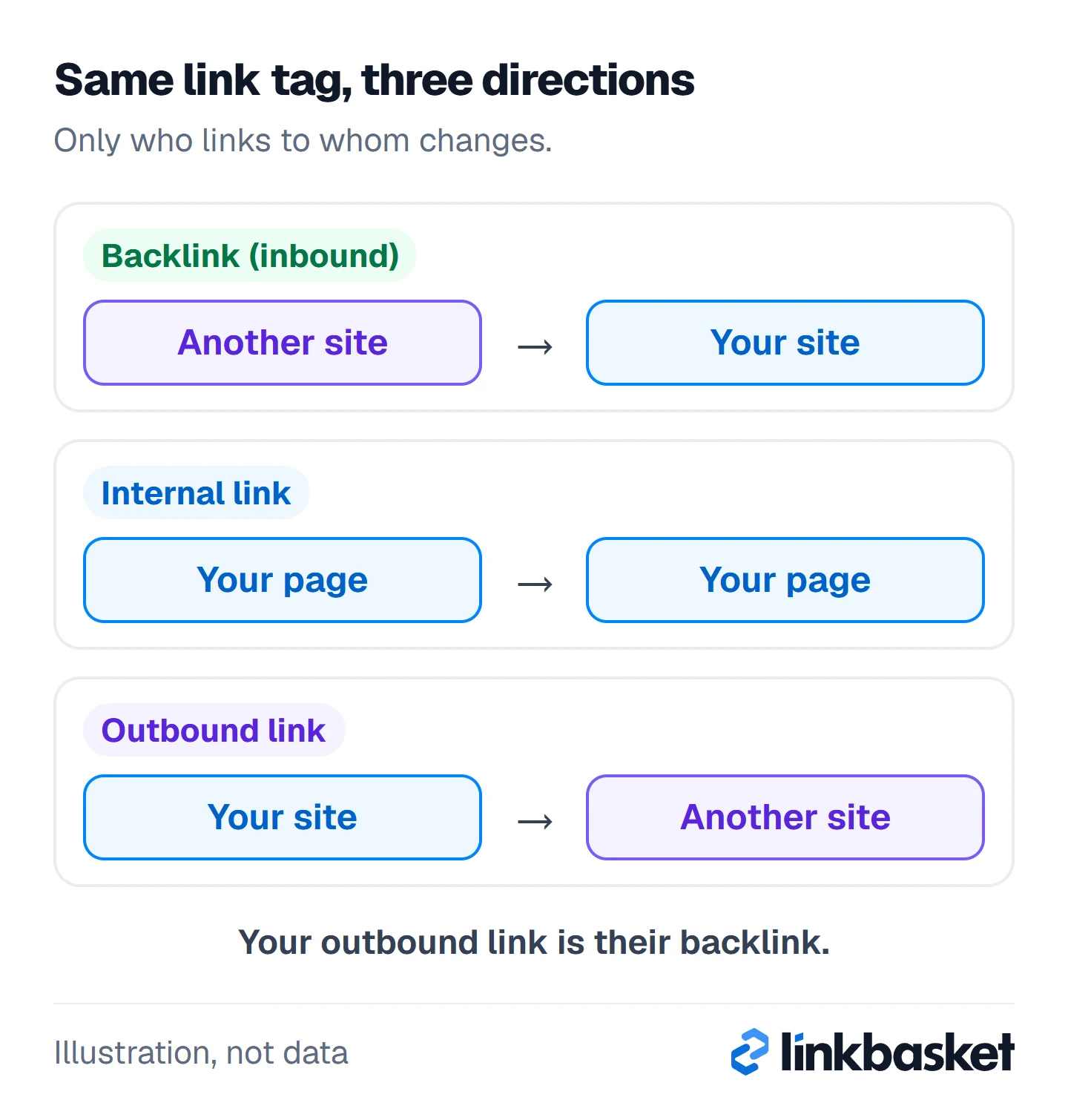
Follow the arrows. The tag never changes; only the direction does.
| Link type | Goes from | Goes to | Who controls it | Main SEO job |
|---|---|---|---|---|
| Backlink (inbound) | Another site | Your site | The other site's owner | Discovery and a relevance signal for you |
| Internal link | Your page | Your page | You | Helps Google find and group your pages |
| Outbound (external) link | Your site | Another site | You | Cites sources and helps readers |
| Self-made link on a profile or forum | A page you posted on | Your site | Mostly you | Usually little; often ugc or nofollow |
What is outbound linking?
Outbound linking means linking from your pages to other websites, usually to cite a source or point readers to a useful tool. Google's link guidance says "Linking to other sites isn't something to be scared of," and suggests sponsored or ugc for paid or user-made links.
In practice, add outbound links where they help a reader check a claim. One or two per section is plenty. Don't bother hiding them behind nofollow when you cite a trusted source.
Link building vs backlinks: are they the same thing?
No. Backlinks are the result, and link building is the work of getting them. A backlink is an object you can point at. Link building is the process: creating pages people want to cite, pitching editors, writing guest posts or paying for placements.
| Term | What it is | Example |
|---|---|---|
| Backlink | One link from another site to yours | A news article links to your study |
| Link building | The activity that earns or buys backlinks | Pitching that study to 30 journalists |
| Link profile | All the backlinks your site has | 1,200 backlinks from 150 referring domains |
To read and audit that whole set, see our guide to your backlink profile.
Some backlinks arrive with no link building at all. A stranger finds your guide, likes it, and cites it. When you publish something genuinely useful, that happens more than you'd expect. The methods range from earned editorial links to paid placements, and our guide to the types of backlinks rates each one on value, risk and effort.
Which link building metrics describe a backlink?
The common link building metrics are DR, DA, referring domains, organic traffic, anchor text and the link attribute. Google uses none of the third-party scores; they come from SEO tools that estimate link strength.
- DR (Domain Rating): Ahrefs' score from 0 to 100 for the strength of a site's backlink profile, on a logarithmic scale.
- DA (Domain Authority): Moz's version of the same idea, built from its own link index.
- Referring domains: the number of separate sites that link to a page or site.
- Organic traffic: an estimate of monthly visits from Google, and the best sign that real people read the site.
- Anchor text and attribute: what the link says, and whether it is followed.
Don't trust any of these scores alone; read them against traffic. With hypothetical numbers: a DR 60 site with almost no visitors is a weaker source than a DR 30 site with 20,000 monthly readers in your niche. Our checklist on what makes a good backlink shows how to weigh them.
Are all backlinks good for SEO?
No backlink is good by default; some help, many do nothing, and a few break Google's rules. Google's spam policies define link spam as links made "primarily for the purpose of manipulating search rankings."
That policy covers buying or selling links that pass ranking credit, excessive link swaps, automated link programs, low-quality directory links and widely distributed footer links.
What lowers the risk is a link that looks like one an editor would place anyway: a relevant site with real traffic, an in-body placement, a natural anchor, and a sponsored tag where the publisher adds one. The reasons links still matter at all are covered in our guide on why backlinks are important.
Which edge cases change how a backlink counts?
Five common cases change whether a backlink counts the way you expect: JavaScript links, image links, unindexed pages, user-generated links and many links from one site. When you land a new link, run these five checks:
- Is it a real link tag? Without an anchor element and an href, Google may never see it. JavaScript-only links can slip through.
- Is an image carrying it? Then the alt text becomes the anchor, so don't skip it.
- Is the source page indexed? When you get a new link, search the page URL in Google. If it isn't there, the link can't pass anything yet.
- Is it a comment or forum post? Sites usually mark these ugc or nofollow. Expect visits, not ranking credit, and don't bother chasing them for SEO.
- Is it the first link from that site? The 10th link from one blog adds far less than a first link from a new site. Ahrefs, for example, counts one link per website toward DR.
How many links a page needs is a separate question, and the answer depends on the pages you compete with. Our guide on how many backlinks you need to rank walks through a method.
When should you get help with backlinks, and when not?
Get specialist help when Search Console shows a manual action for unnatural links, rankings fall sharply after a spam update, or you're planning a large disavow. Those jobs need an auditor with no stake in selling you more links. Don't use a link seller for it, us included.
Frankly, you probably don't need outside help if your site is under 6 months old and you haven't published your best pages yet. Content and internal links come first. Once you know which pages deserve links, you can build them yourself, hire an agency, or pick placements on a marketplace.
FAQ
Is a backlink the same as a hyperlink?
A backlink is a type of hyperlink. Every hyperlink joins two pages; it becomes a backlink when it points from one website to a different website. A link between two pages on your own site is an internal link instead.
How can I see who links to my website?
Open Google Search Console, click Links, and read the Top linking sites table. Google groups links by root domain and caps each on-screen table at 1,000 rows, with exports up to 100,000 rows. Our guide on how to check backlinks covers free and paid tools.
Do backlinks from my own other websites count?
They are still backlinks, since they come from a different domain. If you've built several sites, though, a network of sites you control, built to link to each other, matches what Google's spam policies call link spam, so don't build one just for rankings.
Is a nofollow backlink useless?
No. A nofollow link generally passes no ranking credit, but it can still send readers who buy, share or link to you later. A nofollow mention on a big news site often beats a dofollow link on a site nobody visits.
Next step: see backlinks before you build them
To see what these metrics look like on real publisher sites, create a free account and browse our link marketplace inventory; domain names show after sign-up, and no card is needed. If you'd rather hand the work off, our link building services page explains the options. To keep learning, read our guide to different types of backlinks next.