Digital PR is the practice of earning online coverage, brand mentions and backlinks by pitching stories, data and expert comment to journalists and publishers. Unlike traditional PR, it is judged mostly by links, search visibility and referral traffic, not by print clippings or ad-value equivalents. So what is digital PR in practice? Below we cover how it differs from the old model, its main types, what became of HARO, and when it's worth the money.
Last updated: November 9, 2026
What is digital PR, in plain terms?
Digital PR means getting other websites, mostly news sites, trade press and blogs, to write about you and link to you because you gave them something worth covering. Usually data. Sometimes a sharp opinion, or an expert who picks up the phone when a reporter on deadline needs three clean sentences by four o'clock.
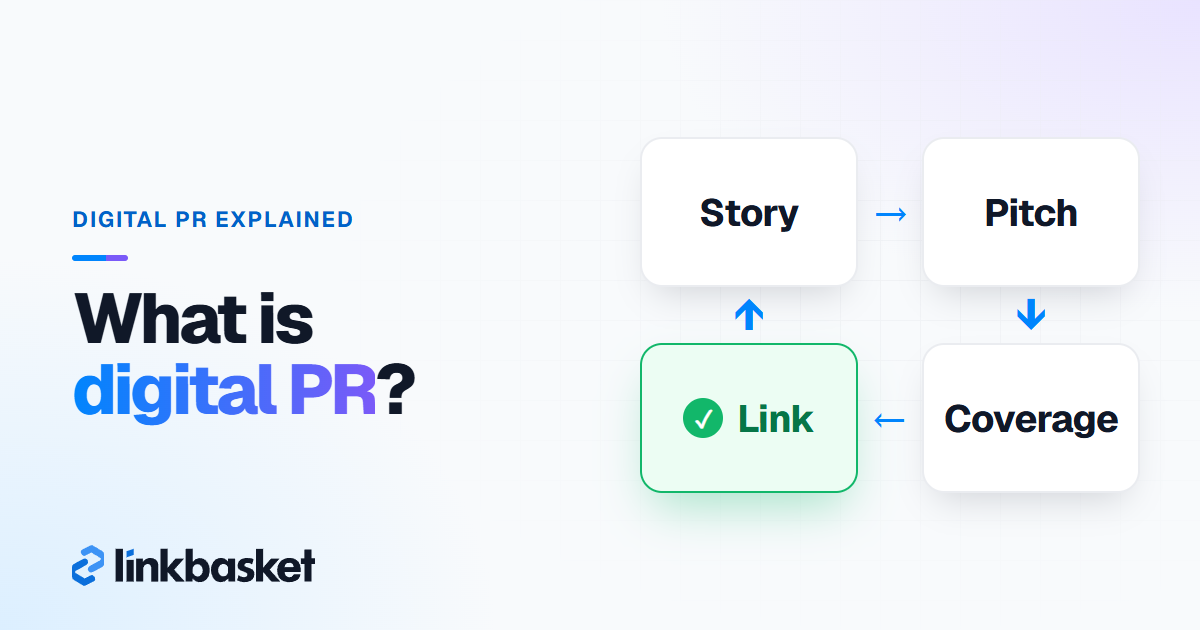
Here's the loop in four steps:
- Create a story A survey, a data analysis, a free tool or expert comment.
- Find the journalists The writers who already cover that topic.
- Pitch them By email, or by answering requests they post.
- Get credited Some publish, credit you and link to a page on your site.
The digital PR meaning that SEO teams care about is step 4. Everything else is setup. A credited link from a respected publication tells search engines other people vouch for you. It also sends readers, and puts your brand in front of people who never searched for you.
How is digital PR different from traditional PR?
Digital PR differs from traditional PR in what it measures: links, rankings and referral traffic instead of print reach, broadcast slots and reputation alone. The pitching skills overlap. The scoreboard doesn't. A front-page print feature with no online link can thrill a CEO and do nothing at all for your rankings, while a short mention on a trade site with a followed link can move a page.
| Traditional PR | Digital PR | |
|---|---|---|
| Main goal | Reputation, awareness, crisis control | Links, mentions, search visibility |
| Typical outlets | Print, TV, radio, trade magazines | News sites, online trade press, blogs, podcasts |
| What counts as a win | A feature, an interview, a broadcast slot | A followed link or a brand mention on a relevant site |
| How it's measured | Reach, sentiment, share of voice | Referring domains, rankings, referral sessions |
| Who usually runs it | PR or comms team | SEO team, PR team, or both together |
| Tie to SEO | Indirect | Direct |
Many teams now blend the two. A PR team lands an interview, and the SEO team makes sure the online version links to the right page. When you hear "digital marketing PR" or "PR digital marketing", that blend is usually what people mean.
The pitching skills overlap. The scoreboard doesn't.
What are the types of digital PR?
The main types of digital PR are data-led campaigns, reactive PR, expert commentary, tools and assets, and link reclamation. Most programmes mix two or three. Few run all five.
- Data-led campaigns. A survey, a scrape of public data, or an index. BuzzStream's State of Digital PR report, updated in February 2026, found 95.9% of practitioners pitch data-led content.
- Reactive PR. Commenting on breaking news within hours, with a quote or a quick statistic.
- Expert commentary. Answering journalist requests, often through services like HARO. More on that below.
- Tools and assets. Calculators, maps or indexes that writers cite each time the topic comes back.
- Link reclamation. Finding articles that mention your brand without a link, then asking the writer to add one.
Two older formats need a warning. A digital marketing press release spread through wire services rarely earns links worth having on its own.
For how these types fit into a plan with goals, a media list and measurement, see our guide to building a digital PR strategy.
Is digital PR the same as link building?
No. Digital PR is one way of doing link building, and it also chases brand mentions and referral traffic that pure link building ignores. Our digital PR vs link building comparison covers cost per link, control and risk side by side.
What happened to HARO?
HARO (Help a Reporter Out) still exists in 2026, but it changed hands. Cision rebranded it as Connectively in 2024, shut it down, then sold the HARO brand to Featured.com in April 2025, which revived the free email format.
Here's the timeline, checked November 2026:
- 2024: Cision, HARO's owner at the time, rebranded the service as Connectively.
- December 2024: Cision shut Connectively down, as Press Gazette reported.
- April 15, 2025: Cision announced the sale of HARO to Featured.com. The release said Cision "no longer offers the Help A Reporter Out or Connectively services."
- April 22, 2025: HARO came back in its original email format. Featured's founder, Brett Farmiloe, told Press Gazette the emails would be "free and supported by advertising."
- November 2026: helpareporter.com is live, says it is "Powered by Featured", and offers free daily media queries by sign-up.
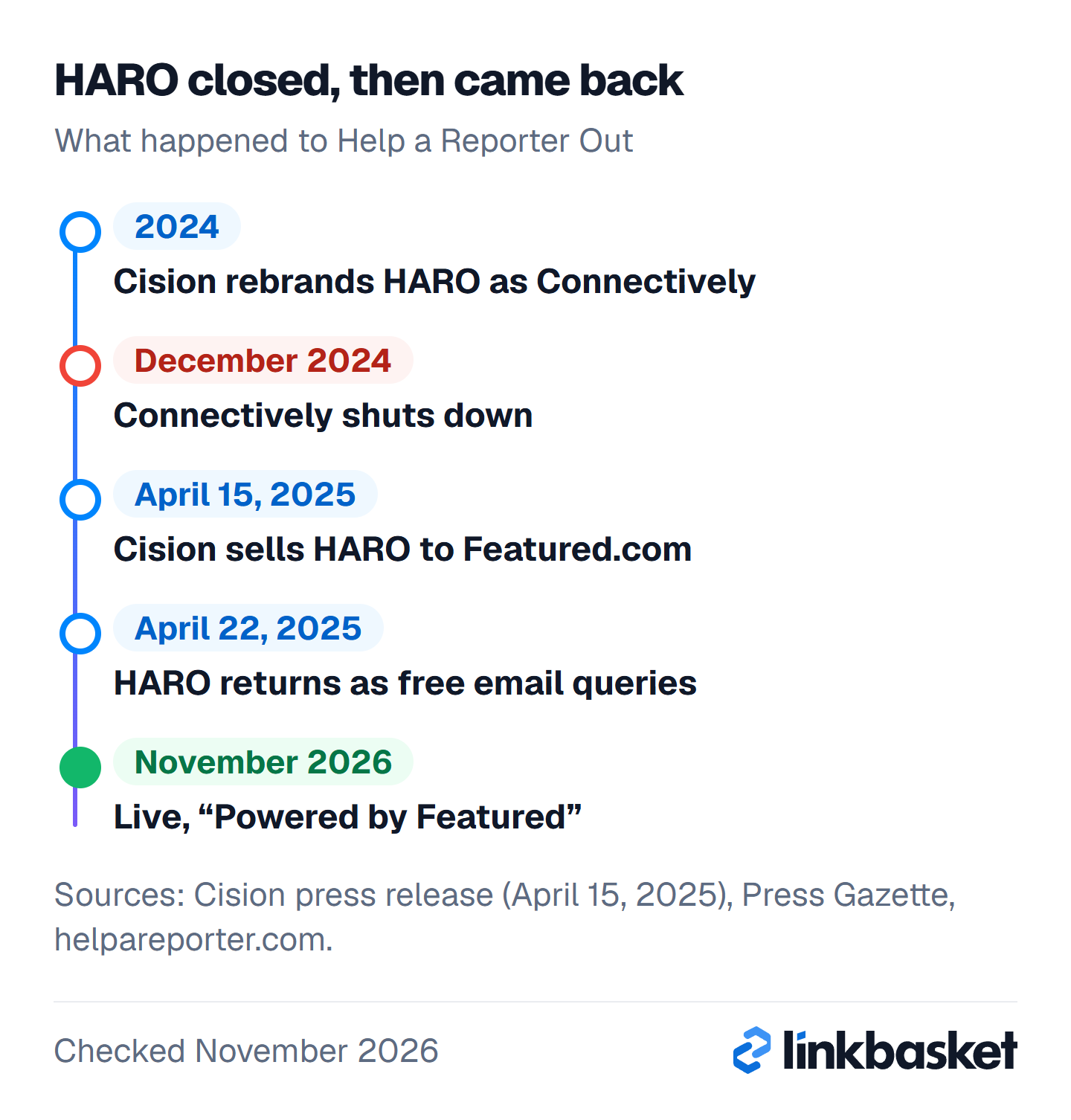
Look at the red dot. From December 2024 to April 2025, about four months, no HARO service ran at all. Check the date on any guide that calls it dead.
What is HARO link building?
HARO link building means answering journalist requests from HARO, or a similar service, so that published stories quote you and link to your site. It's expert commentary at scale. In practice, most replies go unused. Reply only where you hold real expertise. Reply fast. And don't use a template; editors spot them instantly.
What are the current HARO alternatives?
Two alternatives we checked in November 2026 are Source of Sources and Qwoted. Source of Sources is run by Peter Shankman, who founded the original HARO; its site says the list "doesn't cost a dime" and sends queries up to three times a day. Qwoted describes itself as a network of journalists and experts, with free account sign-up on its home page. Plans and limits change often, so check each site before you commit time.
How much does digital PR cost?
Digital PR costs about $597 per link on average, according to BuzzStream's digital PR cost survey, updated June 12, 2026. The average monthly contract was $5,458.
BuzzStream asked about 70 agency leaders and freelancers, so read the figures as rough guides. Its weighted midpoints by service type were $400 per link for journalist requests, $625 for reactive and proactive PR, and $800 for hero campaigns. UK respondents reported $818 per link on average; US respondents reported $350.
Expert commentary is the cheapest route in. Hero campaigns cost the most, and they carry the most variance, because one news cycle can bury six weeks of research, design and outreach without anyone on your team doing anything wrong. Ouch.
When is digital PR worth it?
Digital PR is worth it when you have a story journalists want, a page that can hold the links, and enough budget and patience to absorb a campaign that misses. Lack all three? Then it usually isn't.
| Your situation | Is digital PR worth it? | Start with |
|---|---|---|
| You own unique data or can run a survey | Yes | A data-led campaign |
| A credentialed expert can reply within hours | Yes, at low cost | Expert commentary and journalist requests |
| Monthly link budget under $2,000, no story | Not yet | Placements, then revisit PR |
| A product page needs links within 30 days | No | Placements aimed at that page |
| Brand needs trust in a health, finance or legal niche | Often | Expert commentary from a qualified person |
| Money pages already rank in the top 5 | Yes | PR to lift the whole domain |
The $2,000 and 30-day lines are our rules of thumb, not industry data.
Worked example: digital PR on a small budget (hypothetical)
Every number here is hypothetical. Say you run a bookkeeping firm and your owner, a chartered accountant, gives 5 hours a week to expert commentary.
- She answers 20 relevant journalist requests a month.
- Say 3 replies get used, and 2 of those include a link.
- Her time is worth $80 an hour, so 20 hours a month costs $1,600.
- That's $800 per link, the same as BuzzStream's hero-campaign midpoint, with zero design spend.
Now tighten it. If she answers only the 10 requests where she's a perfect fit, and say the same 2 links land, the cost drops to $400 per link. Fewer, better replies win. Honestly, that's the whole lesson of expert commentary.
Which edge cases change whether digital PR fits?
Five cases bend the usual advice, and most people miss at least one:
- Local businesses: national coverage rarely helps a single-location firm. Local news and community links usually matter more, as our local link building guide explains.
- Boring B2B niches: the story has to come from data or people, not the product. Payroll software can publish salary data.
- New domains: PR links lift the homepage, but inner pages still need their own links.
- Regulated niches: finance, health and legal journalists want named, qualified sources. A content marketer quoting tax rules won't get used.
- Unlinked coverage: big outlets often mention brands without a hyperlink. A mention still has value for brand searches, so don't treat it as a failure.
When should you hire a digital PR specialist, or skip PR?
Hire a digital PR specialist when you have budget for at least a full quarter, around one average monthly contract of $5,458 in BuzzStream's survey, and want national coverage you can't land yourself. Skip PR for now when a money page needs links this month.
Skip it, too, if nobody on your team can speak with authority on your topic. In that case, placements on relevant sites are the faster route, and our guide to what makes a good backlink shows how to judge one. Don't skip the risk check. Google's spam policies treat links bought to manipulate rankings as link spam, so paid links are never risk-free. These checks lower that risk:
- The site covers your topic.
- It has real organic traffic from your market.
- It publishes editorial pages for readers, not posts for sale on every subject.
- The anchor is natural: your brand, a URL or a plain phrase.
- A sponsored tag is fine with you where the publisher adds one.
LinkBasket checks each live link weekly for 12 months after it goes up.
FAQ
Is digital PR part of SEO?
Yes, for most teams. Digital PR is an off-site SEO tactic, because it earns links and mentions from other sites. It also overlaps with brand marketing, so SEO and PR teams often share the work.
Is HARO still free in 2026?
For sources, yes. When we checked helpareporter.com in November 2026, it offered free daily media queries by sign-up. Featured's founder said in April 2025 that the emails would be supported by advertising.
How is digital PR different from a press release?
A press release announces your news to everyone at once. Digital PR pitches a specific story to specific journalists. Releases can be one part of a campaign, but keyword-stuffed anchors in distributed releases count as link spam under Google's policies.
How long does digital PR take to work?
First coverage often lands within a week of pitching. BuzzStream's February 2026 report found 51.4% of practitioners say measurable results take 3 to 6 months, so judge it over a full quarter.
Next step: try digital PR or build links another way
If you have a story or an expert, start small with journalist requests and read our step-by-step guide to building backlinks for the other tactics. To have us run a campaign, see our managed digital PR campaigns. And if a specific page needs links soon, browse publisher sites with metrics shown using a free account.