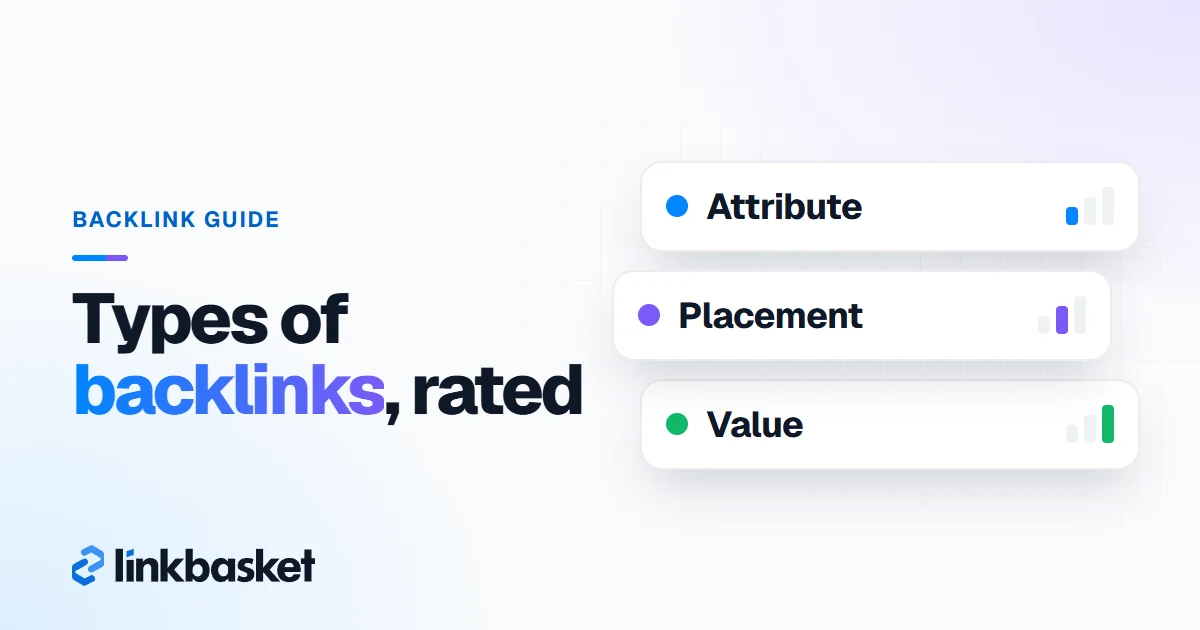
The types of backlinks are best sorted 3 ways: by attribute (dofollow, nofollow, sponsored, ugc), by how the link was placed (editorial, guest post, niche edit, PR mention, directory, profile, forum, comment), and by the value it brings. Every link has all three at once.
Last updated: November 9, 2026
That is why "3 types of backlinks" means different things on different blogs. One writer means dofollow, nofollow and sponsored. Another means earned, built and bought. Both are right. Both leave half the picture out, and most people miss that a single link always belongs to one group on each axis at the same time. Below, we cover the 4 attribute types, the 8 placement types, and a table that rates all 12 on value, risk and effort.
What are the main types of backlinks?
The main types of backlinks fall into three groups: attribute types that describe the HTML, placement types that describe how the link got there, and value tiers that describe what it does for you.
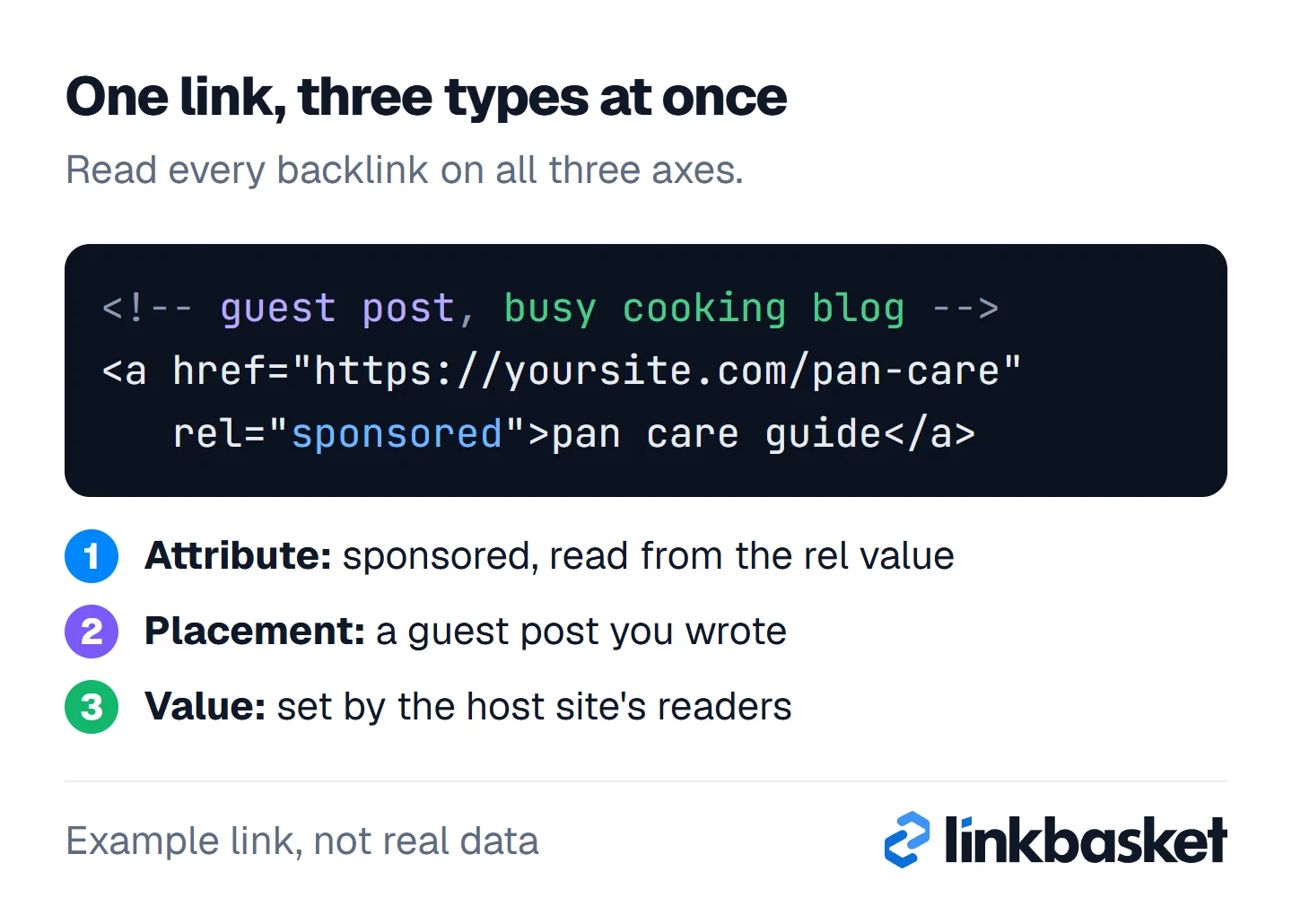
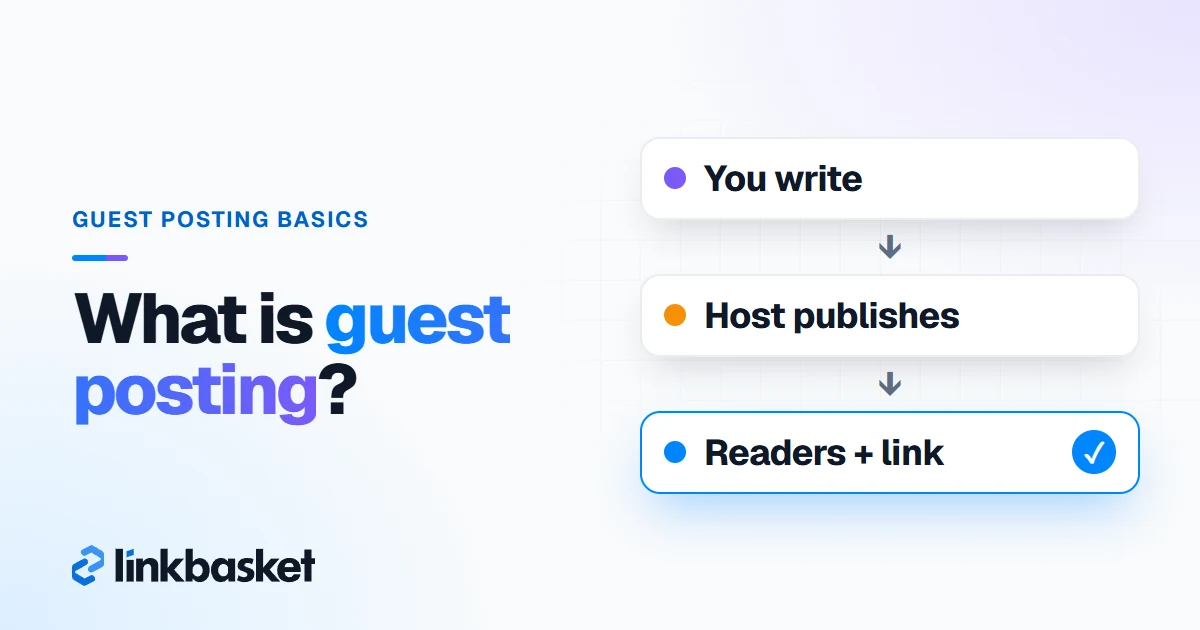
The figure reads one guest post link three ways. Same link, three labels.
Most people judge a link on one axis. Read it on all three axes before you judge it. Do it every time. A guest post (placement) can be dofollow or sponsored (attribute), and it can be high or low value depending on the site. If you're new to the basics, start with our explainer on what a backlink is and come back.
What are the types of backlinks by attribute?
By attribute, there are 4 types of backlinks: dofollow, nofollow, sponsored and ugc. The attribute is the rel value in the link's HTML, and it tells Google how the linking site wants the link treated.
- Dofollow: a normal link with no
relvalue. It can pass ranking credit. "Dofollow" is industry slang; there is norel="dofollow"tag. - Nofollow:
rel="nofollow", which Google's link attribute guide says to use "when other values don't apply." - Sponsored:
rel="sponsored", for "advertisements or paid placements." - UGC:
rel="ugc", for user-generated content such as comments and forum posts.
Google says links with the last three values "will generally not be followed," and since September 10, 2019 it has treated them as hints rather than strict orders. In practice, assume a nofollow, sponsored or ugc link sends visitors and brand exposure, not ranking credit. Our guide to dofollow vs nofollow links covers the edge cases. Short version? Don't use the attribute alone to judge a link.
What are the types of backlinks by placement?
By placement, there are 8 common types of backlinks: editorial links, guest posts, niche edits, digital PR mentions, directory listings, profile links, forum links and blog comments. Placement describes who put the link there and why.
What is an editorial backlink?
An editorial backlink is a link a writer adds on their own because your page helps their readers. You didn't ask, pay or trade for it. It is the type Google's systems are built to reward.
You earn editorial links with pages people want to cite: original data, clear tools, a definitive guide. They're slow. You can't control them. And that is exactly why they carry weight, because a link nobody could buy or fake tells Google far more than one that anybody with a credit card and a spreadsheet of publisher emails could arrange by Friday.
What is a guest post backlink?
A guest post backlink is a link inside an article you write for another site. The deal is simple. The publisher gets free content, and you get a byline plus usually 1 or 2 links back to your site, sometimes in the author bio, though better publishers let you place one in the body where it actually helps the reader.
Value depends on the host. Nothing else matters as much. A relevant site with real readers and an in-body link is worth having. Google's spam policies, though, list guest posts with ranking-credit links or optimized anchor text as an example of link spam, so paid guest posts carry policy risk. Our guide to what guest posting is explains how editors judge pitches.
What is a niche edit backlink?
A niche edit backlink, also called a link insertion, is a link added to an article that is already published and indexed. That's the appeal. The page may already rank, already get traffic and already have backlinks of its own, so your link lands on a URL Google has crawled for months instead of a brand-new page nobody has found yet.
The risk mirrors guest posts. Same rule, same catch, same fix. If you pay for the insertion to move rankings, Google treats it as link spam. Here is how the two paid placement types differ:
Guest post
- A new article you write for the site
- The page starts with no traffic or links
- You shape the whole text around your link
Niche edit
- Your link goes into an article already live
- The page may already rank and get visits
- The publisher keeps the rest of the text
When you can't decide, ask which matters more to you: a fresh page you control, or an older page with readers. Read niche edits vs guest posts for when each type makes more sense.
What is a digital PR backlink?
A digital PR backlink is a link from a news site or major publication that covers your story, data or expert comment. Journalists link because the story needs a source. You can't fake that.
These are among the strongest links you can get, and some arrive nofollow. That's perfectly fine. Reach is the point here. One mention on a national site can send more readers than 20 small blog links. Our digital PR guide walks through the process.
What is a directory backlink?
A directory backlink is a listing on a business directory or citation site, usually with your name, address, phone and link. Local and industry directories help people find you. Mass submission doesn't. When you see a service offering 500 directory submissions for $50, skip the offer, because those are the exact low-quality directory links Google's spam policies describe and they'll do nothing useful for a real business.
Google's spam policies name "low-quality directory or bookmark site links" as link spam. In practice, stick to directories real customers use, such as your chamber of commerce or a trade body. Our guide to directory and citation link building lists what to check.
What is a profile backlink?
A profile backlink is a link in a user profile you create on a forum, social site or web app. Anyone can make one in 2 minutes. That's the problem. When you can create a link that fast, so can every spammer on earth, so search engines give profile links little weight and you shouldn't expect them to move a ranking.
What is a forum backlink?
A forum backlink is a link you post inside a thread or your forum signature. Most forums add ugc or nofollow. Check before you post. Google's spam policies name forum comments with optimized links in the post or signature as link spam.
A helpful answer with a link that solves the question can still send visitors. Don't spray signature links. They look desperate. Our post on forum and profile backlinks covers the narrow cases where they're harmless.
What is a blog comment backlink?
A blog comment backlink is a link in the comment section under a post. Nearly every blog platform marks these ugc or nofollow by default, so they pass little or nothing.
Honestly, don't bother with them as an SEO tactic. A thoughtful comment can start a relationship with the author, and that relationship may lead to an editorial link later.
Which types of backlinks have the most value?
Editorial links and digital PR mentions carry the most value, relevant guest posts and niche edits come next, and profile, forum and comment links carry the least. Risk runs the other way. Cheap, automated types carry most of it.
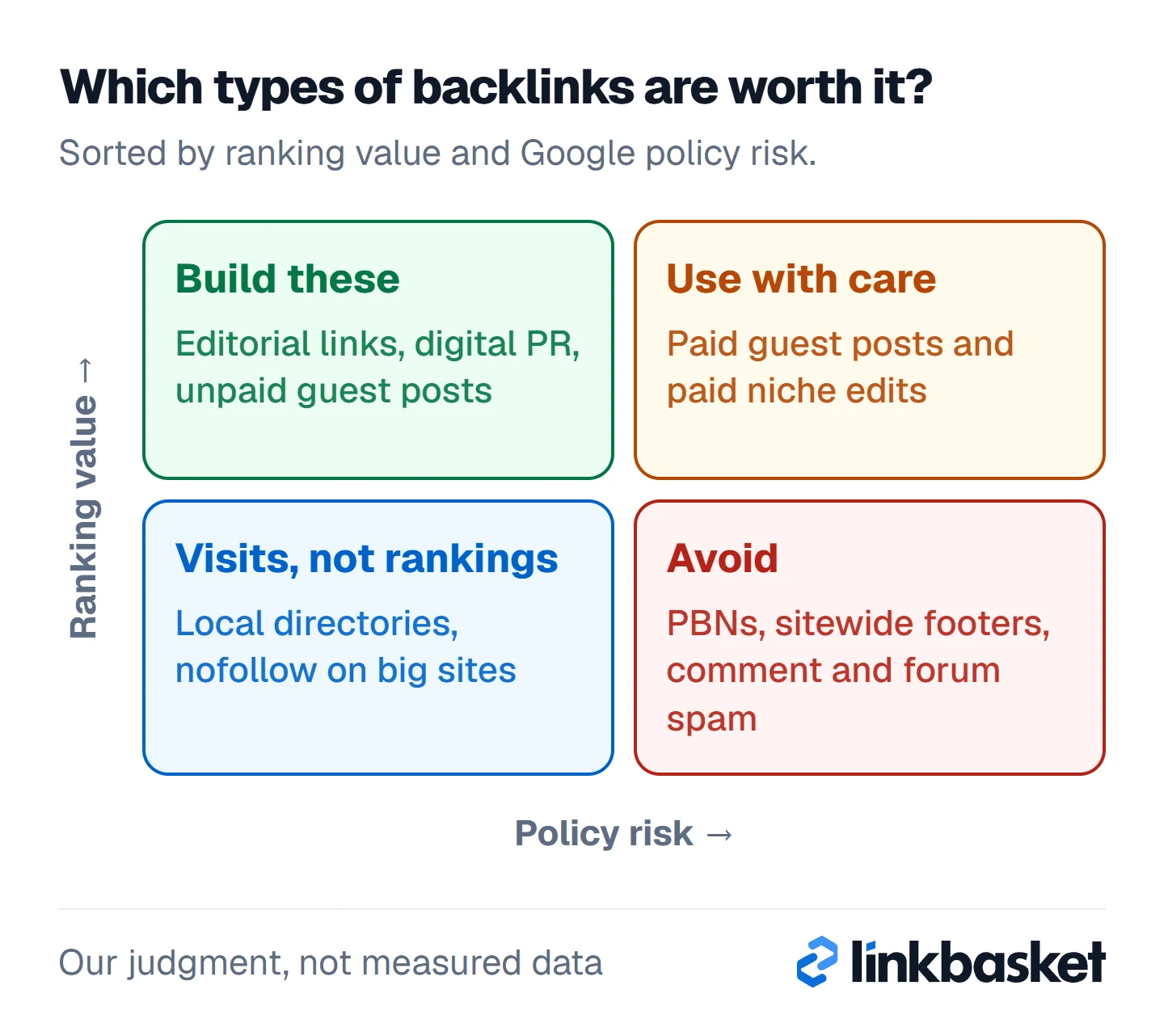
Start top-left, where value is high and risk is low. Bottom-right is where to stop.
The ratings below are our judgment, not measured data. Relevance and real traffic can move any row up or down.
| Backlink type | Value | Policy risk | Effort | Best use |
|---|---|---|---|---|
| Editorial (earned) | High | Low | High | Linkable content, data, tools |
| Digital PR mention | High | Low | High | Stories with news value |
| Guest post, unpaid | Medium to high | Low to medium | Medium | Niche sites with real readers |
| Guest post, paid dofollow | Medium | Medium to high | Low | Only relevant, editorial sites |
| Niche edit, paid | Medium | Medium to high | Low | Relevant pages with traffic |
| Resource page link | Medium | Low | Medium | Useful tools and guides |
| Local or trade directory | Low to medium | Low | Low | Local and B2B visibility |
| Nofollow link on a big site | Low for rankings | Low | Varies | Referral visits and brand |
| Profile link | Low | Low to medium | Low | Brand pages only |
| Forum link | Low | Medium | Low | Answers that genuinely help |
| Blog comment link | Very low | Medium | Low | Relationships, not rankings |
| PBN or sitewide footer link | Low | High | Low | Avoid |
Notice the pattern in the table. Anyone with a spare hour can make the cheap links too, so search engines learn to ignore them.
The easier a link is to make, the less it tends to count.
Are paid types of backlinks against Google's rules?
Yes, paid links that pass ranking credit break Google's rules. Google's spam policies list buying or selling links for ranking purposes as link spam, and say paid links are fine when marked nofollow or sponsored.
What lowers the risk: a relevant site with real organic traffic, a link inside the article body, a natural anchor, a sponsored tag where the publisher adds one, and no link farms. Don't buy from a seller who can't show you the site first.
Which types of link building strategies fit your site?
The right types of link building strategies depend on your site's age, your niche and your budget. Start with the types you can earn, then add placements only where you can't earn links fast enough.
| If your site is… | Start with | Add later | Skip |
|---|---|---|---|
| New (under 6 months) | Directories real buyers use, partner links | 2 to 4 relevant guest posts | Paid links at volume |
| Local business | Local directories, local news, sponsorships | Local guest posts | National PR for its own sake |
| SaaS or B2B | Original data, integration partner pages | Digital PR, niche edits | Profile and comment links |
| Ecommerce | Supplier and brand pages, product reviews | Guest posts on hobby blogs | Sitewide footer links |
| YMYL (health, money, law) | Expert quotes and PR | Very selective guest posts | Anything you can't defend |
Here is a worked example, and every number is hypothetical. Say you run a 9-month-old project management app with $1,200 a month for links. You might spend $600 producing one small data study for PR, $400 on 2 guest posts at $200 each on relevant productivity blogs, and $200 on 1 niche edit in a well-read comparison article. After 3 months that's up to 9 placements plus whatever the study earns. If the study lands 5 editorial links, it beat the paid placements on cost per link. If it lands none? You still own the data, and in practice a second pitch angle often works where the first one didn't.
Which edge cases change a backlink type's value?
Five edge cases change a backlink type's value: sitewide placement, syndication, sponsored tags on guest posts, links from your own sites, and links in big nofollow outlets.
- Sitewide links: when you get a link in a footer or sidebar, it appears on every page, so tools may show 500 backlinks from 1 site. Google lists widely distributed footer and template links as link spam. Our guide to backlinks vs referring domains explains the counting.
- Syndicated articles: the same post republished on 5 sites is 5 copies, and often only the original carries much weight.
- Guest posts with a sponsored tag: still a guest post, now policy-safe, with little ranking credit.
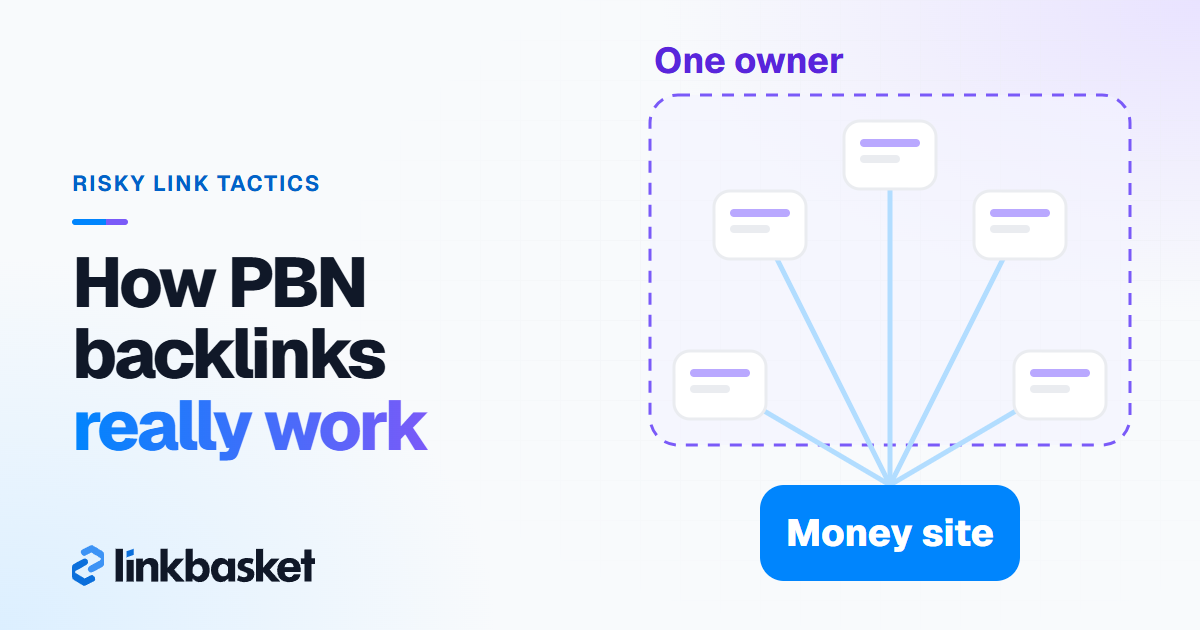
- Your own other domains: technically backlinks, but a network built just to link matches what Google calls link spam. Read about PBN backlinks before you go near one.
- Big nofollow outlets: low ranking credit, high referral value.
When should you not chase certain types of backlinks?
Don't chase profile, comment, PBN or automated links for rankings; they cost time and carry the most risk. Call a backlink audit specialist if Search Console shows a manual action for unnatural links or your traffic drops sharply after a spam update.
You also don't need every type. Don't fall for the idea that a "diverse" profile needs all 12. Plenty of sites rank with 2 or 3 types done well. Usually that means editorial links plus a few relevant placements, built steadily over a year or two rather than bought in one burst the week before a product launch. Why links matter at all, and when you can skip them, is the topic of our guide on why backlinks are important.
When you're about to add a type to your plan, check it against this list first:
- The site covers your topic, not every topic.
- It has real organic traffic, ideally from your market.
- The link sits in the body of an article, not a footer or profile.
- You'd be happy to explain to a journalist how you got it.
- The site doesn't sell links to anyone in any niche.
FAQ
What are the 3 types of backlinks?
The 3 most common answers are dofollow, nofollow and sponsored, sorted by attribute. Others split links into earned, built and bought. Neither split is official; Google defines only the rel values nofollow, sponsored and ugc.
Which type of backlink is best for SEO?
An editorial backlink from a relevant site with real organic traffic is the best type for SEO. Digital PR mentions are close behind. When you're comparing two links of the same type, check our list of backlink quality checks.
Are directory backlinks still worth it in 2026?
Local and trade directories that real customers use are still worth it, mainly for local visibility. Generic submission directories are not; Google names low-quality directory links as link spam.
Do nofollow backlinks help SEO?
Nofollow backlinks generally pass no ranking credit, but they can send buyers and get your brand noticed by writers who later link without a tag. Treat them as traffic and reputation, not rankings.
Next step: choose the types of backlinks to build first
Pick 2 or 3 types from the table that fit your site and budget. Then stop there. To compare guest post and link insertion sites with DR, traffic and link type shown before you pay, browse our publisher site inventory with a free account. For hands-off help, see our link building services. And to plan volume, read how many backlinks you need to rank.