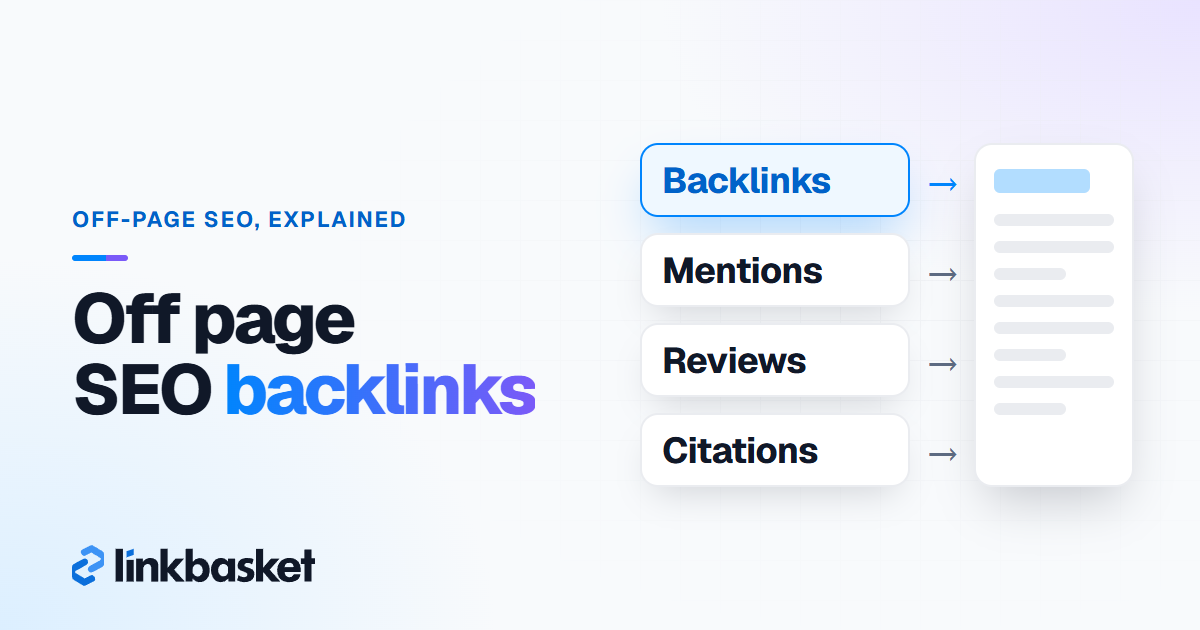
Off page SEO backlinks are links from other websites to yours, and they are the part of off-page SEO that Google documents most clearly. Off-page SEO covers everything done away from your own site to show search engines it deserves trust: backlinks first, then brand mentions, reviews and local citations. On-page SEO is what you fix on your own pages. Both matter. Order matters more.
Last updated: November 9, 2026
What is the difference between on-page SEO and off-page SEO?
On-page SEO is what you control on your own pages, such as content, titles, headings and internal links. Off-page SEO is what other sites and people do that reflects on you: links, mentions, reviews and citations.
A third bucket, technical SEO, keeps the site crawlable and fast. Here's how the three split:
| On-page SEO | Off-page SEO | Technical SEO | |
|---|---|---|---|
| Where it happens | Your pages | Other sites and platforms | Your server and code |
| Main levers | Content, titles, headings, internal links | Backlinks, brand mentions, reviews, citations | Crawling, indexing, speed, mobile |
| Who controls it | You, fully | Others; you influence it | You, fully |
| Typical tools | Editor, CMS | Outreach, PR, placements, review requests | Search Console, crawlers |
| Speed of effect | Days to weeks after recrawl | Weeks to months | Days to weeks |
The search phrase "on page SEO and off page SEO" usually hides a sequencing question: which first? On-page. Every time. A link pointed at a thin page passes authority into something that still can't satisfy the searcher. Fix the page, then build links to it.
Links amplify what's there, good or bad.
What does Google say about links and off page SEO backlinks?
Google says it uses links to judge relevance and to find new pages, and that PageRank, its link analysis system, is still part of its core ranking systems. That's the clearest official backing any off-page factor has.
Three Google sources, checked November 2026:
- Link best practices: "Google uses links as a signal when determining the relevancy of pages and to find new pages to crawl."
- Ranking systems guide: Google's guide to its ranking systems says PageRank was "one of our core ranking systems used when Google first launched," and that it "continues to be part of our core ranking systems." The same guide says Penguin, its old link spam system, was folded into the core systems in 2016.
- Spam policies: Google's spam policies define link spam as "creating links to or from a site primarily for the purpose of manipulating search rankings."
So links count, and manipulative links are a policy breach. Every off-page plan has to live between those two facts. Honestly, most bad link decisions come from forgetting one of them.
Which off-page SEO factors matter besides backlinks?
Besides backlinks, the off-page factors worth your time are brand mentions, reviews and local citations. Google documents reviews and links for local rankings; the value of unlinked mentions is mostly indirect.
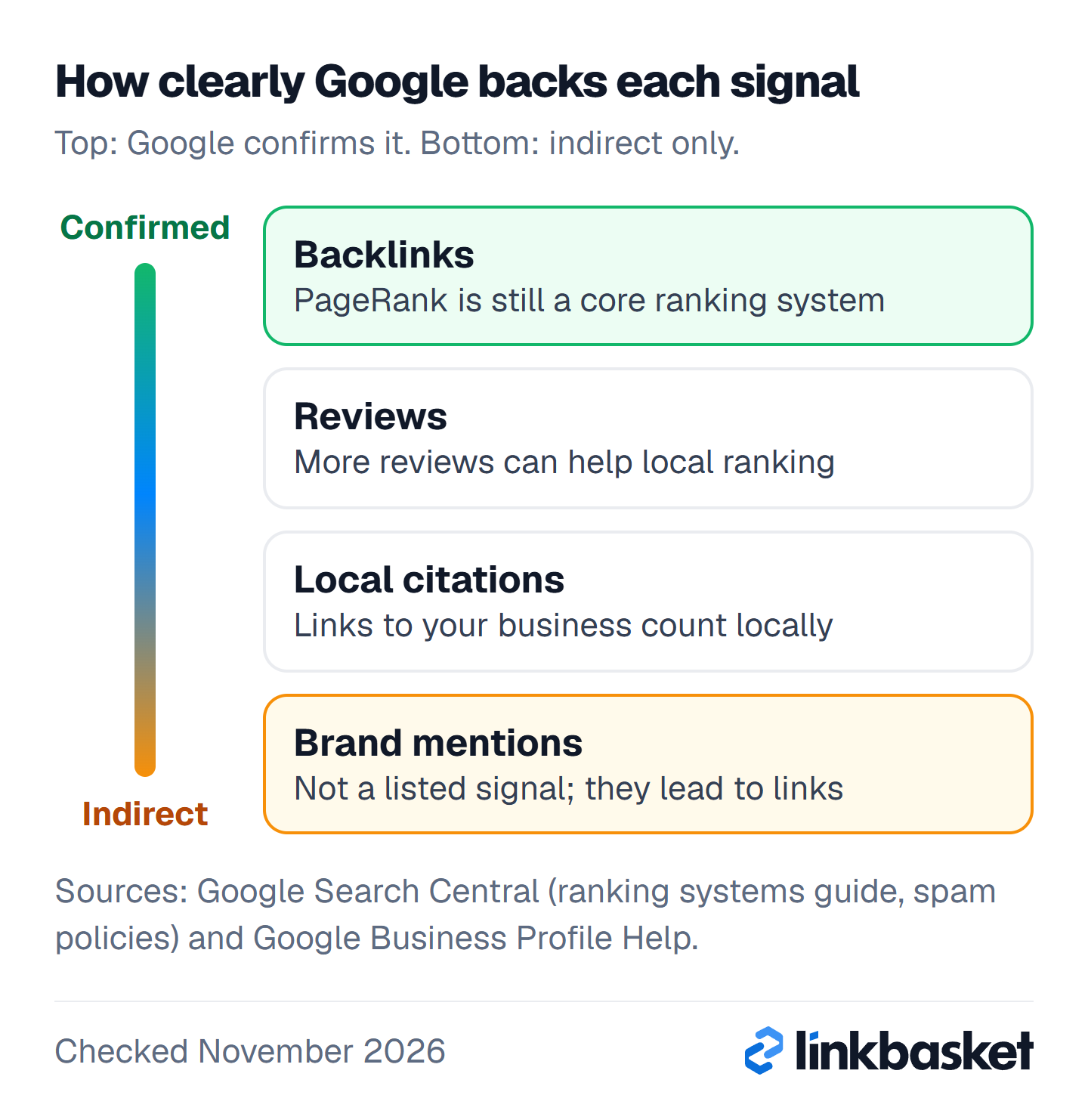
Read the scale from top to bottom. The higher a signal sits, the more directly Google's own docs back it, so that's where most of your off-page time should go.
Do brand mentions help off-page SEO?
Brand mentions help off-page SEO indirectly: Google's public docs don't list unlinked mentions as a ranking signal, but mentions lead to branded searches, referral visits and, often, links. They also give AI answer engines more independent places that name you.
The practical move: find articles that mention your brand without a link, and ask the writer to add one. Our guide to what digital PR is covers how mentions fit into PR work.
Do reviews count as off-page SEO?
Reviews count as off-page SEO for local businesses, because Google says so directly. Its local ranking help page states: "More reviews and positive ratings can help your business's local ranking."
That page names three local factors, relevance, distance and prominence, and says prominence is "based on info like how many websites link to your business and how many reviews you have." It also says there's "no way to request or pay for a better local ranking on Google." Ask happy customers for reviews. Don't buy them, ever, and don't trust any vendor who offers to.
Are local citations off-page SEO?
Local citations, listings of your business name, address and phone number on directories and local sites, are off-page SEO for businesses that serve an area. Keep the details identical everywhere, starting with your Business Profile.
Be choosy, though. Google's spam policies list "low-quality directory or bookmark site links" as link spam. A listing on your city's chamber of commerce site helps. Paying for 500 directory submissions doesn't. Our local link building guide goes deeper.
Where does link building fit in off page SEO?
Link building is the core of off-page SEO for most sites, because links carry the signal Google confirms it uses. Mentions, reviews and citations support it, and their weight depends on your business type.
Use this table to set priorities:
| Your site | Off-page priority 1 | Priority 2 | Priority 3 |
|---|---|---|---|
| Local service business | Reviews and Business Profile | Local citations | Local links: news, chambers, sponsors |
| Ecommerce store | Links to category pages | Brand mentions and reclaim | Product reviews on your own site |
| SaaS or B2B | Links to feature and comparison pages | Digital PR with data | Mentions on review platforms |
| Publisher or blog | Earned links to guides | Brand mentions | Social distribution |
| New site, under 6 months | On-page first; then 4 to 6 relevant links | Brand mentions | Citations if local |
These priorities are our judgement, not a Google ranking.
Which off page link building tactics work?
The off page link building tactics that work best are the ones that look like real editorial choices: guest posts on relevant sites, link insertions in existing articles, digital PR, resource-page outreach and unlinked-mention reclaim.
- Guest posts: you write for a relevant site and include a link in context.
- Niche edits: a link added to an existing, already-indexed article.
- Digital PR: journalists cite your data or expert.
- Outreach: resource pages, broken links and mentions.
For the full tactic-by-tactic walkthrough, see our guide on how to build backlinks. We won't repeat it here. When you're starting from zero, though, pick one tactic and do it well before you add a second.
A plain word on paying.
Which off page SEO tricks should you avoid?
Avoid any off-page SEO trick that Google names in its link spam list: link exchanges, sitewide footer links, low-quality directories, forum signature links and automated link tools. They're cheap. That's the problem.
Straight from Google's examples of link spam:
- "Excessive link exchanges" or partner pages built only to cross-link
- "Using automated programs or services to create links to your site"
- "Widely distributed links in the footers or templates of various sites"
- "Forum comments with optimized links in the post or signature"
- "Low-quality directory or bookmark site links"
- "Links with optimized anchor text in articles, guest posts, or press releases"
In practice, when a tactic sounds like a trick, it usually is one. Don't fall for "1,000 backlinks for $20" offers.
How do you measure off page SEO backlinks and other signals?
Measure off page SEO backlinks by counting new referring domains to each target page every month, then checking whether those pages climb. Track reviews and branded searches beside them, since links rarely move alone.
A simple monthly scorecard:
- Referring domains to the site and to each target page, from Search Console's Links report or a tool like Ahrefs.
- Links lost since last month, and why: page deleted, link removed, switched to nofollow.
- Rankings for the 5 to 10 queries each target page should win.
- Branded search clicks in Search Console, compared with the same month last year.
- Review count and average rating, for local businesses.
Don't judge a month in isolation. Links can take weeks to be found and counted, so compare quarter on quarter. When you see referring domains rise while rankings stay flat for 3 months, the problem is usually the page, not the links. Our walkthrough on how to check backlinks shows the free tools for step 1.
Worked example: off-page SEO for one page (hypothetical)
Every number here is hypothetical. Say you sell standing desks, and your main category page ranks at position 9. The top 5 results average 35 referring domains. You have 12.
- Step 1, on-page: you rewrite the page, add a size guide and fix the title. Two weeks later, it moves to position 7.
- Step 2, mentions: a brand search finds 6 articles naming you without a link. You email all 6; say 2 add a link. Now 14.
- Step 3, links: you place 8 links on office, ergonomics and remote-work sites at an average of $160, so $1,280. Now 22.
- Step 4, reviews: you ask buyers for product reviews on your own site, which help shoppers convert but aren't a Google Business Profile signal for an online-only store.
After 90 days, say the page sits at position 5. The gap to the top 5 is now 13 domains, not 23. Your next quarter's plan writes itself: close the remaining gap, in practice another 8 to 10 relevant links.
Which edge cases change off-page SEO priorities?
Some situations flip the usual order:
- Online-only stores: Business Profile reviews matter less; links and product reviews on your site matter more.
- Multi-location firms: each location needs its own reviews and citations.
- Sites hit by a link spam update: stop building and audit first.
- Brands with lots of press: reclaiming unlinked mentions may beat any new tactic.
- Sites in other markets: links from sites in each target country count for more; see our guide to international link building.
When should you call a specialist instead of building links?
Call an SEO specialist when Search Console shows a manual action for unnatural links, when rankings drop sharply after a spam update, or when you're thinking about a large disavow. Get an auditor with no stake in selling you links.
Build links only when you can tick every box:
- The target page matches search intent and isn't thin.
- The site has no indexing or crawl problems.
- You can name the pages that need the links.
- Search Console shows no manual action for unnatural links.
Fix on-page and technical issues first. Links amplify what's there, good or bad.
FAQ
Is off-page SEO more important than on-page SEO?
Neither wins alone. On-page SEO makes a page worth ranking; off-page SEO, mostly backlinks, tells Google others trust it. Fix on-page first, because links to a weak page waste money.
Are social media links off page SEO backlinks?
Most social links are nofollow, so they pass little ranking credit. They still help people find and share your content, which can lead to real backlinks later.
How many backlinks do I need for off-page SEO?
There's no fixed number. Count referring domains to the top 5 pages for your keyword and aim to close part of that gap. Our guide to backlinks you need to rank walks through the maths.
Is off-page SEO only link building?
No. Link building is the biggest part, but reviews, local citations and brand mentions are off-page too. For local firms, reviews can matter as much as links.
Next step: start your off-page SEO with the right links
Fix the page first, then pick link sources that match your niche. Learn what makes a good backlink, browse publisher sites with DR and traffic shown using a free account, and read how to buy backlinks with a weekly link check. LinkBasket checks each live link weekly for 12 months and restores, moves or refunds it if it's removed.