Natural link building is earning links that other sites add on their own, because your page is worth citing, not because you paid, traded or placed them. You can't order a natural link. You can make one likely: publish original data, free tools or useful references, then put them where writers look.
Last updated: November 9, 2026
What are natural backlinks?
A natural backlink is a link an editor or writer adds by choice, without being asked, paid or offered anything. Some people call them organic backlinks. They're the kind of link Google's systems are built to reward.
Google explains why in its link best practices, checked in November 2026: "Google uses links as a signal when determining the relevancy of pages and to find new pages to crawl." A link a writer chose freely is the cleanest version of that signal. Nobody shaped it for search.
In practice, links sit on a spectrum. Most link builders blur it. We won't.
| Link type | Who starts it | Natural? | Example |
|---|---|---|---|
| Unsolicited citation | The writer | Yes, fully | A blogger cites your survey in a post |
| Outreach-prompted, editorial | You pitch, editor decides | Mostly | A journalist uses your data after a pitch |
| Guest post | You write, editor approves | Partly | You write an article with one link back |
| Paid placement | You pay | No | A publisher posts your link for a fee |
This guide is about the first two rows.
How does natural link building actually happen?
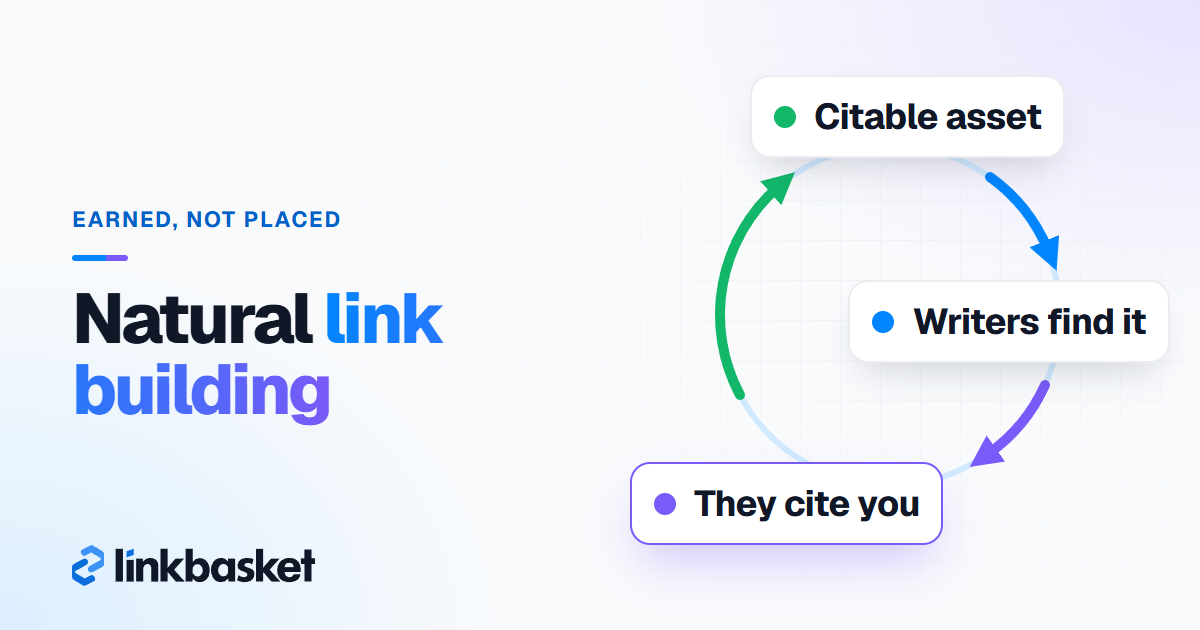
Natural link building happens when a writer, mid-research, finds your page and decides it's the best thing to cite. So the job has two parts: make something citable, and make sure writers find it.
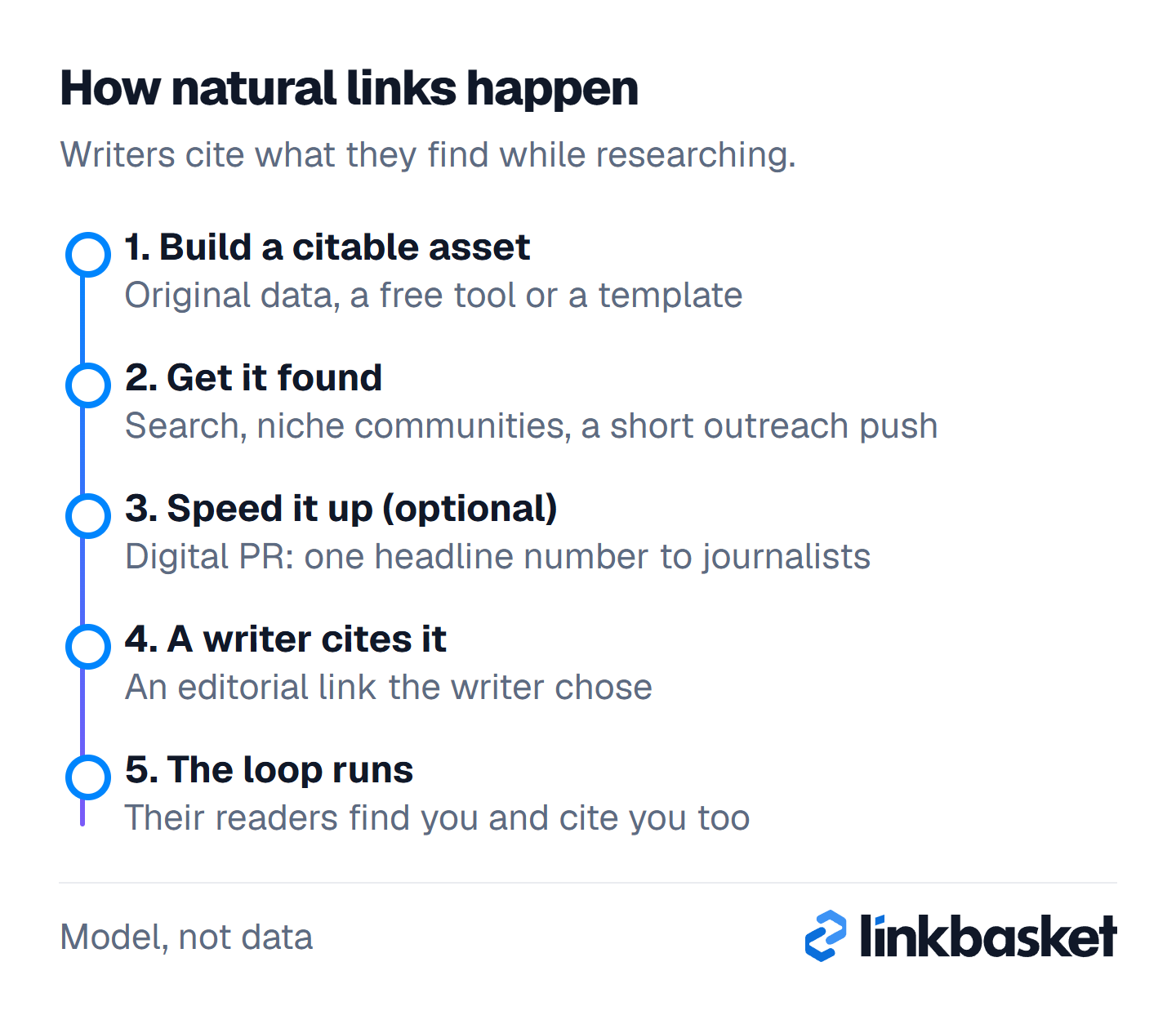
Follow the line from step 1 to step 5. Step 3 is optional; step 5 is where the work starts paying you back without more effort.
Think about how a writer works. She's drafting a post on remote work, needs a number for how many teams meet weekly, and searches for "remote team meeting statistics." Whatever ranks on page one gets cited. If that's your survey, you get the link. Then the next writer finds her post, follows it to you, and cites you too. That loop is the whole engine.
That's why natural link building and ranking feed each other. Pages that rank for "statistics", "calculator", "template" or "definition" searches pull in citations long after you stop promoting them. Pages that never rank? They depend on you pushing them forever.
Which assets earn natural backlinks?
The assets that earn natural backlinks give writers something to cite that they can't easily get elsewhere: a number, a tool, a template, a clear definition or a diagram. Each type earns links for a different reason.
- Original data: surveys, price indexes, yearly benchmarks; writers need a source for every number they use
- Free tools and calculators: a mortgage calculator or a word counter gets linked from every "useful tools" list in its niche
- Templates and checklists: teachers, trainers and bloggers link to them instead of rebuilding them
- Clear explainers and glossaries: the page that defines a term best gets cited whenever the term comes up
- Diagrams and charts: an embeddable chart with a credit line earns links each time someone reuses it
Don't build the 4,000-word guide that repeats ten other pages. Nobody cites a summary. Ask one question first: what would a writer in my niche need to cite this month that doesn't exist yet? Build that.
How do you build natural backlinks with free tools?
You build natural backlinks with free tools by making a small, single-purpose tool that people in your niche search for and bookmark. Calculators, checkers and generators work best, because nobody wants to rebuild one.
Here's a worked example with a $3,000 build, and every number in it is hypothetical. Say a landscaping supplier pays a developer $3,000 for a mulch calculator: enter the bed size, get the number of bags. The page ranks for "mulch calculator" after about 4 months. Gardening bloggers start linking to it from posts like "how much mulch do I need," and by month 12 it has 25 referring domains, none of them asked for.
Compare that with outreach. If a guest post costs 4 hours and you value your time at $50 an hour, 25 guest posts would cost $5,000 in time. The calculator cost less, and it keeps earning. But it only worked because people search for it. A tool nobody searches for earns nothing. Check search volume before you hire a developer.
How do writers find your natural link building assets?
Writers find natural link building assets in three places: search results, the communities they read, and their inbox. Cover all three in the first month after launch, because an asset nobody sees earns nothing.
- Search. Give the page one clear target query, such as "mulch calculator" or "remote work statistics 2026", and put that phrase in the title and first line.
- Communities. Share it once in the forums, subreddits, Slack groups or newsletters your niche reads, with a plain note on what it does. No hard sell.
- Inbox. Email the 10 to 20 people who linked to an older or weaker version of the same thing. They've already shown they cite this topic.
Is step 3 still natural? Mostly. You asked someone to look; they decided whether to link. That's the outreach-prompted row in the table above, and it's how most assets get their first push. When you skip it, you're betting the asset ranks on its own, and for a new site that bet usually takes a year to pay off.
How does digital PR speed up natural link building?
Digital PR speeds up natural link building by putting your data or story in front of journalists directly, instead of waiting for them to find it. The coverage is still editorial: the journalist decides whether to write and whether to link.
A good campaign has one headline number, a short method note and someone available for comment. Send it to writers who've covered similar stories in the last 3 months. Not a blast list.
The links that follow are often the best you'll ever get. Some are nofollow, especially on big news sites. Don't let that bother you, because the coverage brings readers, and other writers who read it later cite you with no tag at all. Our guide to what digital PR is covers the method.
Which natural link building tactic fits your site?
The natural link building tactic that fits your site depends on what you already have: data, development budget, expertise or a story. Use this decision table.
| If you have | And your niche | Start with |
|---|---|---|
| Customer or product data | Gets press coverage | Data study plus digital PR |
| Developer budget ($1,000+) | Has calculator or checker searches | Free tool |
| A real specialist on staff | Is health, finance, legal or technical | Expert commentary and explainers |
| Time but no budget | Has bloggers who write lists | Templates, checklists, glossaries |
| None of the above | Any | One explainer that beats page one, then outreach |
If none of these fit yet, earn links through outreach first. Our guide on how to get high quality backlinks covers the outreach tactics in order.
What are the signs of a natural link profile?
A natural link profile looks varied and uneven: mostly branded anchors, a mix of dofollow and nofollow, links from big and small sites, and growth that follows your content rather than your budget. Here's the contrast at a glance.
Natural profile
- Mostly brand, URL or plain anchors
- A mix of dofollow, nofollow and ugc
- Big and small sites, some forums
- Bumps after launches, then calm
Unnatural profile
- The same keyword anchor again and again
- 100% dofollow
- Many look-alike "general" blogs
- Flat, identical monthly counts
Then work through the six checks one by one:
- Anchor text: most anchors are your brand, your URL or plain phrases like "this study." Exact-match keyword anchors are rare.
- Link attributes: some links are nofollow or ugc. A profile that's 100% dofollow looks arranged.
- Site mix: a few big sites, many small ones, some forums and directories. Real profiles are messy.
- Target pages: links point to your data, tools and guides, not only your homepage or money pages.
- Growth: links arrive in bumps after launches and coverage, then settle. A flat 10 links every month for a year looks bought.
- Relevance: most linking sites share your topic or audience.
You can check all six in Ahrefs, Semrush or Google Search Console. Our guide to your backlink profile shows how to read the reports.
How long does natural link building take?
Natural link building usually takes 3 to 12 months to show results, because an asset has to rank or get covered before writers find it. These are planning estimates, not measured results:
| Stage | Typical time | What's happening |
|---|---|---|
| Build the asset | 2 to 8 weeks | Data collection, tool build, writing |
| First links (via PR or outreach) | 2 to 6 weeks after launch | Journalists and bloggers you contacted |
| Asset ranks for its query | 3 to 6 months | Depends on competition and site strength |
| Unsolicited links start | 4 to 9 months | Writers find it while researching |
| Steady trickle | 12 months and beyond | The citation loop runs on its own |
That's slow. It's also cumulative. A paid placement gives you one link; an asset that ranks can keep earning for years. Most people quit at month 3, right before the curve bends.
Which edge cases make natural link building harder?
Four situations make natural link building harder: a brand-new site, a dull niche, a regulated niche and a local business.
- New site: with no authority, your asset won't rank fast, so lean harder on PR and outreach for the first 6 months
- Dull B2B niche: nobody shares invoice software for fun, but trade writers still need numbers, so data studies work where clever content doesn't
- Health, finance or legal: writers cite credentials, so put a named, qualified author on every asset
- Local business: local news, events and sponsorships bring natural local links that national content never will
When is natural link building not enough?
Natural link building isn't enough when you need links on a deadline, when your niche has few writers, or when competitors rank with far more links than you can earn this year. In those cases, people add outreach or paid placements.
Signs you've reached that point:
- A launch or deadline sits less than 3 months away.
- Fewer than 20 writers cover your niche at all.
- The top results for your keyword have far more referring domains than you can earn this year.
Be clear about the trade first.
If you buy anyway, choose relevant editorial sites with real traffic and natural anchors.
Call a specialist instead when Search Console shows a manual action for unnatural links. That needs an independent auditor, not more links.
FAQ
Can you get organic backlinks for free?
Yes. Free organic backlinks come from assets people cite: data you already have, a useful template, a clear explainer. You pay in time. Our guide to getting free backlinks lists more no-cost tactics.
Are guest posts natural links?
Partly. An editor approves the post, so the link is editorial, but you started it and wrote it. Google's spam policies list large-scale guest posting with keyword-rich anchors as link spam. One relevant guest post with a natural anchor is fine.
How many natural backlinks per month is normal?
There's no normal number. A small blog might earn 0 to 2 a month and a popular tool 50. Spikes after PR are natural too. Our guide to link velocity explains why patterns matter more than counts.
Do natural backlinks have to be dofollow?
No. Natural links include nofollow links from news sites and forums, and that mix is part of what makes a profile look real. Dofollow links pass more ranking credit, but nofollow ones still bring readers.
Next step: build one asset worth citing
Pick one row from the decision table and build that asset this quarter. Then judge the links it earns against our guide to what makes a good backlink, and see how earned links fit with white hat link building as a whole.