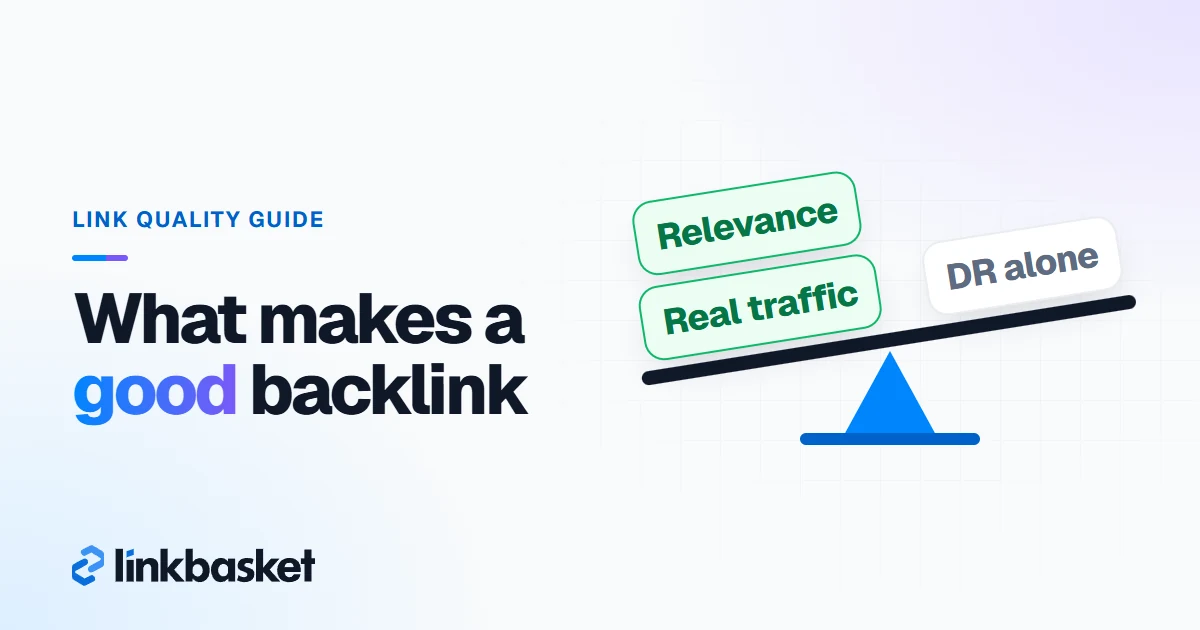
Good backlinks are links from relevant websites with real organic traffic, placed by an editor inside the body of a page Google has indexed. A high Domain Rating (DR) proves little on its own. Run the eight checks below on any link, earned or bought. If a site fails the first two, relevance and real traffic, the other six barely matter.
Last updated: November 9, 2026
What makes good backlinks? The 8 checks
Good backlinks pass eight checks, and any single one can flip the verdict on a link.
- Relevance. The linking site covers your topic or serves your buyer.
- Organic traffic. Real people reach the site through Google, from countries you sell to.
- Editorial placement. The link sits in the article body, inside a sentence that makes sense.
- DR or DA, read against traffic. A DR 40 site with steady visitors beats a DR 80 site with none.
- Link attribute. Dofollow passes ranking credit by default. Links marked
nofollow,sponsoredorugcgenerally don't. - Anchor text. Brand names and natural phrases are low-risk. The same exact-match keyword on every link is a red flag.
- Link neighbourhood. A recipe blog with casino links in every post will sell a link to anyone.
- Indexation. If Google never indexes the page, your link passes nothing.
How do you check if a backlink is good, step by step?
Check a backlink in the order that kills bad links fastest, so you never spend an hour on a site that was always going to fail.
- Search
site:example.comin Google. Hundreds of posts but only a handful indexed? Stop there. - Read five recent posts. Health on Monday, crypto on Tuesday and roofing on Wednesday means a general site.
- Open the 12-month organic graph in Ahrefs or Semrush and compare its country split with your market.
- Hold DR up against that traffic.
- Agree placement and attribute in writing before paying, then plan the anchor.
- Finally, open three recent guest posts and see where their other links go.
The flow shows the same order. Don't skip ahead: start at the top and stop at the first red box.
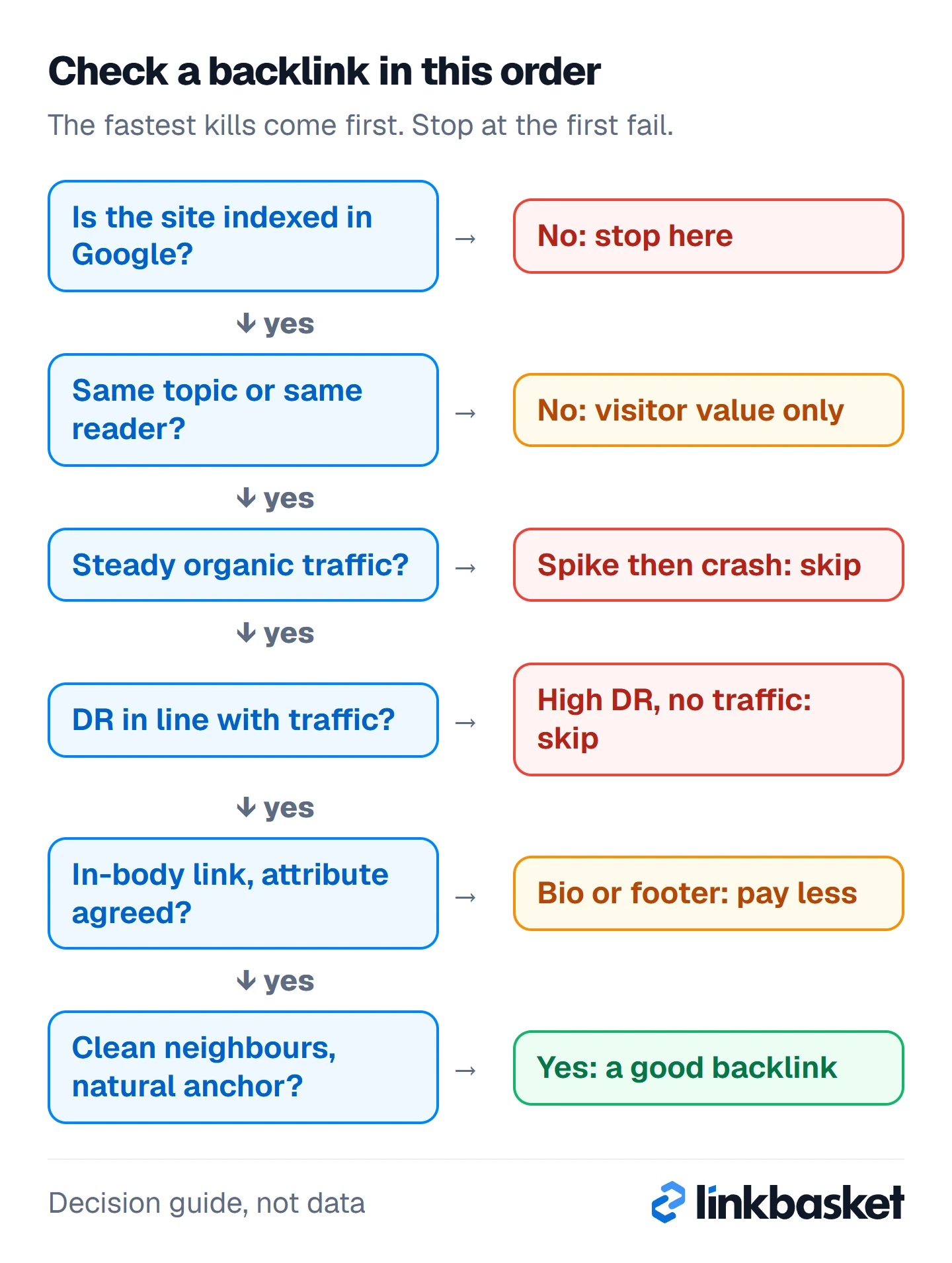
Steps 1, 2 and 6 still need a look at the live site. Our walkthrough on how to check backlinks covers the free tools for that.
Does relevance beat authority for good backlinks?
Yes, relevance usually beats authority, because a link from a page about your exact topic sends a clear topical signal and visitors who might buy. It works on two levels.
- Same topic: a cycling blog linking to a bike-fitting studio needs no explaining.
- Neighbouring topic, same reader: a running blog linking to a sports physio still makes sense.
- General site: the page decides. A travel site's post on travel insurance can link to an insurance comparison page. A beach-holiday post on the same site linking to a CRM tool can't.
- Off-topic site and page: skip the link, whatever DR says.
Here is a worked example, and every number in it is hypothetical. Say you run a bike-fitting studio in Leeds and compare a DR 35 cycling blog with a DR 70 lifestyle site.
DR 35 cycling blog
- 12,000 monthly organic visits
- 80% of them from the UK
- $150 for a link
DR 70 lifestyle site
- 3,000 monthly organic visits
- Mostly from outside the UK
- $300 for a link
Now divide price by traffic. The cycling blog costs $12.50 per 1,000 monthly visits, while the lifestyle site costs $100, eight times as much, for readers who mostly live nowhere near Leeds and have never thought about a saddle height in their lives. It wins one check. DR. Pick the cycling blog.
The matrix turns that call into a rule you can reuse. When you find a new site, place it in a box before you look at its DR.
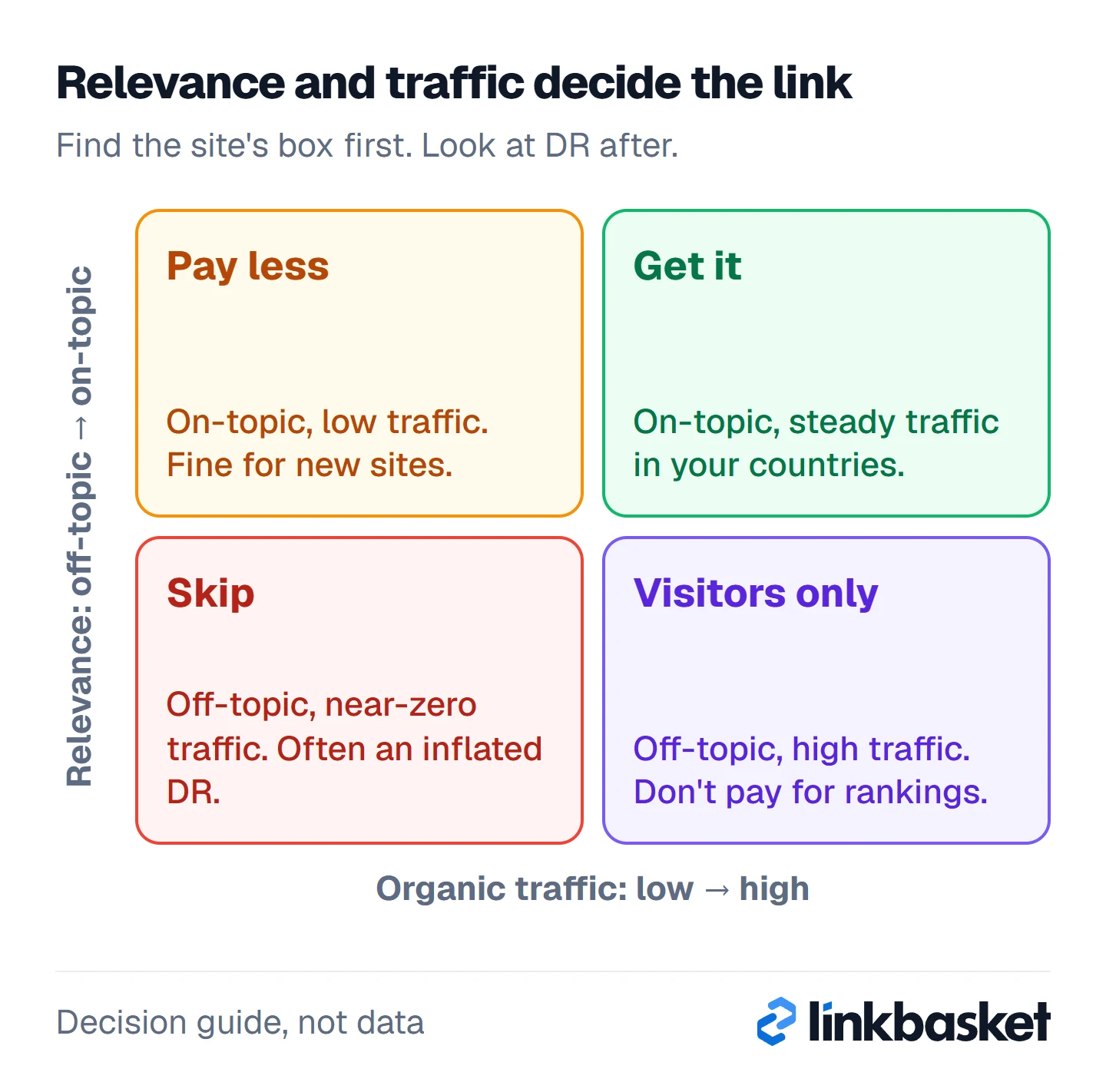
Does the backlink site get real organic traffic?
Real organic traffic is the quickest sign that Google trusts a site. Ranking for real searches means it has cleared Google's quality systems at some level, even if the visits come from a few hundred long-tail queries that bigger publishers never bothered to target. High DR with no visitors? Not cleared.
When you open the traffic graph, read four things:
- The 12-month trend. A sharp spike and then a crash often means a core update or a spam action hit the site.
- Landing pages. If almost all visits go to two old posts, a new guest post there gets little.
- Country split. A US law firm gains little from readers in markets it doesn't serve.
- Ranking keywords. Top terms like "free movie download" tell you the wrong crowd is visiting.
Don't trust price as a shortcut. Publishers set their own rates from authority, traffic and niche, and some add a surcharge for sensitive topics, so a pricier slot doesn't prove a better link. In practice, cost per 1,000 monthly visits tells you more.
Where should a good backlink sit on the page?
A good backlink sits in the body of the article, inside a relevant paragraph, where an editor chose to put it. Position signals intent. Here's the ranking, strongest first:
- In the body, inside a relevant paragraph
- In the body, in a short on-topic resource list
- In the author bio, which is weaker and often nofollow
- In a sidebar, footer or sitewide blogroll, the weakest spot of all
Google's spam policies list widely distributed footer and template links as link spam, so that last group can do harm as well as nothing. If a seller offers only a bio or footer link, price it that way.
How much do DR and DA matter for high quality backlinks?
DR and DA matter as a first filter for high quality backlinks and nothing more, because Google uses neither score. DR (Domain Rating) is an Ahrefs score from 0 to 100, built from a site's own backlink profile. DA (Domain Authority) is Moz's version. Neither measures visitors.
So read both next to traffic:
- DR 30+ with real, relevant traffic: a good candidate.
- DR 70+ with matching traffic: a high authority link, worth paying more for.
- High DR, near-zero traffic: probably inflated. Skip.
- Under DR 30, growing niche blog: cheap and natural, though each link moves rankings less.
Inflated DR often has a known cause. In March 2024, Google added expired domain abuse to its spam policies: buying an expired domain and reusing it mainly to manipulate rankings. Such a site keeps its old backlinks, and so its DR, while the new content earns almost no search traffic. That gap between DR and traffic is the tell.
Do nofollow links count as good backlinks?
Nofollow links count as good backlinks for visitors and brand reach, but they generally pass no ranking credit. Google lets sites qualify outbound links with nofollow, sponsored or ugc, and says links marked that way "will generally not be followed."
Don't write them off. A nofollow mention on a big news site still sends readers, and it puts your brand in front of journalists and bloggers who may later cite you with no tag at all.
Are paid backlinks ever good backlinks?
Paid backlinks can pass every quality check here and still break Google's rules, so no paid dofollow link is risk-free.
Penalties are rarer than people fear. In its December 2022 link spam update post, Google said its SpamBrain system can now detect both sites that buy links and sites that exist to pass them on, and that it neutralises the credit those links carry. So a bad paid link is often just wasted money.
What lowers the risk is how the link looks and where it lives. An editorial site with genuine readers, a relevant page and a natural anchor resembles what sites earn on merit. A domain that sells to every niche and advertises "dofollow guaranteed" fits the exact pattern SpamBrain hunts for. A sponsored tag keeps you inside Google's rules but passes little ranking credit.
What anchor text makes a backlink good?
Good backlink anchor text is mostly your brand, a bare URL or natural wording, with exact-match keywords used rarely. Anchor text is the clickable part of a link, and it comes in five common types:
- Branded: "LinkBasket"
- Bare URL: "linkbasket.net"
- Generic: "this guide"
- Partial match: "a guide to checking backlink quality"
- Exact match: "good backlinks"
Exact match isn't banned. A profile stuffed with it, though, is exactly what Google's policy means by optimized anchor text in guest posts and press releases. When you see the same money keyword on link after link, change the next one.
When you order on LinkBasket, you pick the target URL and anchor in your brief. Publishers may decline anchors that look spammy. Good sign.
What does a bad backlink neighbourhood look like?
A bad backlink neighbourhood is a site whose other outbound links point to junk, which puts your link in poor company. Watch for these signs:
- Casino, CBD, payday-loan or essay-writing links on a blog about something else
- A "write for us" page with a price list for every niche
- Dozens of guest posts a week with no real author pages
- The same theme, contact email and prices across several "different" sites
A quick test settles most cases. Open the last ten posts and count commercial outbound links; when most carry one or two pointing at unrelated businesses, you're looking at a link seller first and a publisher second. Skip the site, whatever its metrics say.
Is the page with your backlink indexed?
An unindexed page passes no value, so confirm Google has indexed the page carrying your backlink once it goes live. Many people skip this. Search its exact URL. Found it? Done.
When it still hasn't shown after two or three weeks, ask the publisher to request indexing in Search Console and look for a stray noindex tag. Pages that never appear usually signal deeper quality trouble.
Good vs bad backlinks: comparison table and decision matrix
This comparison table sums up good vs bad backlinks, and it works on any link, whether you earn it, trade for it or pay for it.
| Check | Good backlink | Bad backlink | How to check |
|---|---|---|---|
| Relevance | Same topic or same reader | Unrelated site and page | Read 5 recent posts |
| Organic traffic | Steady or rising for 12 months | Near zero, or spike then crash | Ahrefs or Semrush graph |
| Traffic source | Your target countries | Countries you don't serve | Country split |
| Placement | In body, in context | Footer, sidebar, sitewide | Check the live page |
| DR / DA | Matches the traffic | High score, no traffic | Compare DR to traffic |
| Attribute | Dofollow as agreed, or honest nofollow | Switched after you paid | Inspect the live link |
| Anchor text | Brand, URL, natural phrase | Same exact match everywhere | Review your anchor list |
| Neighbourhood | Links to real businesses in the niche | Casino, loans, essay sites | Scan 10 recent posts |
| Indexation | Page shows in Google | Missing after 3 weeks | Search the page URL |
Then use the decision matrix to make the call:
| If relevance is | And traffic is | Then |
|---|---|---|
| On-topic | Real, steady, right countries | Get it. This is a good backlink. |
| On-topic | Low but real | Good for new or local sites. Pay less. |
| Off-topic | High | Brand and visitor value only. Don't pay for rankings. |
| Any | Near zero with high DR | Skip. The score is likely inflated. |
| Any | Spike then crash | Wait two months or skip. |
Which edge cases change what counts as a good backlink?
Five situations change what counts as a good backlink: a new site, a local business, a sensitive niche, a big nofollow site and a site that just lost traffic.
- New site (under six months): a few relevant links beat many, and DR 20 to 40 niche blogs cost less.
- Local business: your city's news site can outweigh a national blog, as our local link building guide explains.
- Health, finance, legal: editors are stricter, and some publishers add a surcharge that the site page discloses.
- Big nofollow sites: national outlets and large forums give reach, which you usually win through digital PR campaigns.
- Recent traffic drop: under two months old? Wait for more data.
When should you call in a backlink specialist?
Call in a backlink audit specialist when Search Console shows a manual action, rankings crash after a spam update, or you're weighing a large disavow. Don't hire a link seller for that job. Us included. You want an auditor with no stake in the answer.
No manual action and no crash? In practice, this list is all you need before each order:
- The site covers your topic or serves your buyer.
- Organic traffic is steady and comes from your countries.
- The link sits in the body, with the attribute agreed in writing.
- The anchor is your brand, a URL or a natural phrase.
- Recent posts don't link to casino, loan or essay sites.
- You'll search the page URL 2 to 3 weeks after it goes live.
FAQ
Are high authority backlinks worth paying more for?
Only when visitors match the score. Say two news sites both show DR 75: one draws 200,000 monthly organic visits in your market, the other 900. The first deserves a premium. The second doesn't, because authority without readers is a number someone else built.
How many good backlinks do I need to rank?
There's no fixed number. Check the top five results for your keyword in Ahrefs or Semrush and count their referring domains. If each has 20 to 40, a handful of good backlinks plus strong content can get you close. If they have 500, you need a long-term plan, not a single order.
Is a DR 50 backlink good?
It can be. DR 50 says the site has a decent backlink profile and nothing about traffic, topic or placement, so don't judge it on the score. With steady organic visitors in your niche, yes. With almost none, no.
Can bad backlinks hurt my site?
Usually Google just neutralises them, so you lose money rather than rankings. If you've bought manipulative links at scale, though, a manual action can follow and positions can drop. Search Console will tell you.
Next step: find good backlinks you can check first
To see these checks on real sites, browse our link marketplace inventory with a free account and no card. Once you sign in, domain names, DR, DA, traffic, top country and price all show before you pay, and our page on how to buy backlinks on LinkBasket covers the ordering steps. To earn links instead, read how to build backlinks, or compare the main guest post marketplaces side by side.