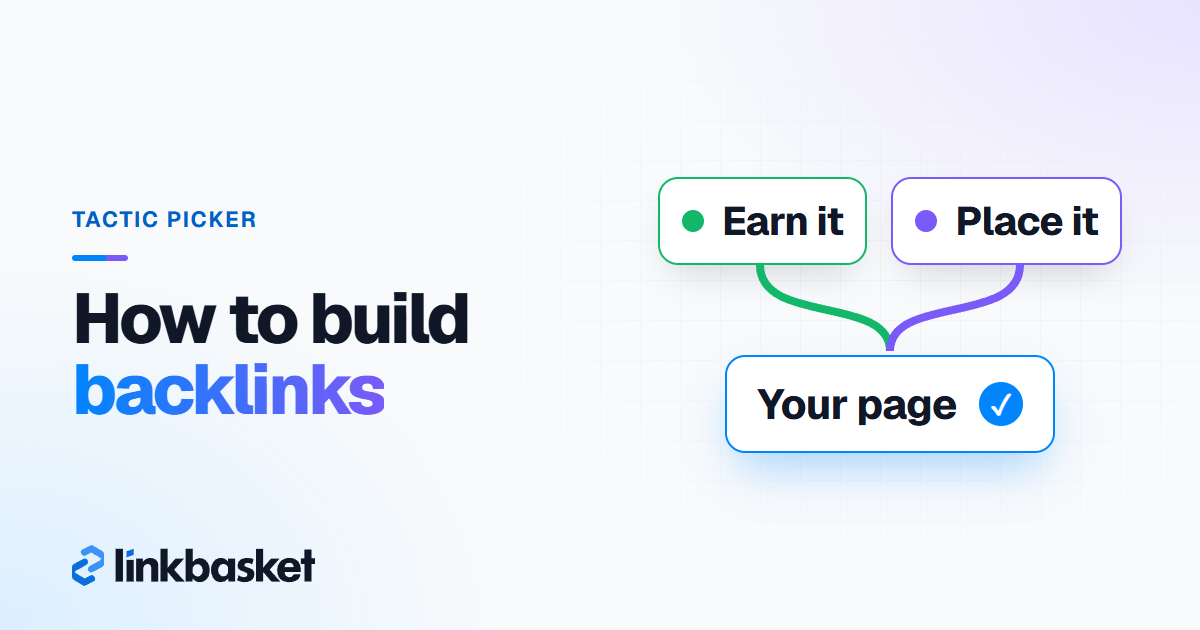
To build backlinks, get relevant websites to link to your pages, either by earning the link with useful content, expert quotes or PR, or by placing it through guest posts and paid placements. The right tactic is the one that fits your budget, deadline, site age and niche. Below, we match seven tactics to those conditions, with cost, time and steps for each.
Last updated: November 9, 2026
Which backlink tactic fits your site? Four conditions
Four conditions decide which backlink tactic fits your site: budget, time to results, site age and niche.
Budget comes first. With $0 you pay in hours, and with a few hundred dollars a month you can buy some of those hours back from writers or publishers who already reach your audience. Then time. Outreach takes weeks to land one link, while a placement on an existing site can go live in days.
Site age matters more than most people expect. A brand-new site has no mentions to reclaim and little worth citing. An older one usually has both, sitting unused. And niche shapes everything: editors in health, finance and legal are strict about who they quote, while dull B2B topics struggle with press coverage yet do fine on resource pages.
Planning a mix over several months? Our link building strategies guide covers pacing and budget.
How to build backlinks: the decision path
The decision path below picks your first backlink tactic. Start at the top. Stop at the first branch that matches you.
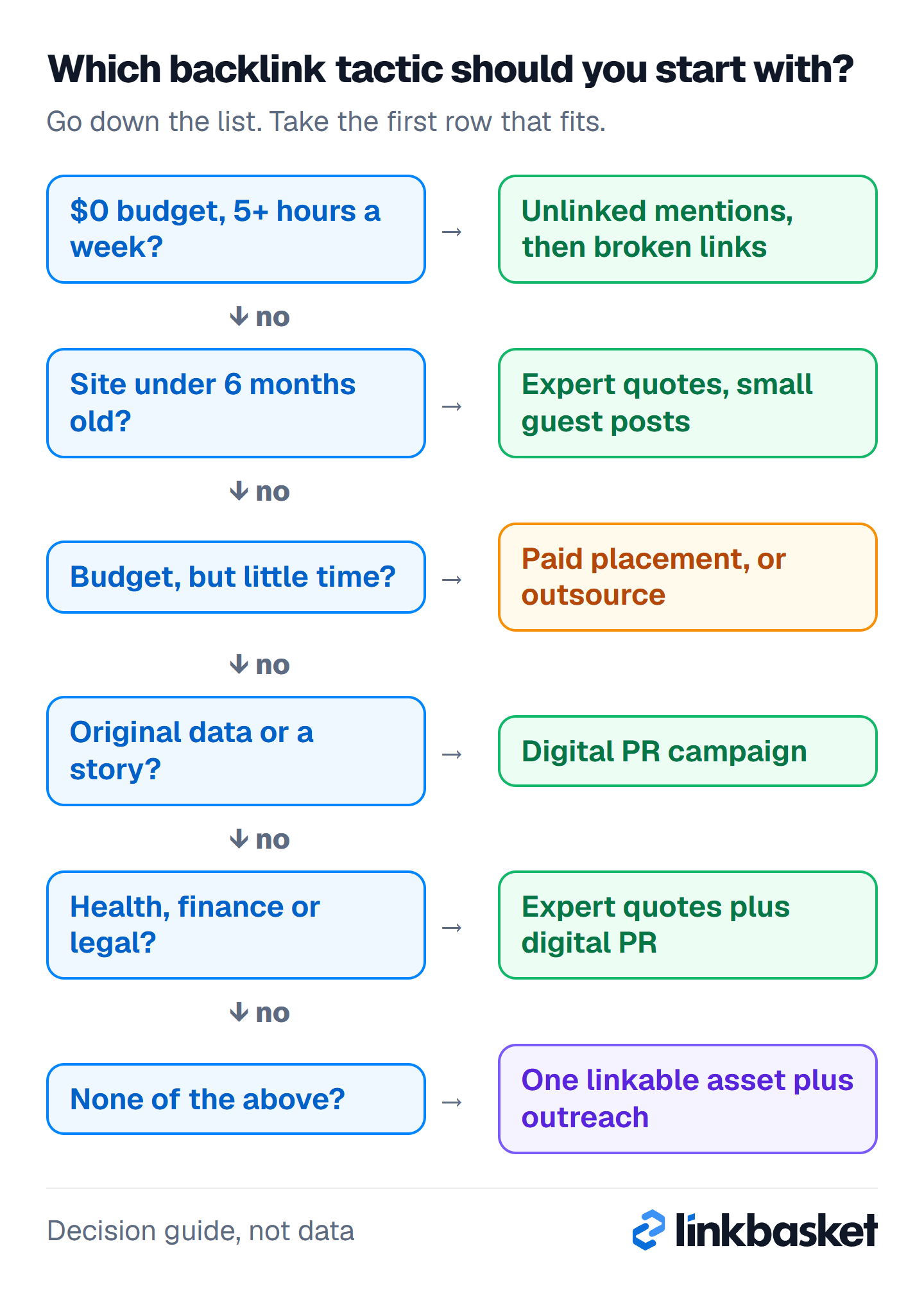
The amber box is the only branch where you may pay for placements, and that carries policy risk. Every other box is an earned tactic.
- $0 and five or more hours a week: start with unlinked mentions, then move to broken and resource link building.
- Site under six months old: skip digital PR for now. Answer journalist requests and pitch small niche blogs instead.
- Budget but little time: buy placements on relevant sites or hire help, as our guide to outsourcing link building explains.
- Original data or a strong story: run a digital PR campaign. Nothing else lands big publications at scale.
- Health, finance or legal: lean on expert quotes and PR, because editors there trust credentials over pitches.
- None of the above: build one linkable asset and promote it with outreach.
Whatever you pick, every new link should still pass the checks in our guide to what makes a good backlink.
What do the 7 backlink tactics cost, and how do they work?
Each of the seven backlink tactics below costs time, money or both. The hours quoted are planning estimates for one part-time person, not measured results.
One dated benchmark keeps expectations honest.
- 8.5% of 12 million outreach emails got any reply at all (Backlinko and Pitchbox, updated April 2019)
That figure comes from the study last updated in April 2019. Replies aren't links. Keep that in mind.
1. How do you turn unlinked brand mentions into backlinks?
You turn unlinked brand mentions into backlinks by asking the writer who already named you to add the link. It costs nothing and takes an hour or two a week.
There's a catch. It only works if people already write about your brand, product or founder, so a new site can skip this one. When it fits, though, these are the easiest links you'll ever get, because the writer already chose to mention you and simply forgot the link, or an editor stripped it out somewhere between draft and publish.
- Set Google Alerts for your brand, product names and founder.
- Search
"your brand" -site:yourdomain.comand open each result. - Note every page that names you without linking.
- Email the author, quote their sentence and give the exact URL. Three lines. Don't tack on a second request.
2. How does broken and resource link building work?
Broken link building finds dead links on resource pages in your niche and offers your page as the replacement. It suits sites with at least one page that genuinely beats what's out there.
The cash cost is $0, plus an SEO tool if you want one. Hours are the real price. Plan on four to eight per batch, because the slow part is finding dead URLs that match a page you actually have, and most of your list ends up in the bin.
Here's a worked example built on the Backlinko rate. Say you send 100 broken-link pitches. At 8.5%, you'd hear back from about 8 or 9 editors, and a few of those replies will be a polite no. If two or three of them end up adding your link, call it a decent batch.
- Find resource pages. Search
"your topic" "useful resources"orinurl:resources. - Find dead pages. In Ahrefs Site Explorer, enter a competitor's domain, open the Best by links report and filter the HTTP code to 404. Each row is a dead page that other sites still link to.
- See who links there. Click a dead page's referring domains to see who still links to it.
- Pitch the fix. When it matches a page you have, or can build, email that site's editor with the broken link, where it sits and your replacement.
- Follow up once. Most people skip this step, which is a shame, because in practice a single polite nudge seven days later often gets the reply that the first email didn't. Then move on.
3. How do expert quotes earn backlinks from journalists?
Expert quotes earn backlinks when a journalist uses your answer to a source request and credits you with a link. Platforms such as Qwoted and Featured post those requests, and most are free to answer.
Each pitch takes 20 to 30 minutes, plus a daily scan of new requests. Results are uneven. Some quotes run without any link, and many news sites tag outbound links nofollow, which still brings readers but little ranking credit.
Speed beats polish. Reporters on deadline tend to pick from the first handful of replies, so a perfect answer sent the next morning usually goes unread. When you reply, lead with a quote of two to four sentences that the reporter could paste straight into the story, add your name, title and one line of credentials underneath, and leave the decision about a link to the writer. Don't demand one.
4. How do you build backlinks with guest posts?
You build backlinks with guest posts by writing an article for another site in your niche, with one link back to a relevant page of yours. It's free when you write it yourself.
Budget three to six hours per post, pitch included. Expect rejections. Editors wade through disguised ads all day, and when you show you've actually read what they published last month, naming a post and the angle it missed, you land in the small pile they answer.
- Search
"your niche" "write for us", then drop any blog whose last ten posts are all guest posts. - Check organic traffic and relevance. Don't bother with sites that publish a price list for every niche.
- Pitch three titles that fit their audience, not yours.
- Write the best post they'll run that month.
- Place one link in the body, where it helps the reader, with a natural anchor.
Vary your anchors. Google's spam policies list optimized anchor text in guest posts as a link spam pattern. Our roundup of guest post marketplaces compares the paid options.
5. What makes a linkable asset earn backlinks?
A linkable asset earns backlinks when it gives writers something they can't get elsewhere: original data, a free calculator, a template or a glossary they'll keep citing.
Building one takes 20 to 60 hours. Paid design or development can push the bill to a few thousand dollars. Links trickle in at first, then keep arriving for years if the asset ranks, but only after you've pushed it with the outreach from tactics 2 and 3.
Skip the giant guide that repeats ten other pages. Nobody cites it. Open the most-linked pages of three competitors in Ahrefs to see what your niche already cites. Make something more useful, more current or easier to use. Then put one quotable number near the top.
6. When does digital PR beat other backlink tactics?
Digital PR beats other backlink tactics when you have original data or a timely story that journalists want to cover. No other tactic here regularly reaches national news desks.
A campaign runs two to six weeks and costs $0 in-house or a few thousand dollars through an agency. Results are lumpy. One lands nothing; the next pulls in dozens of news links.
- Find the story: a survey, your own product data or a fresh angle on the news.
- Write a short release with the headline number in the first line.
- List journalists who covered similar stories in the last three months. Include local and trade press, which often reply faster than national desks.
- Send personal pitches, not a blast, and offer the data plus a spokesperson.
- Track coverage and ask for a link wherever a story names you without one.
Our digital PR service can run campaigns for you. For how it differs from classic outreach, read digital PR vs link building.
7. How does paid placement on checked sites work?
Paid placement works by choosing a publisher site, paying its listed price and sending a brief with your target URL and anchor. The publisher then puts your link live.
First, the risk.
You do control the footprint. A relevant editorial site with genuine organic traffic and a natural anchor looks like an earned link. A no-traffic site selling to every niche looks like what it is.
On LinkBasket, each publisher sets one fixed price per site. You see it before paying, along with DR, organic traffic, top country, link type and typical delivery time. Say a DR 50 site lists a guest post at $150 (a hypothetical figure): that's the whole bill unless you add content writing or an extra link, whose prices also show before checkout.
- Filter. Narrow the LinkBasket inventory by niche, DR, traffic, country and price.
- Check. Open each site page and check its traffic, top countries and link rules.
- Brief. Add your target URL and anchor. Publishers may refuse spammy anchors.
- Pay. Pay from your wallet. If the publisher rejects the order, the full price goes back to your wallet.
- Review. Check the live article within 3 days. We fix a wrong anchor, wrong URL or missing link.
- Monitor. From then on, LinkBasket checks the link weekly for 12 months and restores, moves or refunds any link that drops.
Add-on rates sit on our pricing page, and the full buying walkthrough lives at buy backlinks.
So which side should you lean on? Here is the trade in one view.
Earned backlinks
- Cost: mostly time, $0 to a few thousand
- Speed: weeks to months per link
- Control: the editor picks site and anchor
- Risk: low when the link is editorial
Placed backlinks
- Cost: your time, or a fixed price per site
- Speed: days to a few weeks
- Control: you pick the site and brief
- Risk: paid dofollow links break Google's rules
How do the backlink tactics compare?
The backlink tactics compare most clearly on money, time per link and speed. Time figures are planning estimates.
| Tactic | Money | Time per link | Speed | Best for |
|---|---|---|---|---|
| Unlinked mentions | $0 | Under 1 hour | Days | Known brands |
| Broken / resource links | $0 + tool | 3 to 8 hours | Weeks | Sites with one standout page |
| Expert quotes | $0 | 1 to 5 hours | Weeks | Real experts, YMYL niches |
| Guest posting | $0 + your time | 3 to 6 hours | 2 to 6 weeks | Most sites |
| Linkable assets | $0 to a few thousand | High up front | Months | Long-term link growth |
| Digital PR | $0 to a few thousand | High, per campaign | 2 to 6 weeks | Data, stories, big outlets |
| Paid placement | Fixed price per site | About 1 hour | Per site, shown up front | Budget plus a deadline |
Decision matrix: where should you start building backlinks?
Start building backlinks where your budget and weekly hours meet in this matrix.
| If your budget is | And your time is | Then start with |
|---|---|---|
| $0 | 5+ hours a week | Unlinked mentions, then broken and resource links |
| $0 | Under 2 hours a week | Expert quotes only |
| Small | Some | Guest posting plus a few paid placements on relevant sites |
| Larger | Little | Paid placement, or hire an agency |
| Any | Any, with original data | Digital PR |
Which edge cases change how you build backlinks?
Four edge cases change how you build backlinks: a brand-new site, a local business, a past penalty and an ecommerce store.
A brand-new site with no content should wait. Publish five to ten strong pages first, so links have somewhere useful to point, then start with business profiles, partner and supplier pages, and a couple of niche guest posts.
For a local business, local links beat national ones. Chambers of commerce, local news and sponsorships all work, and our local link building guide goes deeper.
Got a past manual action? Clean up first. If you've still got unnatural links pointing at the site, fresh ones rarely help until a reconsideration request succeeds.
An ecommerce store faces a different problem, because few writers ever link to a category page. Earn links to a buying guide instead. Internal links then pass that value inward.
When should you get help building backlinks?
Get help building backlinks when you need more links than you can win alone, or right away if Search Console shows a manual action for unnatural links. For volume, compare the best link building services. For a penalty, hire a technical SEO consultant who audits links and doesn't sell them.
Before you hire anyone, get answers to these in writing:
- Will you name every site before I pay?
- What organic traffic does each site get, and from which country?
- Who picks the anchor text?
- What happens if a link is rejected or removed later?
A provider who dodges any of them isn't worth the saved hours.
FAQ
How do I create backlinks for free?
Start with unlinked brand mentions, broken and resource link building, and expert quotes. All three cost only time, and so do guest posts you write yourself. Expect a slow start: a few links in month one is normal for one part-time person.
How long does it take for backlinks to work?
Google has to crawl the linking page first, and Google says crawling can take anywhere from a few days to a few weeks. It publishes no timeline for ranking changes after that. Judge a new link over months, not days.
Do I need a lot of backlinks to rank?
Not always. Google's Gary Illyes said at SERP Conf in April 2024 that Google needs very few links to rank pages, as Search Engine Roundtable reported. Your real benchmark is the referring-domain count of the top five results for your keyword.
Do outbound links help SEO?
Not directly. Outbound links don't add to your backlink profile. Link out when a source genuinely helps readers, and mark paid links with rel="sponsored", as Google asks.
How do I get more backlinks to an existing site?
Reclaim lost links first by redirecting old URLs that still attract them. Then find sites linking to two competitors but not you, and pitch those editors a better page. Our guide on how to check backlinks shows where to find that list.
Next step: build your first backlinks this month
Build your first backlinks by picking one tactic from the decision path and running it for four weeks before you add another. Switch weekly and you'll never learn what works. If you want links this month and have the budget, a free marketplace account shows every site's DR, traffic, top country and price before you pay.