Backlinks are important because Google uses them to find new pages and as a signal of which pages are relevant, and because they send real visitors. As of November 2026, Google's own documentation still says PageRank, its link-based system, is part of its core ranking systems.
Last updated: November 9, 2026
So why are backlinks important if Google says they're just one signal? Because in competitive searches, the pages you're up against usually have them. Below are the 5 jobs a backlink does, what Google has written about links, and the cases where you can skip link building entirely.
Why are backlinks important for SEO? The 5 reasons
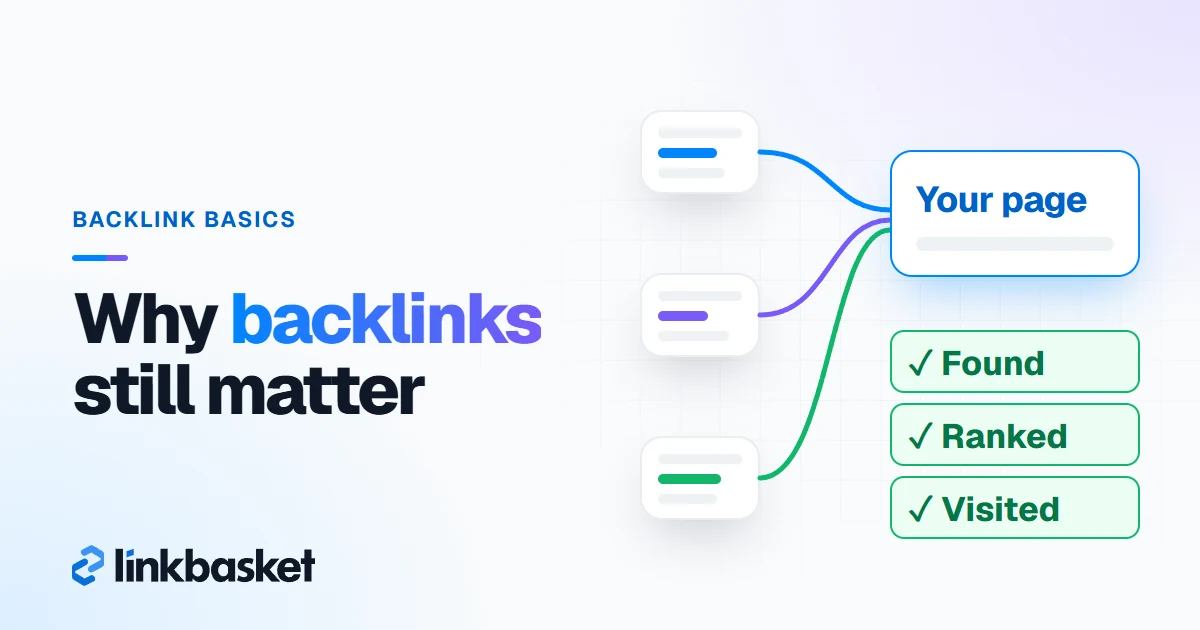
Backlinks are important for SEO for 5 reasons: discovery, relevance, ranking systems, referral traffic and local prominence. The first 3 come straight from Google Search Central; the last 2 are about people.
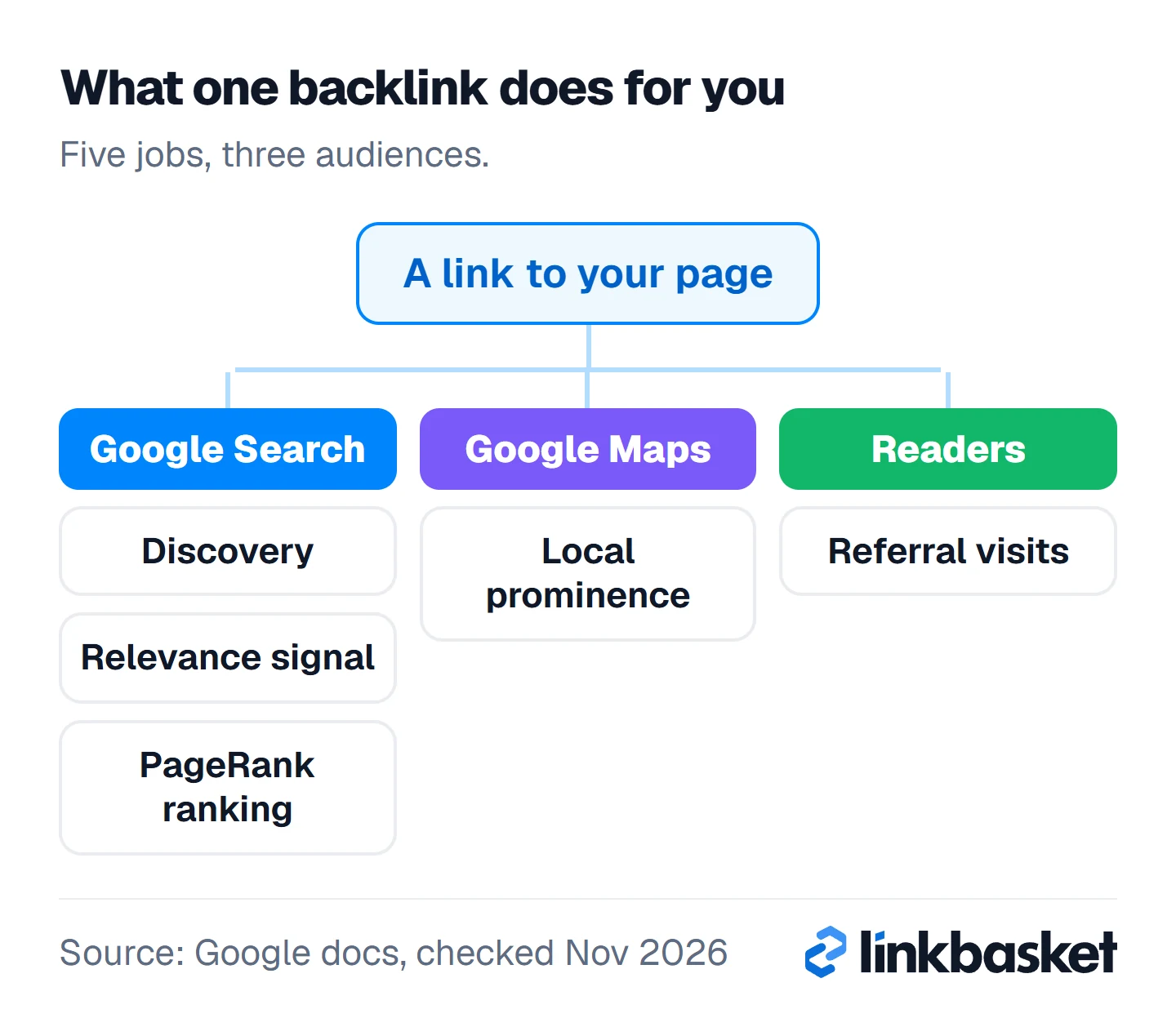
Read the tree from the top. Three jobs happen inside Google Search, one in Google Maps, and one with real readers.
- Discovery: Google finds many new pages by following links from pages it already knows.
- Relevance signal: Google uses links "as a signal when determining the relevancy of pages."
- Ranking systems: PageRank "continues to be part of our core ranking systems."
- Referral traffic: people click links, whatever the
relattribute says. - Local prominence: for map results, Google looks at "how many websites link to your business."
If the word backlink is new to you, our explainer on what a backlink is covers the basics in 2 sentences.
How do backlinks help Google discover pages?
Backlinks help Google discover pages because Google finds many new URLs by pulling links out of pages it already crawls. A page with no links pointing to it is harder to find.
Google's guide to how Search works says it plainly: "Other pages are discovered when Google extracts a link from a known page to a new page." The same guide names the other route, a sitemap you submit yourself.
In practice, this matters most for new sites. When you launch a 20-page site with no inbound links, you're relying on your sitemap and Search Console alone. One link from a site Google crawls daily gives it a second path in. Discovery is not ranking, though. Most people miss this. A crawled page still has to earn its place.
Are backlinks a ranking signal in Google's own docs?
Yes, backlinks are a ranking signal in Google's own documentation, though Google calls them "a signal," not the most important one. Two pages say so, and we checked both on November 9, 2026.
- Google's link guidance: "Google uses links as a signal when determining the relevancy of pages and to find new pages to crawl."
- Google's ranking systems guide calls PageRank "one of our core ranking systems used when Google first launched," adding that "it continues to be part of our core ranking systems."
The same ranking guide describes Penguin, a system "designed to combat link spam," which Google folded into its core ranking systems in 2016. So Google rewards links and polices them at the same time. That is the whole tension of link building in one paragraph.
Google rewards links and polices them at the same time.
What the docs leave out matters too. Read them closely. They give no weight, no rank order and no number of links. Anyone who tells you backlinks are "40% of the algorithm" is guessing.
Are backlinks still important in 2026?
Backlinks are still important in 2026: Google's documentation, checked in November 2026, still lists links as a relevance signal and PageRank as a core ranking system. What has changed is how much spammy links can do.
Google's December 14, 2022 link spam update post says SpamBrain "can now detect both sites buying links, and sites used for the purpose of passing outgoing links," and that credit from unnatural links is lost. Read that carefully. Links still count. Bad ones increasingly count for nothing, which turns out to be the real change since 2022: the downside of a spammy link today is usually wasted money rather than a penalty, though a manual action is still possible if you've bought links at scale.
You'll see conference quotes from Google staff passed around on this topic, often without the full context. We only cite what Google has written in its documentation, because a paraphrase of a live talk is hard to check. Frankly, the docs are clear enough: links matter, content matters more, and manipulation gets neutralised.
Do backlinks send referral traffic?
Yes, backlinks send referral traffic whenever a real person clicks them, and that happens whether the link is dofollow, nofollow or sponsored. This is the benefit of backlinks most people forget.
Here is a worked example, and every number in it is hypothetical. Say a hobby blog's article gets 30,000 visits a month and links to your guide in the second paragraph. If 0.5% of readers click, that's 150 visitors a month. If 2% of those buy a $40 product, the link brings in $120 a month, with zero ranking effect needed.
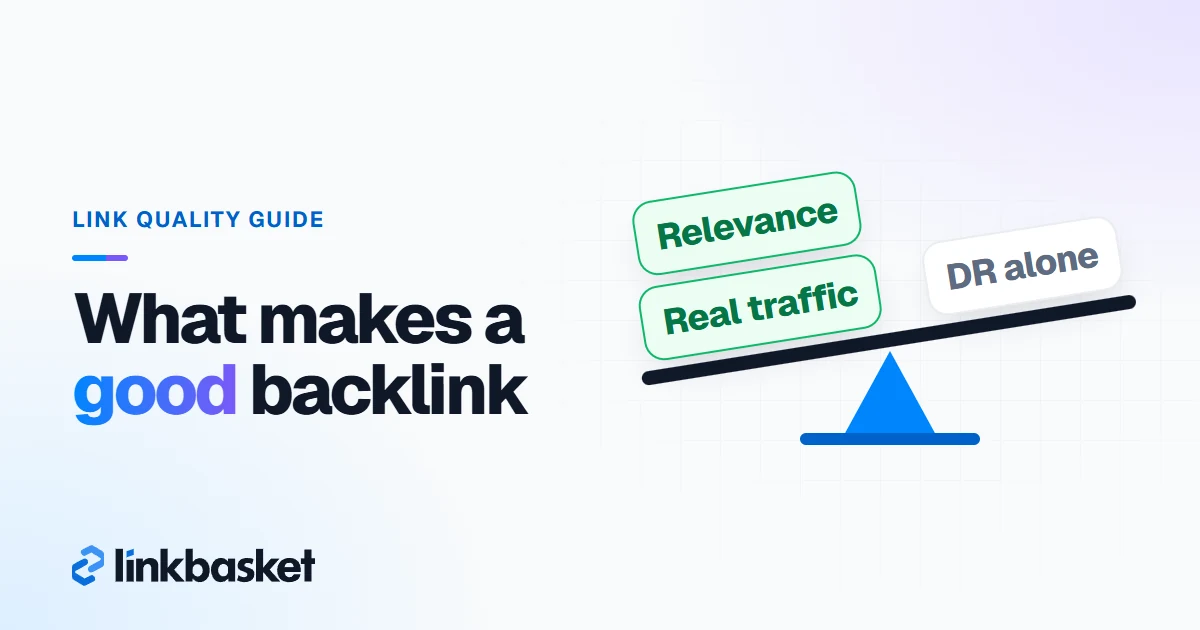
That's why we tell people to judge a link by its readers first. Skip the DR chart for a minute. A link on a page with no traffic can only help through ranking signals. A link on a busy, relevant page works on day 1.
Do backlinks build trust and local prominence?
Backlinks build local prominence directly: Google's local ranking help page says prominence is based partly on "how many websites link to your business and how many reviews you have." For brand trust, links work through people, not a score.
Google Business Profile Help, checked November 2026, names 3 local factors: relevance, distance and prominence. Local links, such as a city news site, a supplier's dealer page or a club you sponsor, feed the third one. Our local link building guide covers where to find them.
Outside maps, links build trust the old-fashioned way. A reader who sees your study cited by a trade magazine trusts you more. A journalist who finds you quoted in 3 places is more likely to quote you a 4th time. Honestly, that compounding effect is one of the best benefits of link building, and it never shows up in a DR chart.
What are the benefits of link building beyond rankings?
The benefits of link building beyond rankings are referral visitors, faster discovery of new pages, brand mentions that lead to more links, and partnerships. Link building in SEO simply means the work of getting other sites to link to yours.
- Referral sales: the worked example above, repeated across 10 or 20 links.
- Faster indexing: new pages linked from crawled sites get found sooner.
- Compounding mentions: one good placement often leads to others.
- Relationships: the editor who accepted one guest post may cite you next year.
None of these need a single paid link. Not one. Our guide to white hat link building covers the methods that earn them.
When don't you need backlinks?
You don't need backlinks when the search is branded, the top results have few links themselves, the goal is the local map pack, or your page isn't yet good enough to deserve them. In those cases, spend the effort elsewhere first.
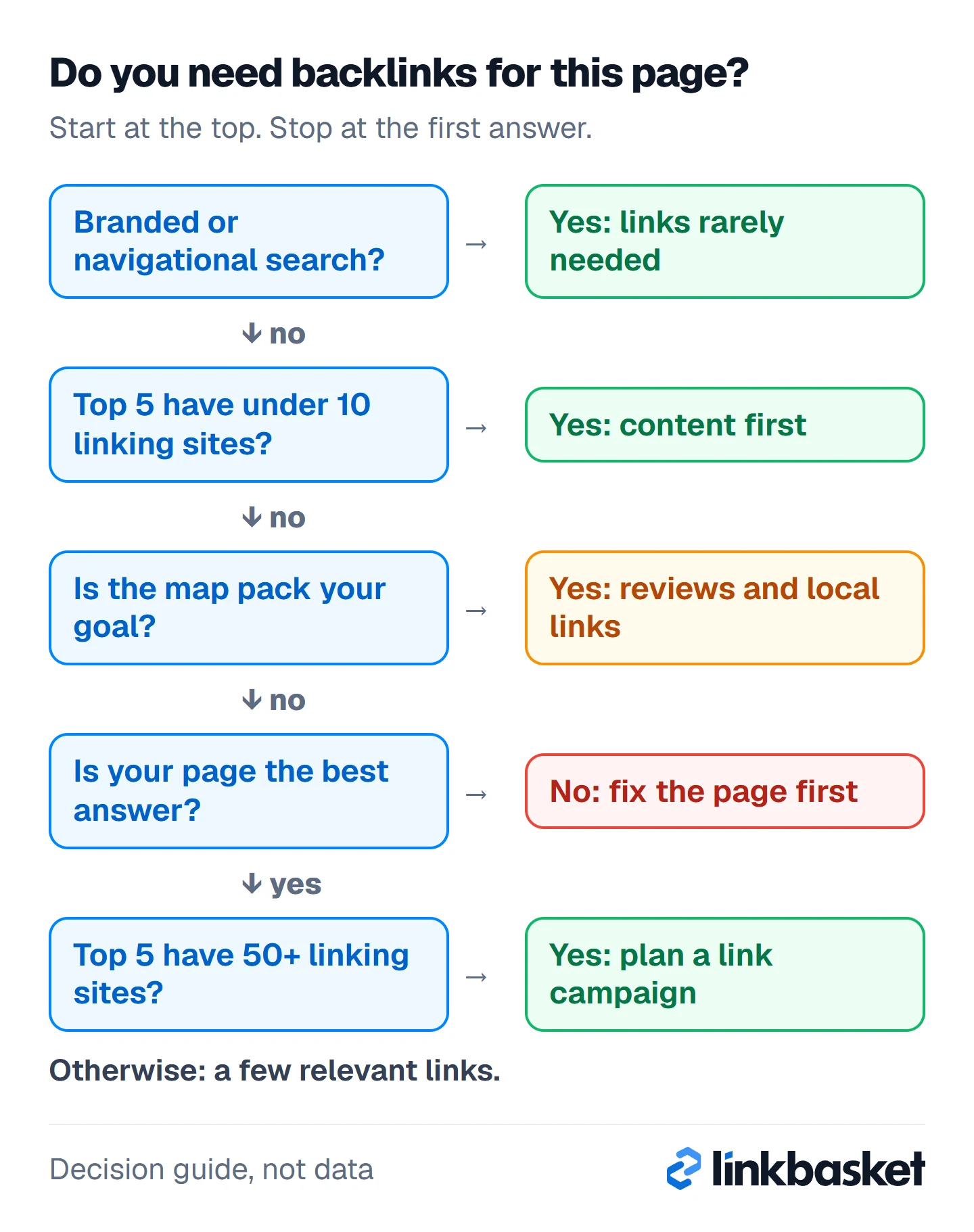
Answer the questions in order and stop at the first one that fits. The table adds a next action for each case.
| Situation | Do you need backlinks? | Do this first |
|---|---|---|
| Branded or navigational search | Rarely | Make the right page easy to find |
| Top 5 results have under 10 linking sites each | A few at most | Write the best page on the topic |
| Local map pack is the goal | Some local links | Reviews, profile, local citations |
| Your page is thinner than the top results | Not yet | Fix the content |
| Top 5 results have 50+ linking sites each | Yes | Plan a steady link campaign |
| Traffic comes from email, social or ads | Not for that traffic | Keep building the channel that works |
Ahrefs gives a useful benchmark. Its Keyword Difficulty page, checked November 2026, says KD 10 maps to about 10 referring domains for a top-10 spot, while KD 50 maps to about 84. If you've picked low-difficulty keywords, content and internal links may carry you most of the way.
Here is a second example, also hypothetical, for when you're picking targets. Say "CRM for dental clinics" shows top 5 pages with 3, 4, 6, 5 and 8 linking sites. The median is 5, so a strong page plus a handful of relevant links could compete. Now say "CRM software" shows pages with 900 or more each. That's a multi-year project, not a first target. Our guide on how many backlinks you need to rank walks through the full method.
Should you buy backlinks if they're this important?
You can buy backlinks, but Google's spam policies treat links bought to manipulate rankings as link spam, so paid dofollow links always carry risk. No seller, including us, can make that risk zero.
What lowers the risk is a relevant site with real organic traffic, an in-body placement, a natural anchor, a sponsored tag where the publisher adds one, and no link farms. Don't trust any seller who hides the domain until after payment. If you're comparing link types first, read our guide to the types of backlinks.
Which edge cases change why backlinks matter?
Four edge cases change how much backlinks matter: brand-new sites, YMYL topics, sites recovering from spam, and pages that already rank on page 1.
- New sites: links matter for discovery even before they matter for rankings. When you launch, a handful of relevant links beats dozens of random ones.
- Health, finance and legal topics: editors are stricter, and a few authoritative citations beat many small links.
- Sites with a link spam history: new links won't fix old problems. Clean up first.
- Pages already in positions 4 to 10: a few relevant links can be the difference, but check that the content isn't the weaker part.
When should you call a specialist?
Call a specialist when your link history, not your content, is the problem. Don't ask a link seller for that audit. Get one first if any of these is true:
- Search Console shows a manual action for unnatural links.
- Rankings dropped sharply right after a spam update.
- You've inherited a site with years of bought links.
And don't use anyone for link building while your top pages are thin. Fix those first; links amplify good pages, they don't rescue weak ones.
FAQ
Do I need backlinks to rank on Google?
Not always. Branded searches and low-competition keywords can rank with strong content and internal links alone. For competitive commercial keywords, where the top pages have dozens or hundreds of linking sites, you almost always need backlinks.
Can a website rank without backlinks?
Yes, for some queries. Google can find a site through a submitted sitemap, and relevance comes from many signals beyond links. But Google's docs still list links as a signal, so in crowded results a page without any links starts behind.
Are backlinks more important than content?
No. Content decides whether a page deserves to rank; links help Google find it and judge it against similar pages. Links pointed at a weak page rarely hold it up for long.
What is the main benefit of backlinks for a new website?
Discovery. A new site has no history, so a few relevant links help Google find and crawl it sooner, and they bring the first referral visitors. Rankings benefits usually take longer.
Next step: decide if your page needs backlinks
Run the decision table above on your top 3 target pages. It takes about 20 minutes. If links are the gap, compare publisher sites with their metrics in our link marketplace inventory, or let us handle it through our link building services. If you'd rather understand the counts first, read our comparison of backlinks vs referring domains.