Local link building is getting links from websites tied to your area, and what you build first depends on your business type: one-location firms fix their profile and citations, multi-location brands fix location pages, and shops split local from niche links. The sources are local news, community blogs, chambers of commerce, clubs you sponsor, suppliers and regional directories. Paid niche placements come last, for specific pages, once the basics are in place.
Last updated: November 9, 2026
How much do links matter for local SEO?
Links matter for local SEO, but Google's own guide lists them as one input to one of three ranking factors, next to reviews and accurate business info.
Google's guide to local ranking, checked in November 2026, says local results depend mainly on relevance, distance and prominence, though its summary line now uses the word "popularity" for the third. The Prominence section says that factor draws on info like "how many websites link to your business and how many reviews you have." So links count. They just sit beside reviews and a complete profile, not above them.
That's why one long list of tactics fails so many owners. A plumber in a town of 40,000 people and a 12-branch dental group face different competition, different budgets and different pages to rank.
What decides your local link building plan?
Four things decide your local link building plan: your business type, your budget, the state of your profile and citations, and how much local competition you face.
- Business type. Single-location service business, multi-location brand, or local shop that also sells online. Each one needs links on different pages.
- Budget. Time only, a small monthly spend, or a real link budget. Many of the best local links cost an email and a coffee. Others cost a sponsorship fee.
- Your current foundation. Is your Google Business Profile verified and complete? Do your name, address and phone number (NAP) match everywhere? If not, links won't fix that.
- Local competition. A town with three electricians needs far fewer links than a city with 300. Check what the top three competitors have before you set a target.
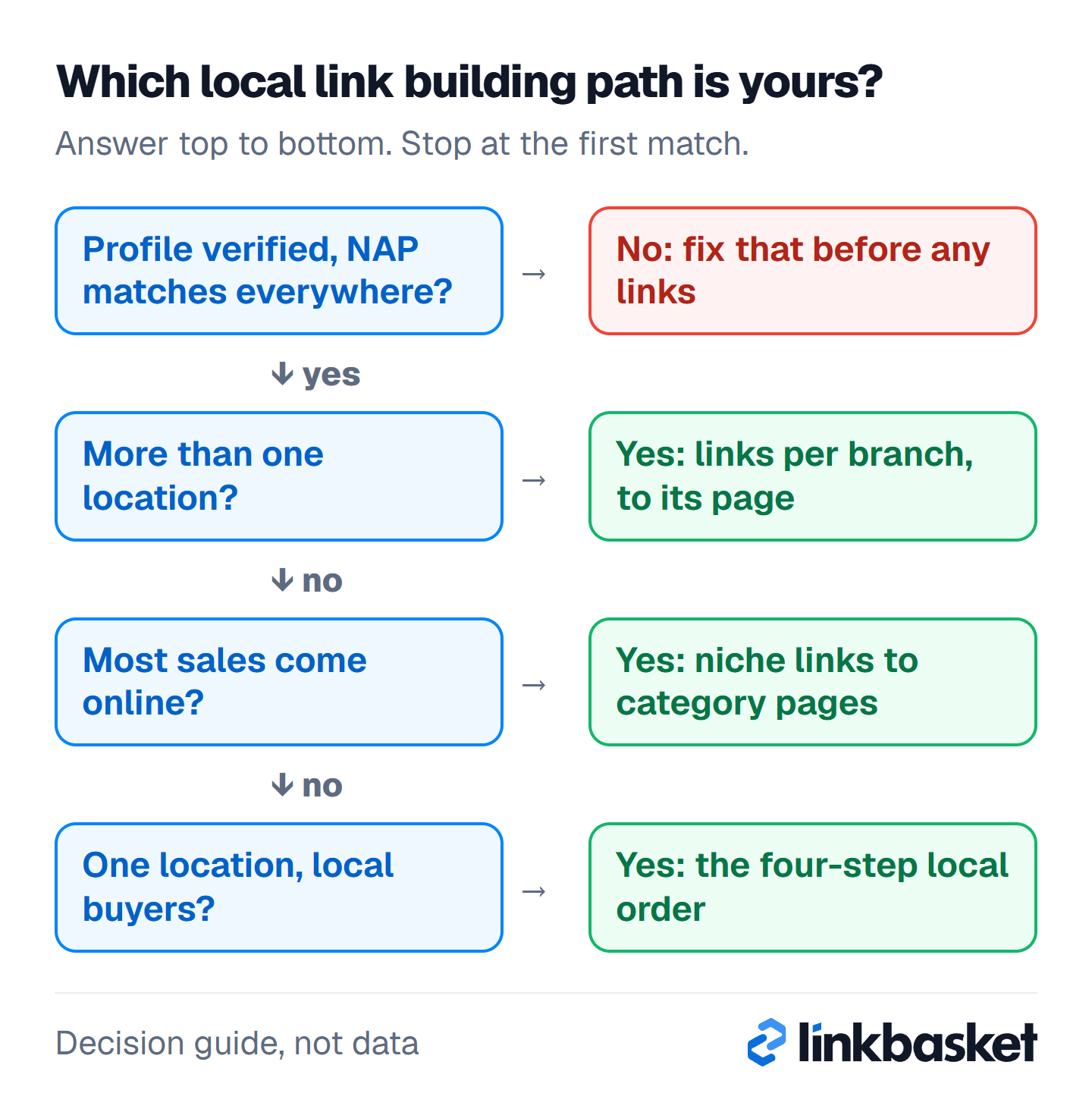
Start at the top of the flow below. Notice the first question is about your profile, not links.
How does local link building work for one location?
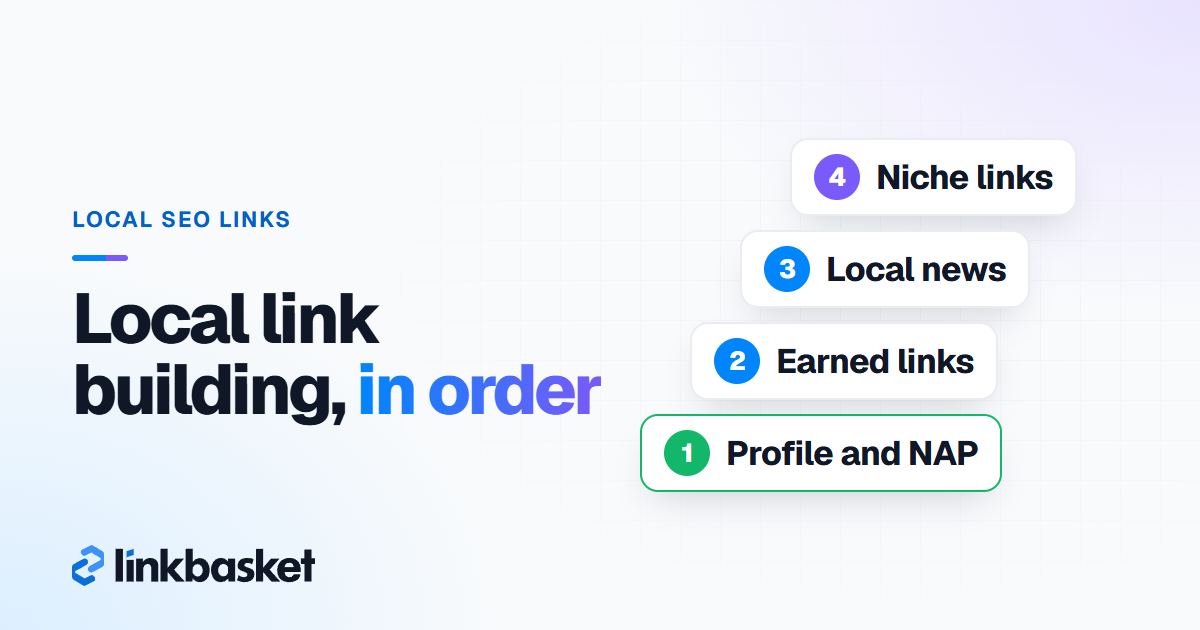
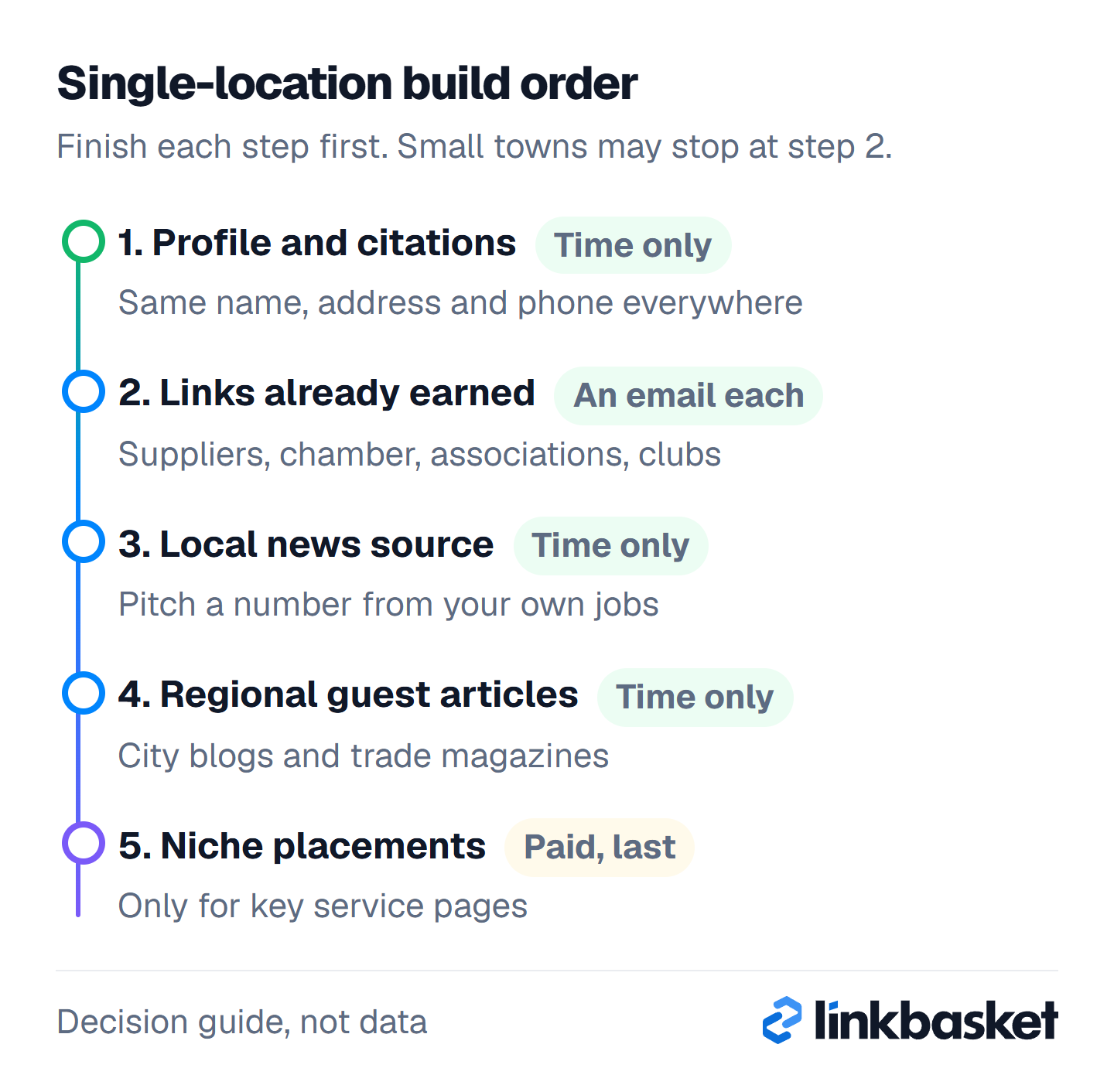
A single-location service business should do local link building in four steps, in order: fix the profile and citations, collect links already earned, become a local news source, then write for regional sites.
Most local businesses fit here. Think plumbers, dentists, accountants, law firms, salons and cleaners with one office and a service area. Don't skip ahead.
Step 1: Fix the foundation. Claim and complete your Google Business Profile. Then list the business on the main directories in your country, plus the ones specific to your trade, with the exact same name, address and phone number on every listing. These citations are local SEO basics, not a link strategy. Many directory links carry little ranking weight on their own, but messy NAP data can hold you back, and Google's guide says businesses with complete and accurate info are more likely to show up in local results. Don't bother chasing news links while three directories list three different phone numbers.
Step 2: Collect the links you've already earned. When you look closely, most local businesses have links waiting:
- Suppliers and manufacturers with "find an installer" or "stockist" pages
- Trade associations and licensing bodies with member directories
- Your chamber of commerce, if you're a member
- Clubs, schools and charities you already support
- Local businesses you partner with, such as an estate agent who refers clients to your surveyor
Each one is a relevant, local, editorial link. Most cost nothing but an email asking to be listed. Most people forget the supplier pages entirely. Check them first.
Step 3: Become a local source. Local news sites and community blogs need stories, and they rarely have the staff to find them. Offer something useful: a seasonal tip from a qualified expert, data from your own jobs, or an event you're running. A roofer who shares how many storm-damage calls came in after a big storm has a story. A press release about "our commitment to quality" does not. When you pitch, lead with the number.
Step 4: Write for regional sites. City blogs, regional business magazines and local trade publications often take guest articles. Skip the sales pitch. Offer a topic their readers care about, like what a boiler service should cost in your county, and mention your business once, in the author bio.
If your foundation is weak, stop at Step 1 until it's done. If you're in a small town with few competitors, Steps 1 and 2 may be all you need. If you're in a big, competitive city, you'll likely need Steps 3 and 4. Maybe placements too.
The timeline shows the full order and what each step costs. Only the last step costs money.
Worked example: how many local links does a plumber need?
Hypothetical example, round numbers. Say you run a plumbing firm in a town of 40,000 people. The three plumbers above you for "plumber + town" have 25, 18 and 14 referring domains. You have 6. Their average is about 19, so you're roughly 13 domains short.
Here's how the four steps might close that gap over six months. Step 2 turns up 5 links: two suppliers, a trade association, the chamber and the youth football club you already sponsor. Step 3 lands 2 local news links after you share how many burst-pipe calls came in during a cold snap. Step 4 adds 3 regional guest articles. That's 10 new referring domains, and you haven't paid for a single link. The last 3? Niche placements pointing at your boiler-repair page, the one page no local group would think to link to. When you run the real count, use the same backlink tool for all four sites so the numbers compare.
How does local link building work for multiple locations?
For multi-location businesses, local link building happens branch by branch: every location needs its own profile, its own citations and its own local links, pointing at its own location page.
If each location has a real, useful page (address, team, opening hours, local reviews, services offered there), local links have somewhere to land. Point each branch's sponsorships, chamber listings and local press at that branch's page, not the homepage.
If your location pages are thin copies with only the town name swapped, fix them first. A local paper won't link to a page that says nothing local, and in practice a thin page gets ignored no matter how good your outreach is.
If you have 10 or more locations, citation work gets heavy. Manage listings centrally so NAP data doesn't drift when a branch moves or changes its phone number, and give each branch manager a short list of local link targets: their chamber, nearby schools and clubs, and the local paper.
Then add a central layer. One brand-level campaign, such as a survey or a city-by-city data study, can earn links that lift every location at once. Our comparison of digital PR vs link building covers when a campaign like that pays off and what it typically costs per link.
How should local shops that also sell online build links?
A local shop that also sells online should split its links by job: local links go to the homepage and store page, while niche links go to the category and product pages that compete nationally.
Local customers search with a place name. Online buyers search for products and don't care where you are. So each link needs a clear job:
Local links
Point them at your homepage and store page. Store openings, local events, "shop local" guides and city blogs fit here.
Niche links
Point them at category and product pages. A local bike shop's road-bike category competes nationally, so a link from a cycling site does more for it than one from the town council's website.
If most revenue comes from walk-in customers, follow the single-location path above. If most revenue comes from online orders, local links become a trust layer. Spend most of your effort on niche relevance. Our page on link building for ecommerce stores goes deeper on category pages.
Where do paid niche placements fit for local businesses?
Paid niche placements fit late in local link building, after citations and earned local links are done, and only for pages that local sites won't link to.
Honestly, that's later than most sellers will tell you. A guest post on a national travel blog won't move a dentist up the map pack. Distance and local relevance matter too much. Don't trust any seller who promises map-pack gains from links alone. Placements make sense in three situations:
- Your organic "service + city" page lags behind competitors with more links, and the local options above are used up.
- You sell beyond your town, like the ecommerce case above, or a consultant with clients nationwide.
- You need links to a specific page that local groups won't link to, such as a detailed service or pricing page.
When you do buy placements, pick sites in your industry whose audience is in your country. If you'd rather hand the whole plan off, start with our link building services page.
What lowers the risk is relevance, real organic traffic, editorial sites, a sponsored tag where the publisher adds one, and no link farms. Keep anchors natural, too. Don't use "best plumber Leeds" on every link; your brand name or a plain description reads like a link a real editor would write. After a placement goes live, LinkBasket checks the link weekly for 12 months and restores, moves or refunds it if it's removed, switched to nofollow or goes offline.
Local link building decision matrix
This local link building decision matrix maps your business type and budget to the first thing to do.
| If your business is... | And your budget is... | Then do this first |
|---|---|---|
| Single location, service area | Time only | Business Profile, core citations, supplier and association links |
| Single location, service area | Small monthly spend | Add local sponsorships and regional guest articles |
| Single location, competitive city | Dedicated link budget | All local steps, then niche placements to key service pages |
| Multi-location | Any | Fix location pages and NAP per branch, then local links per branch |
| Multi-location | Dedicated link budget | Add one brand-level data or PR campaign |
| Local shop, mostly walk-in | Time or small spend | Follow the single-location path |
| Local shop, mostly online sales | Dedicated link budget | Local links to store page; niche placements to category pages |
In practice, most businesses sit in one of the first three rows, so start there and move down the table only when the cheaper links run out and your rankings still trail the businesses above you.
Which edge cases change the local link building path?
Four edge cases change the local link building path: no storefront, regulated professions, a recent move or rebrand, and sponsorships bought mainly for the link.
- No storefront. Google's service-area help page says that if you don't serve customers at your business address, you should remove the address from your profile and list a service area instead. Keep your business name and phone number identical across citations anyway.
- Legal, medical and financial firms. Professional bodies and bar or medical associations are your best local links. Some publishers charge extra for sensitive topics, or refuse them, so read the site rules before ordering any placement. See our notes on link building for law firms.
- Moves and rebrands. If you've moved or rebranded, update every citation before you build new links. Old addresses spread across directories confuse customers and search engines alike.
- Sponsorship links. Sponsor a club because you'd support it anyway. If the link is the only reason, you're paying for a link. Ask for a rel="sponsored" or nofollow tag; that's the clean way to handle it.
When should you hire a local SEO specialist?
Hire a local SEO specialist when you run 20 or more locations, when your profile has been suspended, or when duplicate listings keep coming back.
Don't forget the regulator, either. Law, medical and financial firms should check marketing plans against their regulator's advertising rules; your bar association or professional body's ethics team can tell you what's allowed. For outsourcing the link work itself, our guide on how to outsource link building lists what to ask a provider before you sign.
FAQ
What is local link building?
Local link building means earning links from websites connected to your area or community. Typical sources are local news sites, chambers of commerce, trade associations, suppliers, sponsored clubs and regional blogs. These links show Google and customers that people nearby know your business. They work best alongside a complete profile and good reviews.
Are citations the same as backlinks?
Not quite. A citation is any mention of your business name, address and phone number, with or without a link. Many directory listings do include a link, but their main job is confirming your details. Treat citations as the foundation and earned local links as the part that builds prominence.
How many local links do I need?
There's no fixed number. Count the referring domains of the three businesses ranking above you for your main "service + city" term. Our guide on how to check backlinks shows how. If they have 30 and you have 8, you know the gap. In a small town, a dozen relevant local links can be enough.
Can I buy local backlinks?
You can, but no paid link is risk-free, because Google treats links bought to manipulate rankings as link spam. Earned links from groups you work with are safer and usually more relevant. If you do buy, choose sites in your industry with real traffic in your country, and point them at pages that local sites won't link to.
Do local links beat high-DR links?
For map-pack rankings, a relevant local link often does more than a high-DR link from an unrelated site. For pages that compete nationally, like ecommerce categories, niche relevance and authority matter more. Most local businesses need a mix, with local links first.