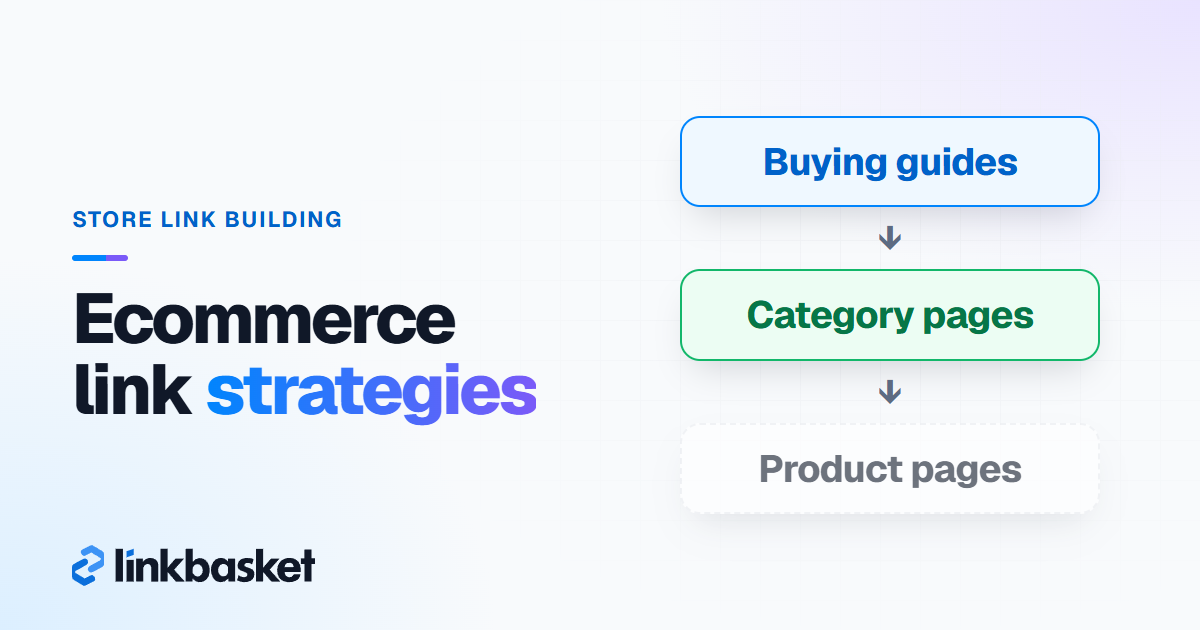
The best ecommerce link building strategies send links to pages that can rank for years, then pass that value inward with internal links. That means buying guides and category pages first, product pages rarely. The tactics that earn those links are data and digital PR, supplier and partner links, local press, and, where it fits, paid guest posts or link insertions on relevant sites. Here's how to decide.
Which pages should an ecommerce store build links to?
Build links to pages that stay live and target buying searches. For most stores, those are category pages and the guides that feed them.
| Page type | Build links to it? | Why |
|---|---|---|
| Category pages | Yes, the main target | They rank for commercial terms and rarely change URL |
| Buying guides and how-tos | Yes, easiest to earn | Publishers link to helpful pages; internal links pass value on |
| Product pages | Rarely | Stock sells out, URLs change, and links to dead pages are wasted |
| Homepage | Let it happen | Brand mentions, PR and partners link here on their own |
| Seasonal pages | Only with a fixed URL | A page that moves each year loses its links |
Don't point paid links at a product page you might delete next season. On LinkBasket, our weekly link checks don't cover a link that fails because you deleted or redirected the target page.
Which ecommerce link building strategies work best?
The strategies that work best give a publisher a reason to link. Here are six, roughly from earned to paid:
- Original data. Pricing surveys, sales trends or return rates make good digital PR stories. Our digital PR strategy guide shows how to pitch them.
- Supplier and manufacturer pages. Many brands list stockists. Ask for a link from the "where to buy" page.
- Partner and creator links. Collaborations, gift guides and expert quotes. If a creator gets free product, the link should be marked sponsored or nofollow.
- Unlinked brand mentions. Search for your store name and ask for a link where none exists.
- Local press. Stores with a shop or warehouse can pitch city news sites. See our local link building guide.
- Paid guest posts and insertions. Placements on niche sites your buyers read. More on this below.
Be careful with product seeding. Google's spam policies list "sending someone a product in exchange for them writing about it and including a link" as link spam (checked November 2026).
Earned links vs paid placements: which fits your store?
Most stores need both, in different amounts. The split depends on budget, time and whether you have a story.
Earned links
Cost time, not placement fees. Strong when you have data, a brand people talk about, or partners. Slow and hard to predict.
Paid placements
Fast and predictable: you pick the site and the page. Every one carries policy risk, so keep them relevant and few.
Use the table below to pick a starting point. Don't spread a small budget across all four rows; when you pick one and do it well, you learn faster.
| If you have | And you want | Then start with |
|---|---|---|
| A data set or a story | Links from news sites | Digital PR |
| Suppliers and partners | Quick, relevant links | Partner and stockist pages |
| A strong buying guide | Links in your niche | Guest posts on niche sites |
| An older article ranking for your term | A link in it | A link insertion |
Where do paid placements fit in ecommerce link building?
Paid placements fit as a top-up, once you have a guide or category page that deserves to rank. They work best when competitors have links from niche blogs you can't reach with outreach alone.
Every number here is hypothetical. Say a kitchenware store has 3 category pages and 2 buying guides. It might buy 2 guest posts on cooking blogs at $150 each, pointing at the guides, and 1 insertion at $90 in an older article that already ranks. That's $390 a month, with internal links carrying value from the guides to the categories.
If you've had a manual action for unnatural links, skip paid links entirely and clean up first.
How do you order links for a store on LinkBasket?
Four steps, and you choose every site yourself.
- Pick sites. Filter by niche, country, DR, traffic and price. Check the topics each publisher won't accept.
- Add the brief. Enter the target URL, ideally a guide or category page, and a natural anchor.
- Pay from your wallet. Top up by card or crypto. Add writing if you don't have an article.
- The link goes live. We track the order until it's published. You get 3 days to check it, then weekly checks for 12 months.
When you're new to this, start with two or three orders and watch what moves. Our page on how to buy SEO backlinks without regrets has the full pre-purchase checklist.
What should a store check before paying for a link?
Run this list on every placement. In practice, the country check catches the most bad buys for stores.
- The target is a category page or guide, not a product that may sell out.
- The site covers your product category for real readers.
- Its top traffic country matches where you ship.
- The anchor reads naturally, mostly brand or partial match.
- You know the link type, the sponsored tag and the link duration.
Want help choosing between a new post and an insertion? Read our niche edits service page, or compare our link building services with agencies. If you need a large mix across many categories, skip the bundles in our link building packages explainer and contact us instead.
FAQ
Should I build links to product pages?
Rarely. Product pages change too often. Build links to category pages and buying guides, then use internal links to pass value to products that sell.
How many backlinks does an ecommerce site need?
It depends on how many links the stores outranking you have. Compare your category pages with theirs. Our guide to how many backlinks you need shows the method.
Is off-page SEO for ecommerce only about links?
No. Brand mentions, reviews and partner pages help too. Links are the part you can plan most directly.
Does link building for law firms work the same way?
The tactics overlap, but legal topics face stricter editors and YMYL scrutiny. Our page on link building for lawyers covers the differences.
Next step
Pick your strongest buying guide, filter the inventory by your niche and shipping country, and shortlist three sites. Check how prices are set per site, or order a guest post for your store when you're ready.