A digital PR strategy is a written plan for earning press coverage and links: you set a goal, choose a story angle, build a media list, pitch journalists and measure what lands. Most strategies fail at the angle, not the pitch. This guide covers each step, the four tactics that earn most links, a digital PR audit you can run on past work, and a hypothetical three-month plan with real benchmarks beside it.
Last updated: November 9, 2026
What goes into a digital PR strategy?
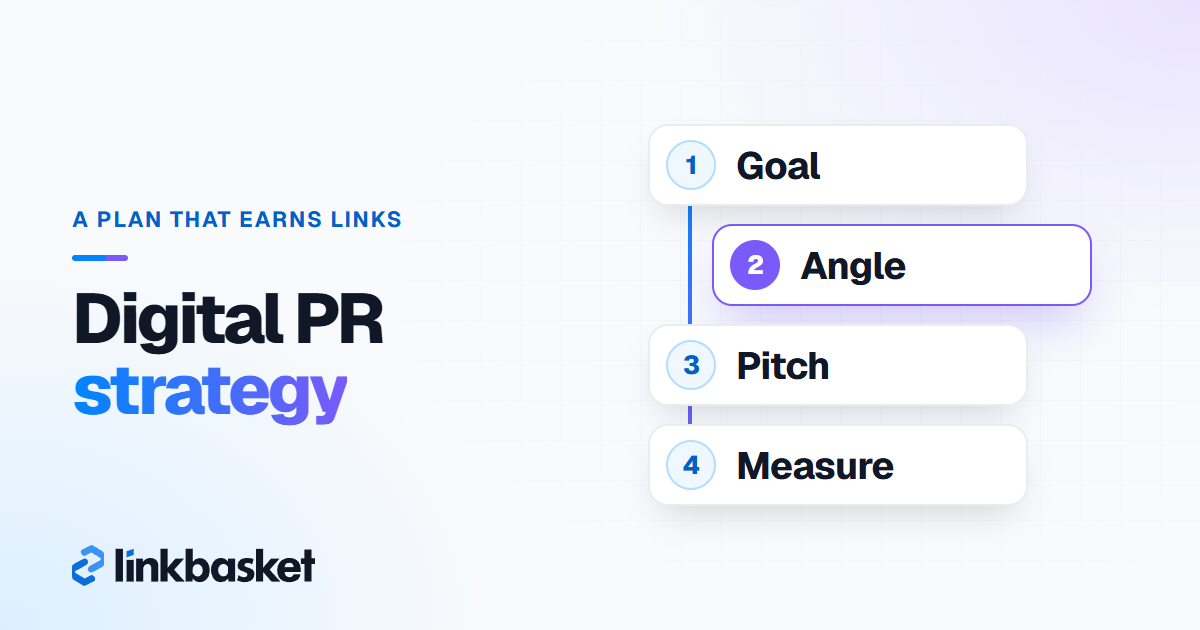
A digital PR strategy has five parts, in this order: a goal, an angle, a media list, a pitch plan and a measurement plan. Skip one and the rest wobble. When you skip the goal, you can't tell a good month from a bad one.
- Goal What the coverage should do: links to the domain, brand searches, referral visits or mentions in AI answers.
- Angle The story itself. A data study, reactive comment, expert commentary or a free tool.
- Media list Somewhere between 50 and 150 named journalists who cover that story. Not a bought list of 10,000 emails.
- Pitch plan Subject line, the first two sentences, timing and one follow-up.
- Measurement Links, mentions and what they did for rankings, checked at 30, 90 and 180 days.
Digital PR is one channel inside a wider link plan. If you're still choosing between press coverage and paid placements, start with our digital PR vs link building comparison. This guide assumes PR already has at least part of the budget.
What goals should a digital PR strategy set?
A digital PR strategy should set one primary goal and two or three numbers to judge it by, agreed before the first pitch goes out. Without them, every campaign gets judged by gut feel, and in practice the loudest opinion in the room wins.
Match the KPI to the goal:
- Domain authority growth: new referring domains, counted monthly.
- Brand demand: branded search clicks in Search Console against the previous 3 months.
- Referral traffic: sessions from coverage, in your analytics.
- AI visibility: how often AI answers name or cite you on your core topics.
Practitioners track a mix. BuzzStream's State of Digital PR report, updated February 19, 2026 and based on interviews with 150+ digital PR professionals, found 85.1% track quality links, 72.3% track total mentions and 70.9% track total links. Only 63.5% track organic traffic or rankings, down from 78% a year earlier. And 55.4% now track AI citation mentions, a metric the report added that year.
Our take? Make links to the domain, or brand demand, the primary goal. Rankings follow links, slowly. Judge month one on rankings and you'll kill a good campaign before it pays off.
Which digital PR tactics should your strategy use?
Four digital PR tactics earn most links: data studies, reactive PR, expert commentary and free tools. Pick the one that fits the assets you already have. Don't copy the one that won an award last year.
How do data studies work in a digital PR campaign?
A data study turns original research into a headline a journalist can use: a survey, a scrape of public listings, or an analysis of government data. BuzzStream's report found 95.9% of practitioners pitch data-led content. It's the default. Everyone does it, which is why the angle has to be sharp.
Three things make one land. One clear finding in the headline. A regional or age split, so local papers can run their own version. And a methodology paragraph a journalist can check in 30 seconds. A 2,000-person panel survey costs real money; a scrape of public data costs mostly analyst hours.
What is reactive PR?
Reactive PR means commenting on a breaking story within hours, with a quote or a quick data point a journalist can drop into a piece already being written. Cheap per pitch. Fast. The catch: someone with real expertise has to be free when the news breaks, sometimes at 7 a.m.
How does expert commentary earn links?
Expert commentary earns links when your specialist answers journalist requests or offers a view on a trend, and the published piece credits them with a link. Request services send daily queries; our explainer on what digital PR is and what happened to HARO covers the current options. Credentials decide who gets quoted. A chartered accountant gets quoted on tax. A marketing manager usually doesn't.
Do tools and calculators work as digital PR tactics?
Yes, tools and calculators work as digital PR tactics when they answer a question people search for again and again, such as a mortgage calculator, a salary checker or an index you refresh each quarter. They take longer to build. They also keep earning citations for years, because writers return to them each time the topic comes back.
Digital PR tactics compared
Use this table to pick a starting tactic for your next digital PR campaign.
| Tactic | You need | Speed to first link | Cost per link (BuzzStream, June 2026) | Best for |
|---|---|---|---|---|
| Data study or hero campaign | Data source, analyst, designer | 2 to 6 weeks to build, then days | $800 hero content midpoint | A big authority push, national press |
| Reactive PR | Expert on call, news alerts | Hours to days | $625 reactive and proactive midpoint | News-heavy niches |
| Expert commentary | A credentialed spokesperson | Days | $400 journalist requests midpoint | Small budgets, B2B, finance, health |
| Tool or calculator | Developer, a repeat-search topic | Months | Not measured in the survey | Evergreen links over years |
We checked every figure in this guide on its source page in November 2026. The cost column comes from BuzzStream's digital PR cost survey, updated June 12, 2026, which asked about 70 agency leaders and freelancers. Its overall average was $597 per link. BuzzStream calls the service figures weighted midpoints, so read them as rough guides, not quotes.
How do you build a media list for a digital PR strategy?
Build your media list from journalists who wrote about your exact topic in the last 6 months, not from a database export. A list of 80 right names beats 2,000 wrong ones.
- Search Google News for your topic and 3 to 5 related phrases. Note each writer, outlet and article date.
- Read two recent pieces per writer. Do they use data? Quote outside specialists? Run regional versions?
- Sort writers into four tiers: national, trade, regional and niche blogs.
- Record the beat, the preferred contact route and the last relevant article in one sheet.
- Cut anyone who hasn't touched the topic in 6 months.
Most people skip the regional tier. Don't. A study split by 10 cities gives you 10 local stories, and regional desks need fresh local angles every single day of the week.
How should you pitch journalists in a digital PR campaign?
Pitch with the finding in the subject line, the story in the first two sentences, and the data or quote ready to paste. Journalists decide in seconds. Sometimes less.
- Subject line: the headline number. A made-up example: "1 in 4 renters lost part of their deposit" beats "New research from BrandCo".
- Opening: two sentences. The finding, and why it matters this week.
- Assets: methodology, one chart and a quotable line, all in the email body. No attachments.
- Timing: BuzzStream's report found 81% of teams get first coverage within a week, and 29.9% said 3 to 5 days after pitching was most common. Judge a pitch round over 1 to 2 weeks, not one morning.
- Follow-up: once, 2 to 3 days later, with a new angle. Never "just bumping this".
Don't bother asking for a link in the pitch. Give the journalist a reason to cite a source page instead: the full data set, a methodology note, an interactive chart.
How do you measure a digital PR strategy?
Measure a digital PR strategy on three clocks: coverage in the first 2 weeks, links and mentions at 30 days, and ranking or traffic changes at 3 to 6 months.
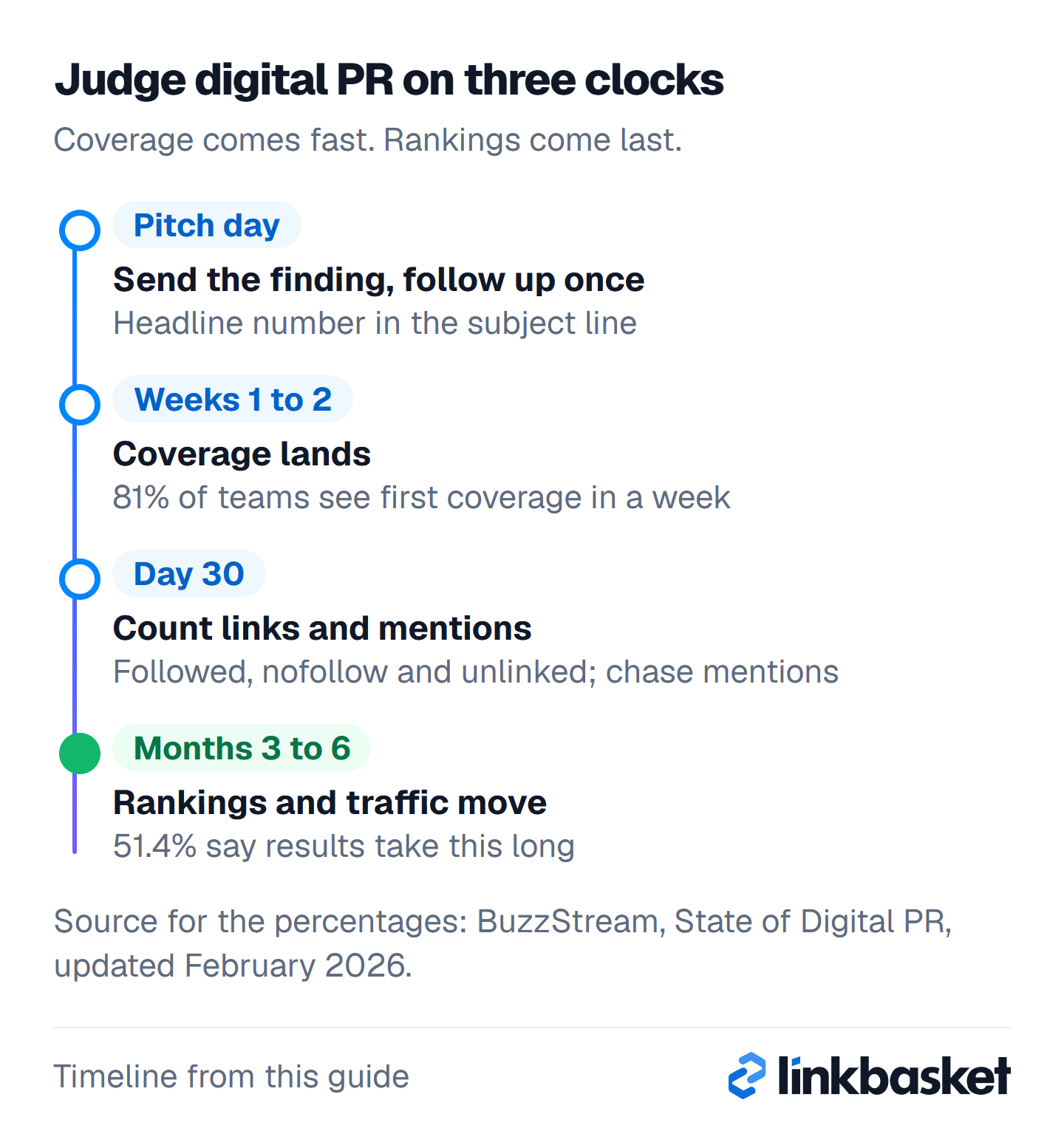
Look at the gap between the second and last dots. In practice, coverage arrives in days and rankings months later. Don't judge a campaign at week two.
Track these per campaign:
- Coverage count, split by outlet tier
- Followed links, nofollow links and unlinked mentions
- Referring domains that are new to your site
- Cost per link: campaign cost divided by followed links
- Rankings of the pages you care about at 90 and 180 days
For benchmarks, the same BuzzStream report found 51.4% of practitioners say measurable results take 3 to 6 months. It also found 39.2% don't know their cost per link at all. Among those who did, $300 to $500 was the most common band, picked by 19.6%.
To confirm each link is live and followed, use the free tools in our walkthrough on how to check backlinks to your site. Then chase unlinked mentions with one polite email asking the writer to add the source link. Honestly, this is the cheapest link in the whole plan.
Worked example: a hypothetical digital PR quarter
Every number here is hypothetical. Say you run a UK renters' insurance comparison site with $18,000 for one quarter, or $6,000 a month.
- Month 1: $9,000 on a data study, a survey of 2,000 renters split across 12 cities. The media list has 120 journalists: 40 national, 50 regional and 30 trade.
- Month 2: pitching. Say 14 outlets cover it, giving 9 followed links, 3 nofollow links and 2 unlinked mentions. One reclaim email works, so followed links reach 10.
- Month 3: $9,000 on reactive PR and expert commentary. Out of 30 pitches, say 8 turn into coverage and 6 carry links.
That's 16 followed links for $18,000, or $1,125 each, almost double BuzzStream's $597 average. Bad result? Honestly, not by default. If 10 of those links sit on national news sites, no price list would sell them to you. But if the goal was links to the 12 city landing pages, this plan missed, because most coverage linked to the study page and the homepage.
In practice, the fix for quarter two is cheap: add internal links from the study page to each city page, and move 40% of spend to placements aimed at those pages.
How do you run a digital PR audit?
A digital PR audit reviews the last 12 months of campaigns to find what earned links, what didn't and why, so next quarter's strategy funds the angles that work. Run one every 6 months, or before you hire an agency.
- List every campaign: angle, total cost, launch date.
- Count coverage, followed links, nofollow links and unlinked mentions for each.
- Work out cost per followed link for each campaign.
- Confirm the links are still live and the linked pages still load.
- Note where links point: homepage, campaign page or money pages.
- Score each angle on links per $1,000 spent.
- Work out the hit rate: pieces of coverage divided by journalists pitched.
- Keep the 1 or 2 best angles. Cut the rest, even the one your CEO liked.
Then turn findings into changes:
| Digital PR audit finding | What it means | Change to the strategy |
|---|---|---|
| Hit rate under 2% | Wrong list or weak angle | Rebuild the list; test the angle on 20 writers first |
| Links mostly to the homepage | No path from coverage to money pages | Add internal links from campaign pages |
| Lots of coverage, few links | Writers cite you without linking | Host the full data on a linkable page; chase mentions |
| Cost per link above $1,200 | Angle too costly for its return | Shift budget to expert commentary or reactive PR |
| Links vanishing within months | Coverage on syndicated or short-lived pages | Favour outlets with stable archives |
The 2% hit rate and the $1,200 line (about twice BuzzStream's average) are our rules of thumb, not industry figures.
Which edge cases change a digital PR strategy?
Six situations change the plan more than budget does:
- Health, finance or legal niches: journalists need credentialed sources. Expert commentary beats stunts.
- B2B with a dull product: anonymised data from your own platform is the story.
- A domain under 6 months old: PR links help the domain, but inner pages still need links. Pair PR with placements.
- A local business: national PR rarely fits. Our local link building guide covers what does.
- An in-house team of one: run reactive PR and expert commentary. Data studies need more hands than one person has.
- Bad news about your brand: pause pitching until it passes.
Should you hire a digital PR agency, or skip PR for now?
Hire a digital PR agency when you need a hero campaign, national press contacts and design work you can't staff, and your budget clears one average monthly contract: $5,458 in BuzzStream's June 2026 survey.
Don't use PR, at least for now, when:
- a money page needs links next month, because PR is slow and uncertain;
- you have no data, no expert and no story;
- you can't wait 3 to 6 months to see results.
In those cases, placements on relevant sites usually fit better, through guest posting on niche sites for example. Be clear-eyed about the trade. Google's spam policies treat links bought to manipulate rankings as link spam, so no paid link is risk-free. When you buy one anyway, don't skip these checks:
- An on-topic site with real organic traffic.
- An editorial page written for readers.
- A natural anchor: brand, URL or plain phrase.
- A sponsored tag, where the publisher adds one.
- Not a link farm selling posts on every topic.
LinkBasket checks each live link weekly for 12 months and restores, moves or refunds it if it's removed.
FAQ
How long does a digital PR campaign take?
When you plan the calendar, expect 2 to 6 weeks to build a data campaign and about a week to see first coverage after pitching. Ranking changes usually take 3 to 6 months. Reactive PR moves faster, often within hours.
How much should a digital PR strategy cost?
BuzzStream's June 2026 survey put the average monthly contract at $5,458 and the average cost per link at $597. In-house teams pay mostly in staff time. Budget for at least one full quarter before judging results.
Can you run digital PR in-house?
Yes, if one person can own the media list and reply to news fast, and a subject specialist will give quotes. In-house teams often start with reactive PR and expert commentary, then add a data study once a year.
Do digital PR links help rankings?
They can. A journalist chose to cite you, which is not what Google's link spam policy targets, but most of these links point to your homepage or a campaign page. Add internal links from those pages so the authority reaches the pages that earn revenue.
Next step: put your digital PR strategy to work
Start with your audit, then pick one tactic for next quarter. If you'd rather hand it off, see how our managed digital PR service works. For pages that need links on a deadline, browse publisher sites in our inventory with a free account, and read how to plan a link building campaign from goal to tracking sheet. More tactics by site type sit in our guide to link building strategies.