A link building campaign is a time-boxed push to earn or place a set number of backlinks on chosen pages, with a fixed budget, a tactic, an anchor plan and a tracking sheet. Plan it in seven steps: goal, target pages, budget, tactic, anchors, tracking and timeline. Then run it for 90 days and judge it against the goal you wrote down on day 1, not against whatever happened to move.
Last updated: November 9, 2026
What is a link building campaign?
A link building campaign is a project with a start date, an end date and a numeric goal, such as 12 new referring domains to 3 category pages in 90 days. Ongoing link building has no finish line. A campaign does.
Why bother with the box? It forces choices. You pick pages, you pick a tactic, and at day 90 you can say whether the money worked. Open-ended link building tends to drift toward whatever is easiest to get, which is rarely what your revenue pages need.
Here are the seven decisions, in order. Don't skip one: write each answer down before you buy or pitch anything.
- Goal A number, such as 11 referring domains by day 90.
- Target pages 3 to 5 pages ranking in positions 5 to 20.
- Budget Links needed times price per link, plus a 15% buffer.
- Tactic One primary tactic, one secondary at most.
- Anchor plan Mostly branded, with exact match kept rare.
- Tracking sheet One row per link, checked once it's live.
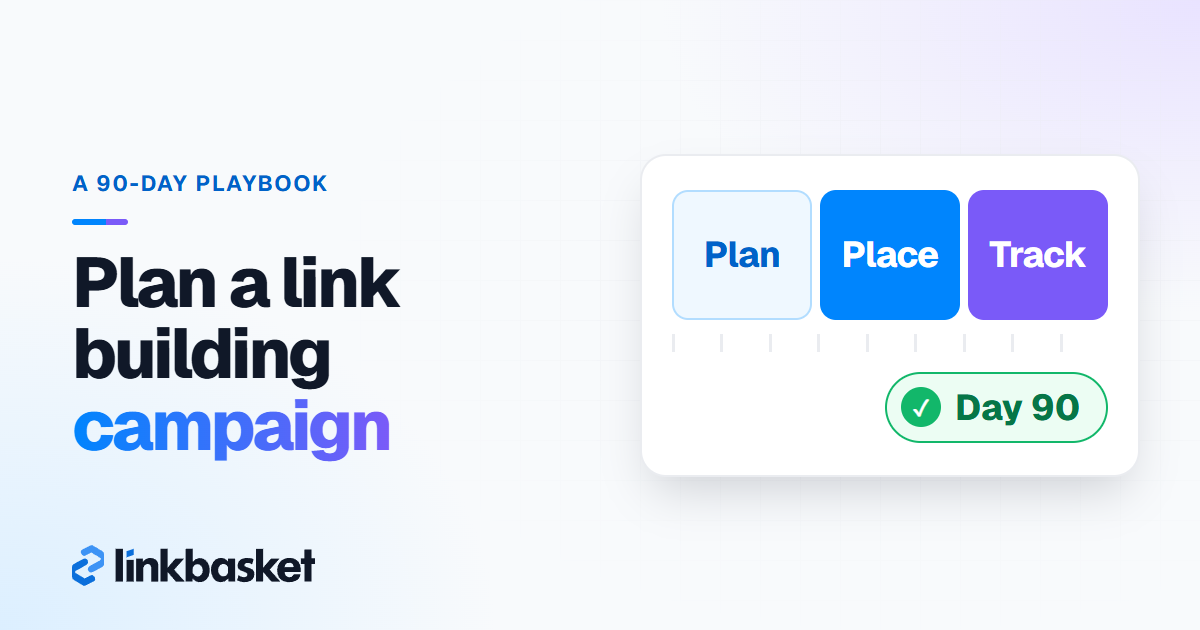
- 90-day timeline Plan, place, then check and compare.
How do you set a link building campaign goal?
Set a link building campaign goal by measuring the referring-domain gap between your target pages and the pages that outrank them, then aiming to close part of it in 90 days. Make it a number you can count.
- Search your target keyword and note the top 5 results.
- Count referring domains to each ranking URL in Ahrefs, Semrush or a similar tool.
- Compare with your page. Say the top 5 average 30 and you have 8; the gap is 22.
- Aim to close a third to half of it in one campaign. Here that's 8 to 11 links.
Write the goal as one line: "11 new referring domains to /running-shoes/ by March 31." Don't use "more authority" as a goal. You can't count it.
Which pages should a link building campaign target?
Target pages that already rank in positions 5 to 20, earn revenue, and have solid content. Links push pages that are close; they rarely rescue weak ones.
- Commercial pages near page one: category, product, service or feature pages.
- Linkable support pages: guides or tools that pass authority to money pages through internal links.
- Not: thin pages, pages with on-page problems, or pages you plan to rewrite next month.
Three to five target pages is plenty for one SEO backlink campaign. Most people spread 10 links across 30 pages, and then none of them moves.
How much budget does a link building campaign need?
A link building campaign needs enough budget to close the gap you set, at the going price of your chosen tactic, plus 10 to 20% for links that fall through. Work it out backwards from the goal.
Price benchmarks help, and we checked these in November 2026. BuzzStream's digital PR cost survey, updated June 12, 2026 and drawn from about 70 agency leaders and freelancers, put guest posting at a $150 weighted midpoint per link and digital PR at $597 on average. Outreach you run yourself costs time instead: say 10 hours per earned link at $40 an hour, and that's $400.
So for an 11-link goal:
- Guest posts at $150 each: $1,650, plus 15% buffer, about $1,900.
- Digital PR at $597: about $6,600, with far less control over which pages get the links.
- In-house outreach at $400: $4,400 of staff time.
On LinkBasket, each publisher sets one fixed price per site, shown before you pay; our page on how publishers price placements explains what drives the spread. For a wider look at costs, see how much link building costs.
Which tactic fits your link building campaign?
The right tactic depends on three things: your budget, your deadline and whether you have a story. Use the table below to pick a primary tactic, then add one secondary tactic at most.
| Budget for 90 days | Deadline | Do you have a story or data? | Primary tactic |
|---|---|---|---|
| Under $1,000 | Flexible | No | Manual outreach: resource pages, broken links, unlinked mentions |
| Under $1,000 | Flexible | Yes, an expert | Expert commentary and journalist requests |
| $1,000 to $5,000 | Fixed, under 60 days | No | Guest posts and niche edits on relevant sites |
| $1,000 to $5,000 | Flexible | Yes, data | One data study plus outreach |
| Over $5,000 | Any | Yes | Digital PR campaign plus placements on money pages |
| Any | Under 2 weeks | Any | Placements only |
The budget bands are our rules of thumb, not industry data.
Paid placements are one honest branch here, not the only one, and they come with a real caveat.
Our guide on how to build backlinks covers the earned tactics in more depth.
How do you plan anchor text for a link building campaign?
Plan anchor text for a link building campaign before you place a single link, mostly branded and natural, with exact-match keywords kept rare. Write every anchor into the sheet in advance.
Google's link best practices say "good anchor text is descriptive, reasonably concise, and relevant to the page that it's on." Its spam policies separately name "links with optimized anchor text in articles, guest posts, or press releases distributed on other sites" as link spam. So the target is anchors a real editor might write.
A mix we suggest as a starting point for 11 links:
| Anchor type | Example | Share | Links out of 11 |
|---|---|---|---|
| Branded | "Stride Running Co" | 40% | 4 to 5 |
| Bare URL | "striderunning.com" | 15% | 2 |
| Partial match | "a guide to trail running shoes" | 30% | 3 |
| Generic | "this sizing chart" | 10% | 1 |
| Exact match | "running shoes" | 0 to 10% | 0 to 1 |
The brand is invented and the split is our rule of thumb; Google publishes no ratio. When you're unsure, go branded. Don't trust a seller who pushes exact match on every order.
What should a link building campaign tracking sheet include?
A link building campaign tracking sheet needs one row per link and columns for the site, the target page, the anchor, cost, status and the date checked live. If it isn't in the sheet, it didn't happen. Skip the sheet and by day 60 you won't know which anchor went where.
Columns we'd use:
- Linking domain
- Linking page URL, once live
- Target page on your site
- Planned anchor and actual anchor
- Tactic: guest post, niche edit, outreach, PR
- Link attribute: dofollow, nofollow, sponsored
- Cost, including writing
- Status: pitched, accepted, live, rejected
- Date live and date of last check
- Indexed: yes or no
- Notes, including the site's DR and organic traffic when ordered
Check every live link at least monthly. Our walkthrough on how to check backlinks shows the free tools.
What does a link building campaign timeline look like?
A 90-day link building campaign timeline runs in three blocks of about 30 days: plan and prospect, place and pitch, then track and adjust. Links land unevenly, so build slack into the last block.
- Days 1 to 14: goal, pages, budget, anchor plan, sheet. Shortlist 2 to 3 times as many sites as you need.
- Days 15 to 45: order placements or send outreach. Each LinkBasket listing shows its typical delivery time, so plan around it.
- Days 46 to 75: second wave for links that fell through. Chase replies once.
- Days 76 to 90: check every link, confirm indexing, compare rankings with day 1.
When you're on a tight deadline, delivery time decides which sites make the first wave.
Hypothetical 90-day link building campaign
Every number here is hypothetical. Say you run an online running shop, and your trail-shoe category ranks at position 11 for its main term. The top 5 average 30 referring domains; you have 8.
- Goal: 11 new referring domains to 3 category pages by day 90.
- Budget: $2,400. That's $1,800 for 10 placements at an average $180, plus $600 of staff time for outreach.
- Tactic mix: 8 guest posts and 2 niche edits on running, outdoor and fitness sites; outreach to 40 resource pages.
- Anchors: 4 branded, 2 bare URL, 3 partial match, 1 generic, 1 exact match.
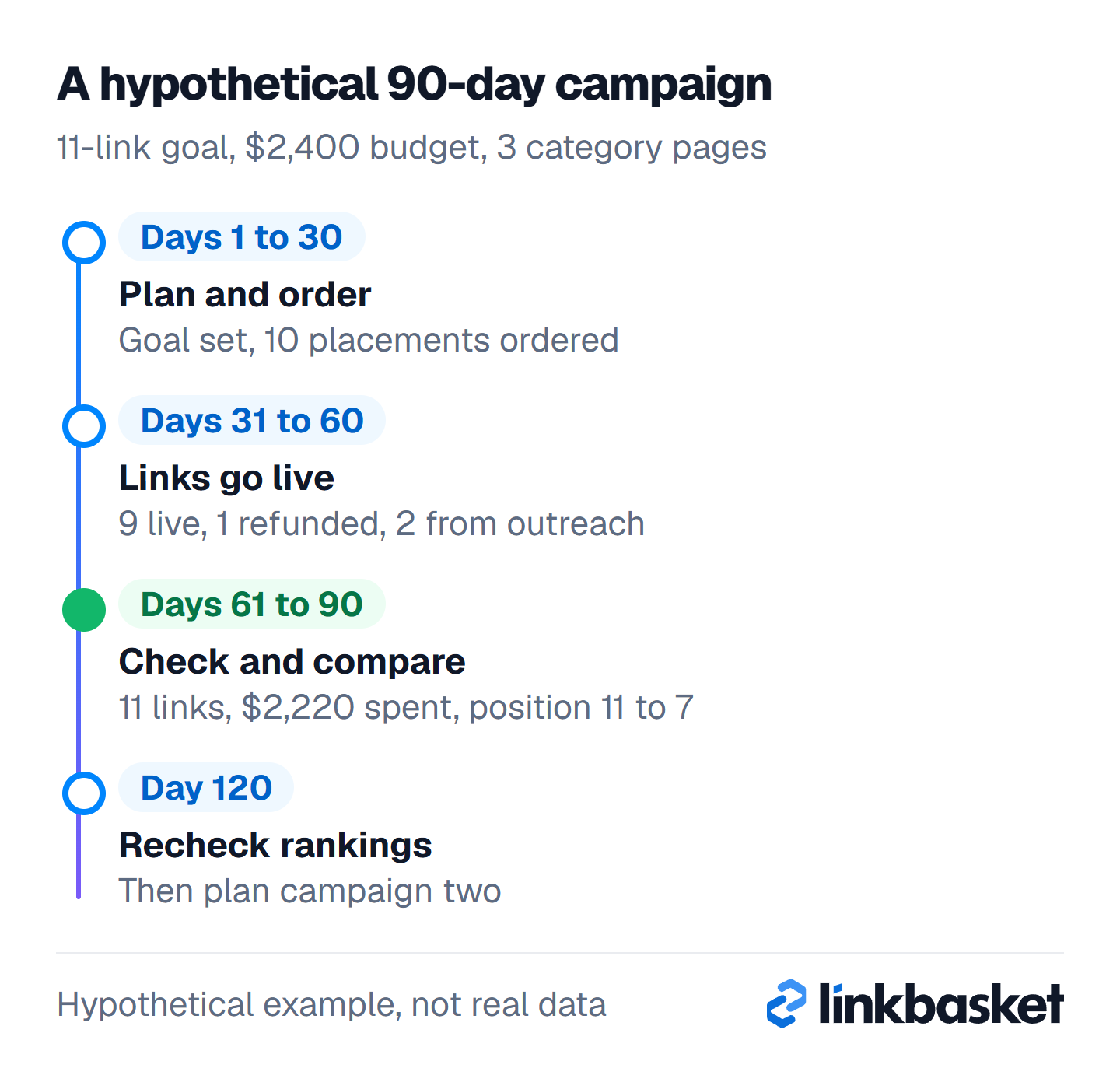
Read the timeline top to bottom. In practice, the spend happens early, but the result only shows in the last block and the day-120 recheck.
Say it plays out like this. 9 of 10 placements go live; 1 publisher rejects the order, and the money returns to the wallet. Outreach to 40 resource pages lands 2 links, a 5% hit rate. That's 11 links, the goal met, at $2,220 spent. At day 90 the trail-shoe page sits at position 7.
Was it a win? On links, yes. On revenue? Honestly, too early to say. Rankings can keep moving for weeks after links land, so log a second check at day 120 before you plan campaign two.
Which edge cases change a link building campaign?
These situations change the plan more than budget does:
- A brand-new site: fewer links, more relevance. Start with 4 to 6 links and watch for indexing problems first.
- A local business: local news, chambers and sponsorships beat national blogs, as our local link building guide explains.
- Sensitive niches: some publishers refuse finance, health or gambling topics, and others charge extra, which the site page discloses.
- A recent manual action: stop. Fix the cause and clean up before you build anything.
- Seasonal pages: start 90 days before the peak, not 2 weeks before.
When should you skip or outsource a link building campaign?
Hire a link building specialist when you need 30 or more links in a quarter, work across several markets, or can't spare 5 to 10 hours a week to run the sheet yourself.
Most people skip this check. Run a campaign only when you can tick every box:
- Your target pages have solid content and no technical problems.
- Search Console shows no manual action for unnatural links.
- You can name the 3 to 5 pages that need links.
- Your goal fits on one line, with a number and a date.
- The tracking sheet exists before the first order or pitch.
If a box stays empty, fix that first. In practice, links poured onto a broken page are money you won't see again.
FAQ
How many links should a link building campaign build?
Enough to close part of the referring-domain gap between your page and the top 5 results. For many small sites that's 5 to 15 links per page over a quarter. More isn't better if relevance drops.
How long does a link building campaign take to show results?
Plan for 90 days to build, then another 4 to 8 weeks for rankings to settle. Some pages move within a month; others need a second campaign.
Should a link building campaign use only one tactic?
Use one primary tactic and one secondary at most. When you run five at once, you can't tell which one worked.
How is an SEO backlink campaign different from digital PR?
An SEO backlink campaign targets specific pages with planned anchors. Digital PR chases coverage for a story and usually links to your homepage or a campaign page. Our guide to building a digital PR strategy covers the PR route.
Next step: launch your first link building campaign
Write your one-line goal, then pick sites. Our page on how to buy backlinks on relevant publisher sites walks through ordering, and you can browse the link marketplace inventory with a free account, no card needed. For niche edits on existing articles, see our niche edit service. Choosing tactics by site type? Read our guide to link building strategies.