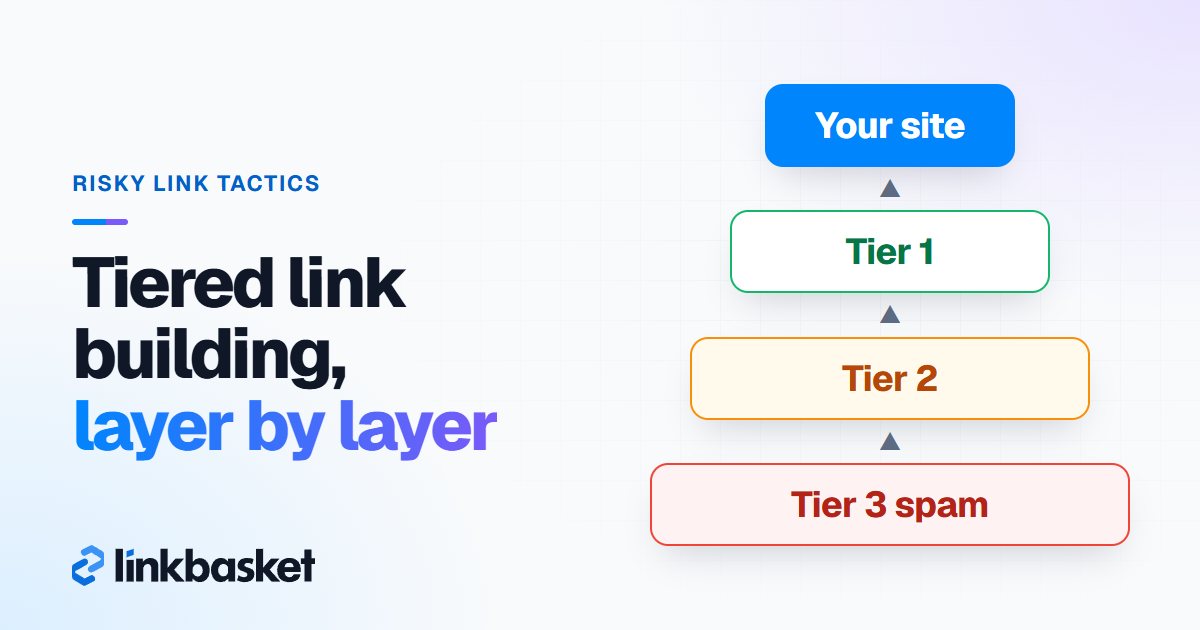
Tiered link building is a scheme where you build links to your links: tier 1 links point at your site, tier 2 links point at the tier 1 pages, and tier 3 links point at tier 2. The tier 1 layer can be legitimate. The lower tiers are almost always automated spam.
Last updated: November 9, 2026
The idea sounds clever. Boost the pages that link to you, and they pass more value on. In practice, the lower tiers add risk and very little else, and when you trace where the links actually sit, you find empty blogs, spun articles and comment sections that no human has read in years. There's one part of the idea worth keeping, and we'll get to it.
What is tiered link building?
Tiered link building is a layered link scheme where each layer of backlinks exists to strengthen the layer above it, with your money site at the top. It's sometimes called a link pyramid.
Picture three rings around your site. The inner ring is a small number of links that point straight at you. The middle ring is a larger set of links that point at those inner links. The outer ring is a huge number of cheap links pointing at the middle ring. Sellers usually price it by volume: 10 tier 1 links, 100 tier 2, 1,000 or more tier 3.
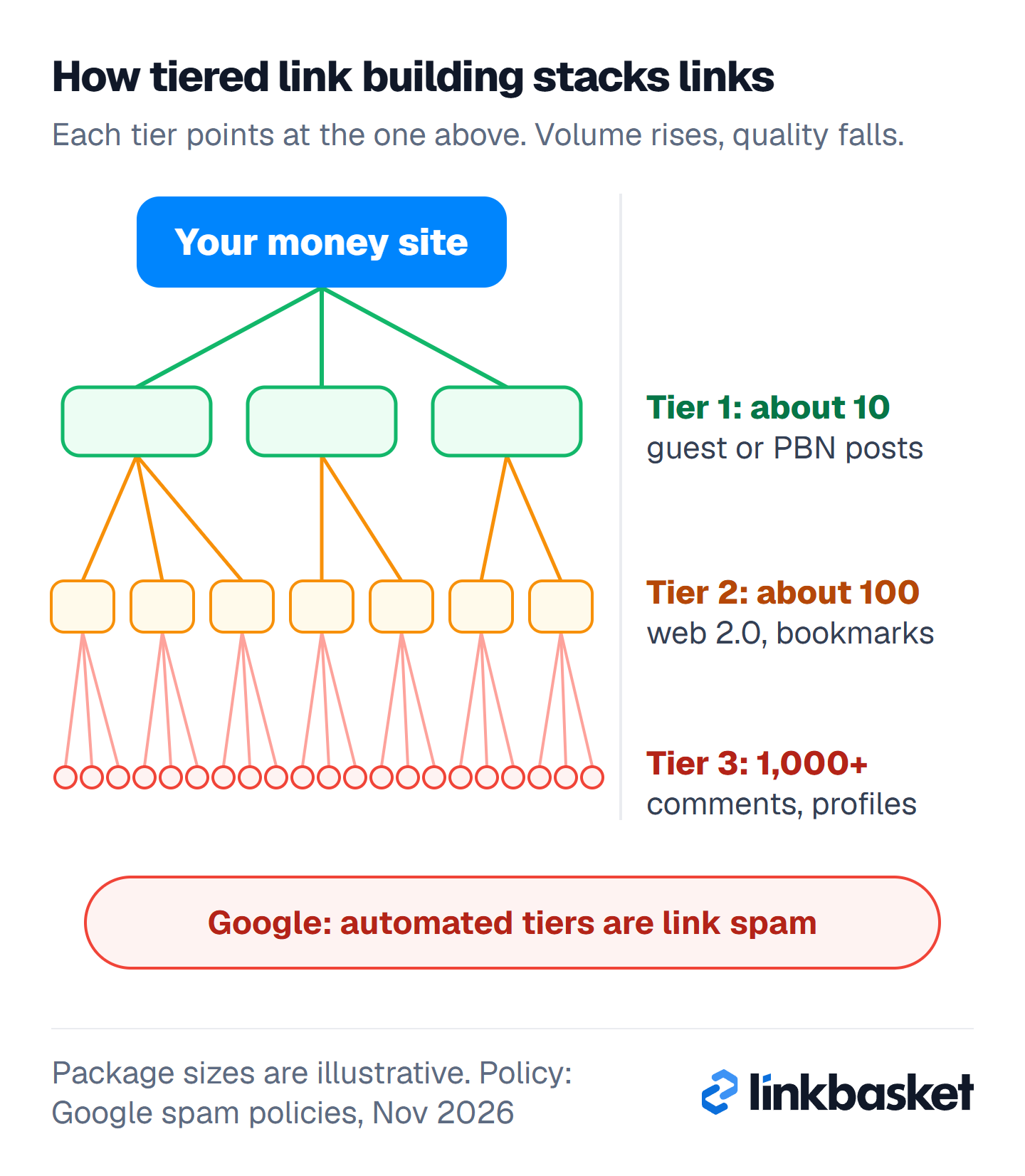
Read the diagram from the bottom up. Each row points at the row above, and the rows get bigger and cheaper as they go down.
How do tier 1, tier 2 and tier 3 backlinks work?
Tier 1, tier 2 and tier 3 backlinks work as a chain: each tier sends links at the tier above, so any value it has flows up toward your site. Here is what each link building tier usually contains:
- Tier 1 backlinks. Links that point straight at your money site. In the better packages these are guest posts or niche edits. In aggressive ones they're PBN posts or web 2.0 blogs.
- Tier 2 backlinks. Links that point at your tier 1 pages. Usually web 2.0 blogs, article directories, social bookmarks or spun posts.
- Tier 3 backlinks. Links that point at tier 2. Almost always automated: blog comments, forum profiles, wiki spam and pages built by link software in the thousands.
Notice the quality drops as the volume rises. By tier 3, nobody writes anything by hand. Software does it all.
What do "aggressive tier 1 backlinks" mean?
Aggressive tier 1 backlinks are direct links to your site from sources built to pass ranking credit, such as PBN posts, with exact-match anchors. The word "aggressive" is the seller telling you the risk is high.
Don't trust the label. When a seller uses that phrase, ask three questions. Who owns the site? Does it get organic traffic? Who chose the anchor? If the answers are "us", "not much" and "you", you're looking at a network link. Our pillar guide to SEO PBN backlinks explains what that means for risk.
Why are tier 2 and tier 3 backlinks spam?
Tier 2 and tier 3 backlinks are spam because they exist only to push ranking signals up the chain. Nobody reads them, nobody chose to link on merit, and most are made by software. That's the textbook case Google's policies describe.
We read the Google Search Central spam policies on November 9, 2026. Google defines link spam as creating links "primarily for the purpose of manipulating search rankings." Its examples include using automated programs or services to create links, and creating low-value content mainly to manipulate linking and ranking signals. Tier 2 and tier 3 tick both boxes.
Google added three more policies in March 2024, alongside a core update. Scaled content abuse, generating many pages mainly to manipulate rankings, describes the spun tier 2 blogs. Expired domain abuse covers the expired domains many tier 1 networks run on. Site reputation abuse, which Google now calls its site reputation policy after an August 2026 update, deals with third-party pages on trusted host sites, and rarely applies to tiers.
Does Google penalise tiered link building?
Google mostly neutralises tiered link building rather than penalising it, which means the links stop counting without warning. A manual action is possible when the pattern is large, but silent devaluation is the common result.
Google's December 14, 2022 link spam update post says its SpamBrain system "can now detect both sites buying links, and sites used for the purpose of passing outgoing links." It adds that credit passed by unnatural links is lost. A tier 2 layer is a set of sites used to pass outgoing links. That's the definition.
Then there's the side effect most people miss. It's nasty. Tier 2 and tier 3 spam points at your tier 1 page, which lives on someone else's site. If that's a guest post on a real publisher, you've just pointed thousands of spam links at their page. Some publishers notice and remove the post. Now your one good link is gone too.
The rarer outcome is a manual action. Google's Manual Actions report lists "Unnatural links to your site" for patterns of manipulative links pointing at a site. Tier 1 links aimed at your site with exact-match anchors are the likeliest trigger.
Worked example: what does a tiered package actually buy?
This worked example puts numbers on a typical tiered package. Every number here is hypothetical.
Say you own one good guest post on a DR 50 cooking blog with 20,000 monthly organic visits. A seller offers to "power it up" with 500 tier 2 links and 5,000 tier 3 links for $49.
| Scenario | Tier 2 links | Tier 3 links | Likely effect on your guest post | Risk to your site |
|---|---|---|---|---|
| Do nothing | 0 | 0 | Keeps its value | None added |
| Buy the $49 package | 500 | 5,000 | Spam links ignored, at best | Low to medium |
| Publisher spots the spam | 500 | 5,000 | Post removed, link lost | Link lost |
| Share it to your 2,000 newsletter readers | 0 | 0 | Real visits, faster discovery | None |
Look at row three. Ouch. If you've paid $150 for a good placement, a $49 add-on could get it deleted. The fourth row costs nothing and sends real readers to the page.
What is the one legitimate idea in tiered link building?
The one legitimate idea in tiered link building is that your good backlinks need to be found, indexed and read. A link on a page Google never indexes passes nothing, and a page nobody visits rarely earns more links.
So keep the goal and skip the spam. The trick is to send real signals, not fake ones. Here's how to get your existing good links discovered and cited:
- Link to the coverage from your own site. An "As featured in" or press page gives Google a crawl path to each article.
- Share it to people who care. Your newsletter, your social accounts and your team's LinkedIn posts send real visits.
- Ask the publisher for an internal link. A link from their related posts helps their readers and your page.
- Cite it in your own outreach. A mention in a respected publication makes your next pitch stronger.
- Earn links to the same page. If other writers cite the article that mentions you, that's natural tier 2, and it's fine.
What you can't do is request indexing for someone else's page. Google's guide (checked November 2026) on asking Google to recrawl URLs says you must be an owner or full user of the Search Console property, that crawling can take a few days to a few weeks, and that a request doesn't guarantee inclusion. Ask the publisher to do it if the page is still missing after 3 weeks.
Tiered link building vs safer options: which wins?
Tiered link building loses to safer alternatives for any site you want to keep, because those alternatives build value at tier 1 instead of propping it up with spam. Use this decision table:
| If your situation is | And you're considering | Then do this |
|---|---|---|
| You have a few good links | Buy tier 2 backlinks to boost them | Promote them to real readers instead |
| Your tier 1 page isn't indexed | Tier 2 link building | Ask the publisher to link it internally and request indexing |
| You want more ranking credit | A tiered package | Add more strong tier 1 links on relevant sites |
| A seller offers aggressive tier 1 | Fast results | Skip it. That's a network link. |
| Your old agency built tiers | More of the same | Audit and stop. Clean up if a manual action appears. |
Keep the goal, drop the spam. Here's the difference in one view (package numbers are hypothetical):
Tiered package
- 500 tier 2 and 5,000 tier 3 links
- Automated pages nobody reads
- Can get your tier 1 post removed
- Credit neutralised by SpamBrain
Promote your tier 1 links
- Link to coverage from your press page
- Share to your newsletter and social
- Ask the publisher for an internal link
- Publisher requests indexing if it's missing
LinkBasket is our marketplace. It lists only guest posts and link insertions on publisher sites, and sells no tier 2 or tier 3 links. Be clear that a paid guest post is still a paid link under Google's policy. What lowers the risk is relevance, real traffic, an editorial site, a sponsored tag where the publisher adds one, and no link farms.
Which edge cases change tiered link building decisions?
Four edge cases change how you handle tiered link building: links you didn't order, syndicated coverage, internal linking on your own site, and spam pointed at you by someone else.
- Your guest post got syndicated. Copies on partner sites that link back to the original aren't a scheme. Leave them alone.
- You run several pages on your own site. Internal links from strong pages to weaker ones are normal site structure, not tiers.
- Someone points spam at your best links. Google mostly ignores it. Disavow only if a manual action appears.
- Your agency added "link boosting". Ask for the list. When you see web 2.0 blogs and bookmarks, that's tier 2, and it should stop.
Most tier 2 and tier 3 links come from the tactics covered in our guides to automated link building and web 2.0 backlinks.
When should you skip tiered links and call a specialist?
Call a link audit specialist if Search Console shows a manual action, if rankings fell after a spam update, or if you find thousands of tier 2 and tier 3 links in your profile. Don't use tiered link building on any site you can't afford to lose.
If an agency built tiers for you, start with these checks:
- Ask for the full list of tier 1, 2 and 3 URLs.
- Cancel any "link boosting" or "power up" add-ons.
- Check that your tier 1 posts are still live.
- Look for a manual action in Search Console.
- Disavow only if a manual action appears.
Don't use an auditor who sells link packages. That rules us out for the audit. Honestly, it should.
FAQ
What is a tier 2 backlink?
A tier 2 backlink is a link that points at a page linking to your site, rather than at your site itself. The aim is to boost the first link's strength. Bought in bulk, tier 2 backlinks are almost always low-quality automated links.
Is it safe to buy tier 2 backlinks?
No. Bulk tier 2 links match Google's examples of automated link spam. The likely result is that Google ignores them. The worse result is that a publisher removes your tier 1 post after spotting the spam.
Can tier 2 links hurt my site directly?
Rarely, because they don't point at your site, so don't panic when you find a few. The harm is indirect: they can get your tier 1 links devalued or removed, and they show a pattern if anyone reviews your links.
How do I get my backlinks indexed without tier 2 spam?
Link to the page from your own site, share it with real readers and ask the publisher to add an internal link. If it's still missing after 3 weeks, ask the publisher to request indexing in Search Console.
Next step: build stronger tier 1 links instead
To add strong tier 1 links, browse our link marketplace inventory with a free account and see each site's traffic and metrics first. Our page on how to buy backlinks on LinkBasket covers ordering. For low-risk link sources, read our guide to forum and profile backlinks, where real participation beats bulk packages.