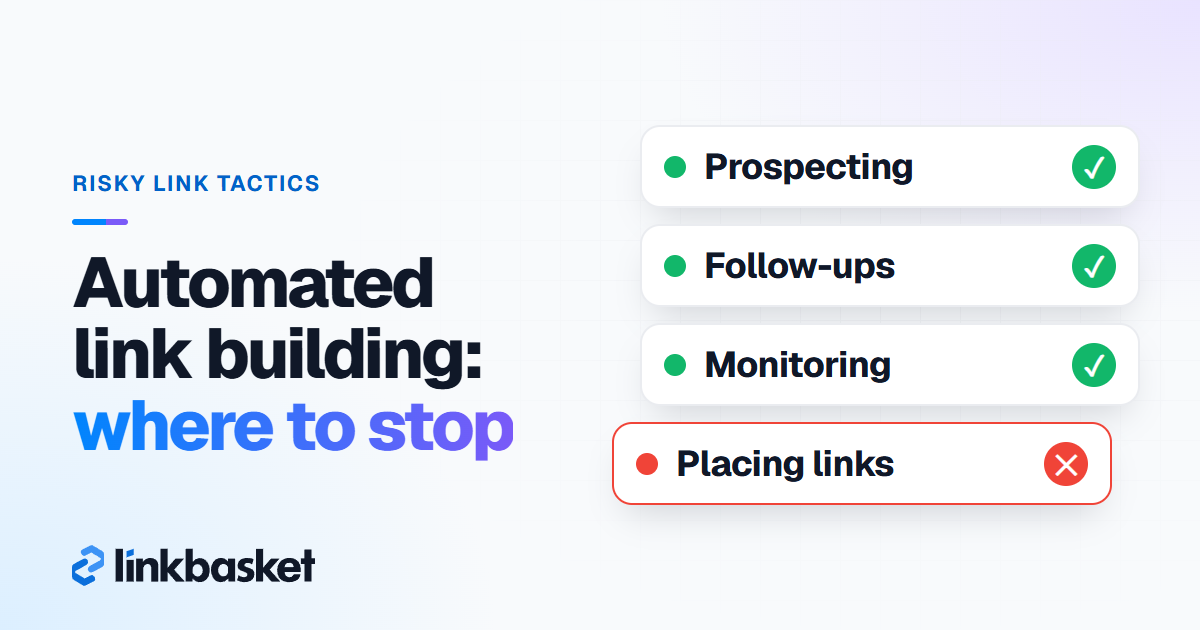
Automated link building is software that creates backlinks without a human editor, such as GSA Search Engine Ranker-type tools, auto-submitters and AI-spun article generators. Google's link spam policy names automated link creation directly. Automation that helps people find prospects, send outreach and monitor links is different, and it's fine.
Last updated: November 9, 2026
So don't frame it as "tools good" or "tools bad". Ask who places the link. When software places it, you're in spam territory. When a person decides, and software just saves them time, you're doing normal link building faster.
What is automated link building?
Automated link building means using software or a service to create links at scale, where a program, not an editor, decides that the link goes live. The buyer sets targets and anchors. The tool does the rest.
The market goes by many names: automatic backlink software, backlink automation software, auto link building, an automatic backlink generator. Underneath they sell one promise. Lots of links, little effort. Some products are desktop software you run yourself. Others are an automated link building service, where someone runs the same software for you and sends a report.
How do automated link building tools work?
Automated link building tools work by finding sites that accept links without review, creating accounts or submissions on them, and posting content that carries your link. The cycle repeats across thousands of targets.
GSA Search Engine Ranker is the best-known example. Its vendor, GSA, describes it as "the industry's most powerful and fully automated backlink builder" on its product page, checked November 2026, and says it finds new target sites automatically. Tools in this group usually:
- Search for target platforms such as blogs with open comments, forums, wikis, directories and free blog hosts.
- Register accounts, often with throwaway email addresses.
- Post text, frequently spun or AI-generated, with your link and anchor in it.
- Check which links stuck, then report a count.
Some packages add an "AI article" step that generates hundreds of pages to carry links. That moves the work from link spam into scaled content abuse as well. Don't confuse the link count in the report with links that count for ranking. They're rarely the same, and when you open a sample of 20 rows from a typical report, you'll usually find comment sections, empty profiles and pages that no longer load.
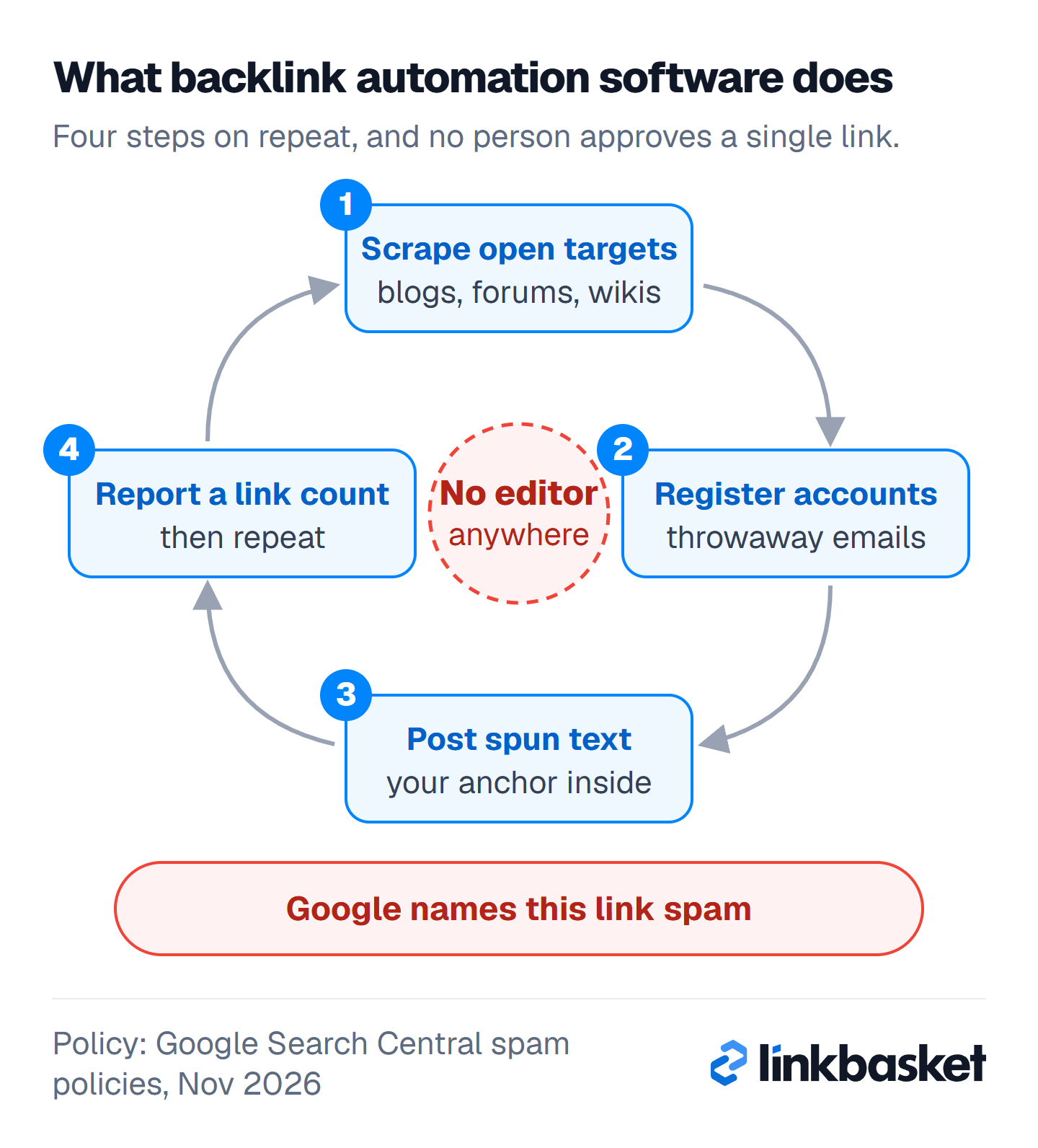
Follow the loop from step 1. Then look at the middle of it: nobody reviews a single placement, and that empty centre is what Google's policy targets.
What does Google's policy say about automated link building?
Google's policy names automated link building as link spam in plain words. The link spam section of the Google Search Central spam policies, checked November 9, 2026, lists "using automated programs or services to create links to your site" as an example.
Three more parts of the policy apply to what these tools produce:
- User-generated spam. Google's examples include spammy posts in forum threads, comment spam on blogs and spammy accounts on hosting services anyone can register for. That's where automated links land.
- Scaled content abuse. Added in March 2024, it covers generating many pages mainly to manipulate rankings, including using generative AI tools to create many pages without adding value for users.
- Expired domain abuse. Also from March 2024. Some automated services post onto expired domains rebuilt as link farms.
The fourth March 2024 addition, site reputation abuse, now called the site reputation policy after an August 2026 update, targets third-party pages on trusted hosts. It's less relevant to bulk tools.
What is the penalty risk of automatic backlink software?
The penalty risk of automatic backlink software is mostly that the links get ignored, and sometimes that your site gets a manual action for unnatural links. Neither outcome is worth the subscription. Frankly, neither is close.
Google's December 2022 link spam update post says SpamBrain can detect sites used to pass outgoing links, and that "any credit passed by these unnatural links" is lost. Automated targets are among the easiest to catch, because thousands of tool users hit the same open blogs and forums. Most of those platforms also mark user links nofollow or ugc, which Google treats as a hint not to count them.
The manual route is rarer and louder. Google's Manual Actions report lists "Unnatural links to your site" for patterns of manipulative links. Ten thousand exact-match anchors from comment spam in a month is the kind of pattern that draws a reviewer's eye. Recovery means cleanup, a disavow file and a reconsideration request that Google says can take days or weeks to review.
Which link building automation is legitimate?
Legitimate link building automation speeds up the human parts of the job (finding prospects, sending outreach and checking links) while a person still decides every placement. Google has no rule against saving time.
Prospecting. Backlink tools like Ahrefs or Semrush can export every site linking to a competitor in seconds. You then filter by traffic and topic, and a person reviews the shortlist. Search Console's Links report shows who already links to you, for free.
Outreach sequencing. Outreach platforms send your pitch and schedule polite follow-ups. BuzzStream's pricing page, checked November 2026, listed automated follow-ups from its Growth plan at $174 a month. The writer still picks each recipient and writes the pitch.
Link monitoring. Alerts tell you when links appear or disappear. Ahrefs Alerts notifies you of new and lost backlinks for any site or URL. On LinkBasket, each live link gets checked weekly for 12 months.
Our list of link building tools compares more options, and the guide to backlink management software covers monitoring in depth.
Worked example: an outreach sequence vs a backlink generator
This worked example compares legitimate outreach automation with an automatic backlink generator. Every number here is hypothetical.
Say you run a bookkeeping software company and pull 200 relevant prospects into an outreach tool. You review them by hand and send a 3-email sequence. A 5% reply rate gives 10 replies, and 4 of those become links on real finance blogs over 6 weeks.
With a backlink generator, you load your URL on Monday and wake up on Friday to a report of 10,000 links.
| Method | Links reported | Links on pages with real readers | Human review | Likely value after 6 months |
|---|---|---|---|---|
| Outreach sequence, 200 prospects | 4 | 4 | Every link | 4 working links |
| Backlink generator, one week | 10,000 | Close to 0 | None | Ignored, or a manual action |
| Automated service, $99 a month | 2,000 a month | Close to 0 | None | Ignored |
Four links look tiny next to 10,000. They're also the only ones in the table that a real person chose to place. That's the whole difference.
How do you spot an automated link building service?
You can tell an automated link building service is behind an offer when the numbers are too big, too fast and too cheap for people to have done the work. Most sellers don't say "software" on the sales page. The signs give it away:
- Volume in thousands. Packages of 1,000, 5,000 or 10,000 links. No editor team on earth places 10,000 links in a week.
- Price per thousand links. When you see a price per 1,000 links, you're buying output from a tool.
- Delivery in 24 to 72 hours. Real publishers take days to review a single article.
- A spreadsheet as proof. Thousands of URLs, mostly comment pages, profiles and wikis, with no traffic data.
- "Mixed platforms". A blend of blogs, forums, bookmarks and wikis is the target list of a link tool.
If you've seen two or more of these on one offer, skip it. The same signs show up on forum packages, which our guide to forum and profile backlinks covers in more detail.
Automated vs manual link building: what to automate?
Automate the tasks where software finds or tracks things, and keep humans on the tasks where a link gets placed or a page gets written. This decision table splits it out:
| Task | Automate? | Why |
|---|---|---|
| Finding competitor backlinks | Yes | Pure data. A person still filters the list. |
| Finding contact emails | Yes | Saves hours. Check before sending. |
| Sending follow-ups | Yes | Scheduled, polite, stops on reply |
| Writing the pitch | Draft only | AI drafts are fine if a person edits and personalises them |
| Writing linked content | No | Bulk AI pages fit Google's scaled content abuse example |
| Placing the link | No | Automated link creation is named as link spam |
| Checking live links | Yes | Alerts catch removals fast |
LinkBasket is our marketplace. It lists only guest posts and link insertions on publisher sites, where a person at the publisher publishes each one. That doesn't make paid links safe. Google's spam policies treat links bought to manipulate rankings as link spam. What lowers the risk is relevance, real traffic, an editorial site, a sponsored tag where the publisher adds one, and no link farms.
Which edge cases blur the automated link building line?
Four edge cases blur the line on automated link building: AI-written outreach, internal auto-linking, local citation tools, and old automated links in your profile.
- AI-drafted outreach. Fine, if a person edits each email. A thousand identical AI pitches is spam of a different kind, and editors delete it.
- Internal auto-linking plugins. Linking your own pages together automatically is site structure, not link spam. Check that the anchors read naturally.
- Local citation tools. Services that sync your business name, address and phone across directories are normal for local SEO. Our guide to directory and citation link building shows where the line sits.
- Old automated links from a past SEO. Most are already ignored. Act only if a manual action appears or the anchors are exact-match at scale.
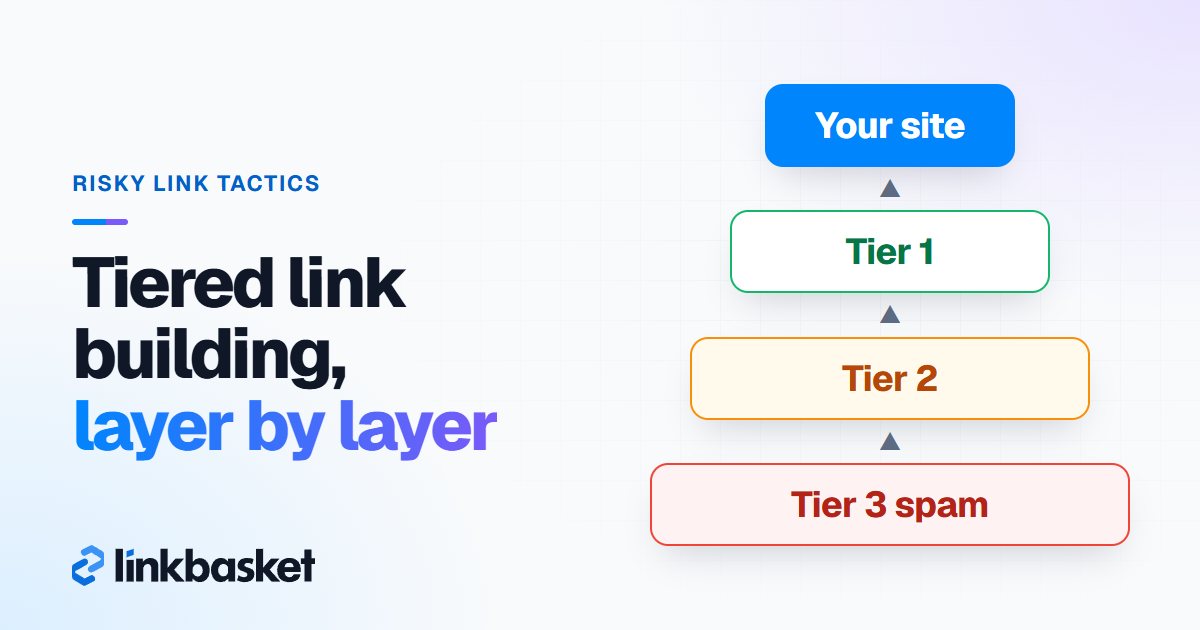
Automated tools also feed other schemes, especially the lower layers of tiered link building.
When should you avoid automated link building?
Don't use automated link building that places links for you on any site you care about, and call a specialist when a manual action or a sharp post-update drop shows up. Those are the two clear lines.
Before you run any link tool, check these five things:
- A person approves every site before a link goes live.
- The tool finds, schedules or tracks. It never posts.
- Every outreach email gets a human edit.
- No page is generated in bulk just to carry a link.
- Alerts are on for new and lost links.
A specialist helps when you find thousands of automated links, when Search Console shows "Unnatural links to your site", or when you inherit a site with a history. Don't hire an auditor who sells links. That excludes us, honestly.
FAQ
Is there a safe automated link building service?
Not one that places links for you. Any service that creates links automatically fits Google's link spam example. Safe automation stops at prospecting, outreach scheduling and monitoring, with a person approving every placement.
Can AI build backlinks for me?
AI can help you research prospects and draft pitches. In practice that saves hours. It shouldn't publish link-carrying pages in bulk, which fits Google's scaled content abuse policy. A person should review every page and every pitch.
Do backlink generators work?
They produce link counts, not rankings. Most generated links sit on nofollow or ignored pages, and Google's SpamBrain is built to neutralise the rest. Treat the report number as noise.
Is automatic backlink software illegal?
No, it isn't illegal. It breaks Google's spam policies, so the cost shows up in search: wasted spend, ignored links and, in bad cases, a manual action.
Next step: automate the research, not the links
To place links that a person publishes, browse our link marketplace inventory with a free account, then read how to buy backlinks on LinkBasket. Our pillar guide to SEO PBN backlinks explains the risk scale across every tactic in this cluster, and the web 2.0 backlinks guide covers the free blog platforms that automated tools target most.