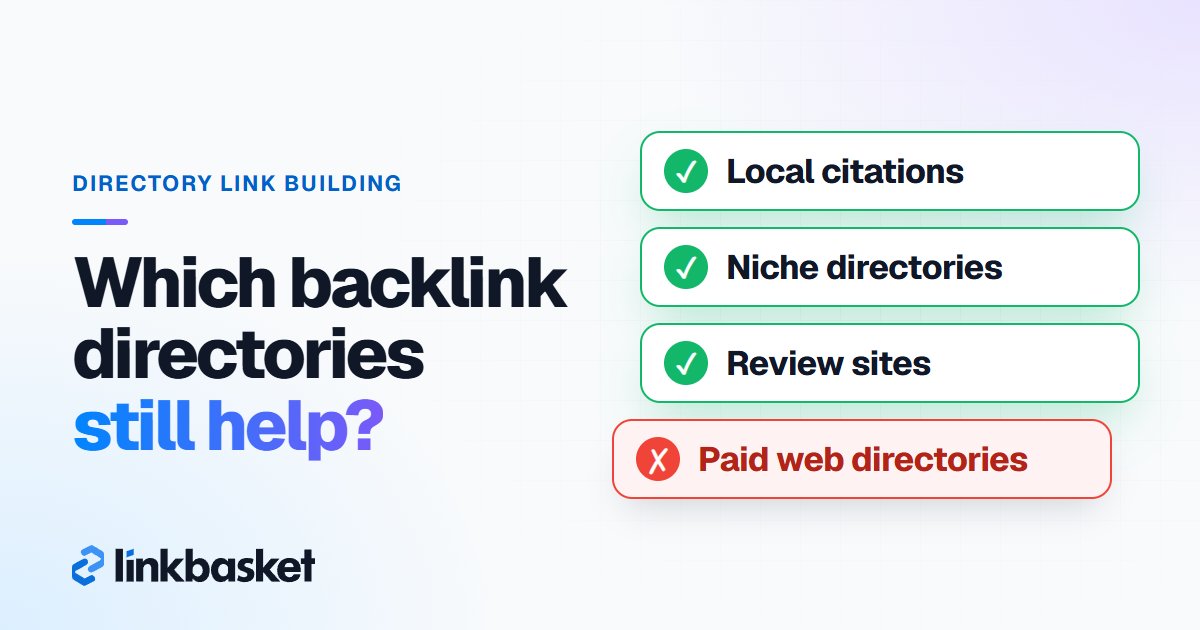
A backlink directory is a site that lists businesses or websites by category, usually with a link, and only some still help. Local citation sites, niche or industry directories and review platforms are worth it. Paid general web directories and directory networks are not, and Google's spam policies list low-quality directory links as link spam.
Last updated: November 9, 2026
What is a backlink directory?
A backlink directory is any site that organises listings of businesses or websites into categories and links to each one. The name covers very different things, which is why advice about directory backlinks contradicts itself so often.
Four kinds show up most:
- Local citation sites: map and business listings with your name, address and phone number
- Niche or industry directories: trade bodies, licensing registers, curated lists for one field
- Review platforms: sites where customers rate you
- General web directories: "add your URL" sites that accept any site in any category
The first three can help. The fourth is where directory link building got its bad name. When you read a forum thread arguing that directories are dead, and another saying they still work, the two sides are usually talking about different kinds of directory without realising it.
Still helps
- Major map and business listings
- Trade association member lists
- Licensing and professional registers
- Curated niche directories with traffic
- Review sites your buyers read
Skip, or it hurts
- Paid “any site, any category” directories
- Directory networks on one template
- Bulk “500 directories” packages
- Bookmark and article directories
- Categories full of casino and essay links
Which backlink directory types still help?
The backlink directory types that still help are the ones real customers or real members use: local citation sites, niche and industry directories, and review platforms. Their value is trust, accuracy and referral visits more than ranking credit.
- Local citation sites. We checked these in November 2026: Google Business Profile, Bing Places for Business (now at bing.com/forbusiness), Apple Business for Apple Maps, and Yelp, whose business page says it's free to be on Yelp.
- Niche and industry directories. Your trade association's member list, a licensing body's register, or a curated directory of tools for one profession. A link here is relevant by definition.
- Review platforms. Clutch for B2B service firms and Trustpilot for consumer brands, both live when we checked. Buyers read them before they call.
Honestly, many of these links are nofollow, and that's fine. Check each one with our guide to checking dofollow links, and count nofollow listings as visibility, not authority.
Which directories hurt your backlink profile?
Directories hurt your backlink profile when they exist to sell links rather than to help anyone find a business. Google's spam policies, checked November 2026, list "low-quality directory or bookmark site links" as a form of link spam.
Signs you're looking at one:
- It accepts any site in any category for a one-off fee, often sold as a "permanent dofollow listing."
- Categories mix casino, CBD, essay writing and plumbing on the same page.
- Nobody searches for anything on it; it has no organic traffic of its own.
- The same template, prices and owner details appear across dozens of "different" directories. That's a directory network.
- It offers "submit to 500 directories" packages. Google's policies also list automated link creation as link spam.
Most people meet these directories through a cheap package: "100 directory submissions for $30." Skip the package. When you check the delivery report, you'll typically find a spreadsheet of URLs, many of them pending approval forever, some on domains that later lapse, and almost none that a customer would ever open. In practice, you're paying someone to fill in forms on sites nobody reads.
What is citation link building?
Citation link building is listing your business's name, address and phone number on trusted local and industry sites, so search engines and customers find the same details everywhere. A citation is the mention itself; the link is a bonus.
Citations matter more for accuracy than for links. Google's local ranking guide says "businesses with complete and accurate info are more likely to show up in local search results." It also counts how many websites link to your business as part of prominence. For the bigger picture of local links, from news sites to sponsorships, see our local link building guide. We won't repeat it here.
Why does NAP consistency matter for directory listings?
NAP consistency matters because your name, address and phone number should match on every directory listing, so customers and search engines never see conflicting details. Inconsistent listings send calls to old numbers and visitors to old addresses.
Google's Business Profile guidelines, checked November 2026, set the rules for your main listing:
- Your name "should reflect your business's real-world name," with no added keywords, locations or taglines.
- The address must be your real location. P.O. boxes and virtual offices aren't eligible.
- Service-area businesses without a staffed storefront should hide their address.
- Use a local phone number under your direct control where you can.
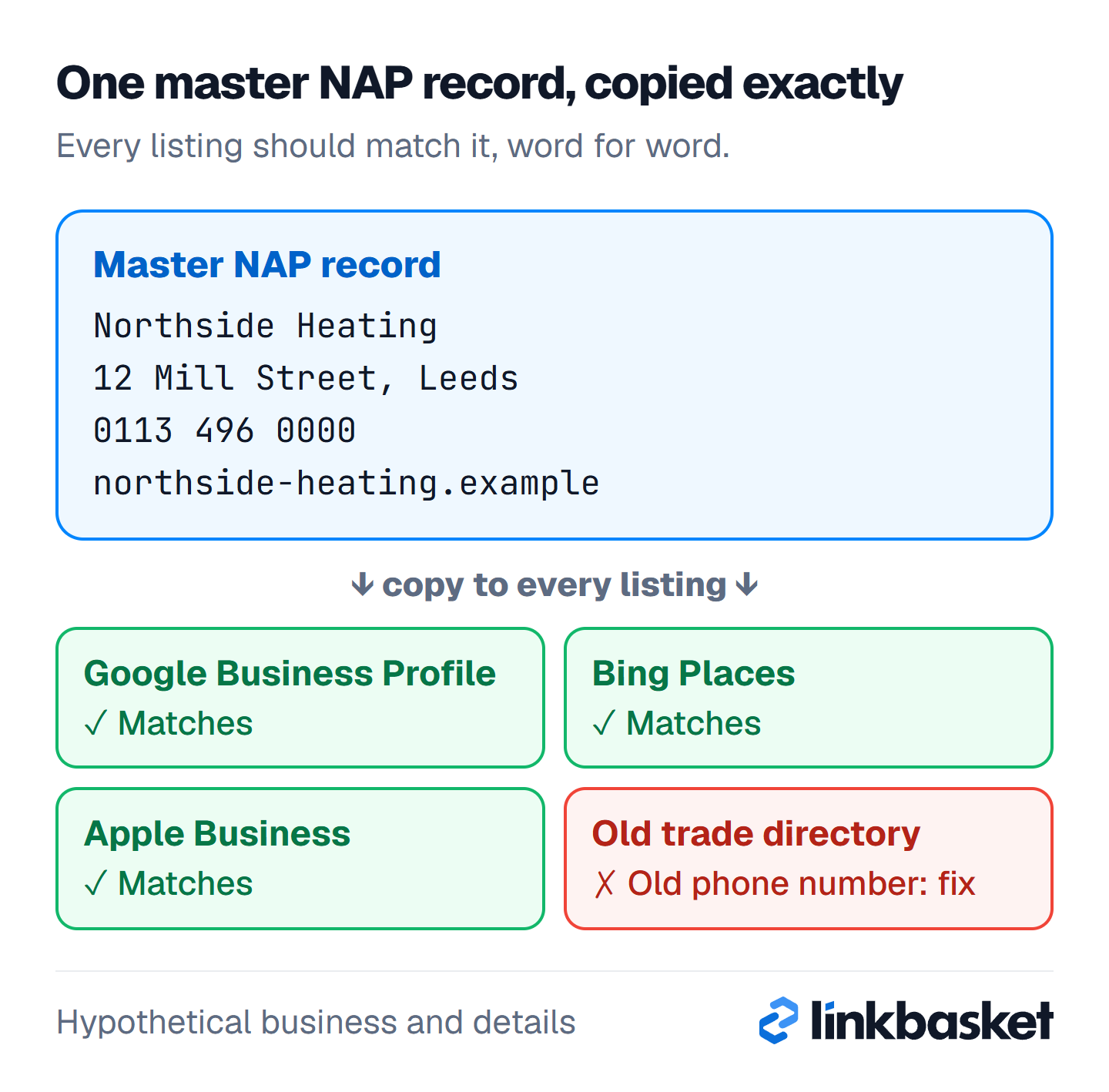
Then copy that record exactly. In the diagram, three listings match the master NAP record and one old directory still shows a former phone number; that one gets fixed first. Here's the routine we'd suggest:
- Write one master record. Exact name, address format, phone format and website URL.
- List every directory you're on. Search your old phone number and old address too.
- Fix mismatches. Start with the listings customers actually use.
- Update the master first. When you move or change number, change the record, then every listing.
Small format differences like "St" vs "Street" are a low priority. A different phone number or a former address does. Don't forget the old listings an agency created years ago; most people miss them because nobody handed over the logins, and those are exactly the ones still showing a number you stopped using in 2021.
How do you vet a backlink directory in 60 seconds?
You vet a backlink directory in 60 seconds with six quick checks, about 10 seconds each. If it fails two, walk away. Don't trust the DR the directory shows on its own sales page.
- Indexed? Search
site:directory.com. Few pages indexed means Google doesn't value it. - Focused? It covers your industry or your area, not everything.
- Used? Real businesses you recognise have listings, with recent reviews or updates.
- Selective? It checks submissions instead of taking anything with a card.
- Clean neighbours? One category page shows no casino, loan or essay links.
- Findable? It ranks or gets traffic for its own category names.
Backlink directory decision table: submit or skip?
This backlink directory decision table sums up which listings to claim, which to consider and which to skip.
| Directory type | Helps? | Typical link | Verdict |
|---|---|---|---|
| Major map and business listings | Yes, for accuracy | Often nofollow | Claim all of them |
| Trade association or licensing register | Yes | Mixed | Join if you qualify |
| Curated niche directory with traffic | Yes | Mixed | Submit, pay only if buyers use it |
| Review platform buyers use | Yes, for trust | Often nofollow | Claim, then collect reviews |
| Paid general web directory | No | Dofollow promised | Skip |
| Directory network or bulk submission | No, can harm | Mixed | Skip |
Worked example: 40 listings, 12 worth keeping
Hypothetical example, round numbers. Say you run a heating company and an old agency submitted you to 40 directories in 2019 for $200. You check them in an afternoon, about 4 hours.
Here's what you find. 14 of the 40 sites are dead. 14 more are general directories with no traffic and casino links in the categories. The remaining 12 matter: 5 local citation sites, 4 trade and supplier directories and 3 review sites. Of those 12, 7 show your old phone number.
So you fix 7 listings, ignore 28 dead or junk ones, and don't pay for any new general directory. Total cost: one afternoon. You don't need to delete the 14 junk listings either; when you can't log in to them, leave them, because Google most likely ignores them already. That's directory link building done properly: 12 accurate listings beat 40 messy ones.
Should you pay for a backlink directory listing?
Pay for a backlink directory listing only when real buyers use that directory and you'd pay for the visits alone. That's the test. Then it's advertising, and Google says paid links are fine when they're marked nofollow or sponsored.
A paid listing bought for ranking credit is different. Google's spam policies treat links bought to manipulate rankings as link spam. That applies to paid directories and to any other paid placement. LinkBasket is our marketplace, and it doesn't sell directory listings. It lists guest posts and link insertions on publisher sites, and the same honest rule applies: no paid link is risk-free. What lowers the risk is relevance, real organic traffic, editorial sites, a sponsored tag where the publisher adds one, and no link farms. A free account on our guest post and niche edit inventory shows each site's DR, traffic, link type and price before you pay, and LinkBasket checks each live link weekly for 12 months.
Which edge cases change backlink directory rules?
Five edge cases change backlink directory rules: service-area businesses, multi-location brands, moves and rebrands, regulated professions and non-English markets.
- Service-area businesses: hide your address on your profile, but keep name and phone identical everywhere.
- Multi-location brands: one listing per real location, each with its own phone number and page.
- Moves and rebrands: update every listing within a few weeks. Old details spread.
- Lawyers, doctors, accountants: official registers and bar or medical listings beat any paid directory. See link building for lawyers.
- Non-English markets: use the directories people use in that country, not an English list.
When should you call a citation specialist?
Call a citation specialist when you manage 20 or more locations, when duplicate listings keep coming back, or when your Business Profile has been suspended. For a pile of old spam directory links, read our guide on how to disavow backlinks before you act; most of those links are simply ignored.
FAQ
Are directory backlinks still worth it?
Some are. Local citations, trade directories and review platforms are worth claiming for accuracy, trust and referral visits. General web directories that accept anyone are not worth paying for.
How many directories should I submit to?
Fewer than you think. Most businesses need their main map listings, 2 to 5 industry or local directories and the review sites their buyers use. Quality and accurate details matter more than count.
What are the best directories for backlinks?
The best ones are specific to you: your trade association, your licensing body, the review sites your buyers read and the major map listings. Our list of backlink websites by type shows how to find them for your niche.
Is a backlink directory the same as a link exchange?
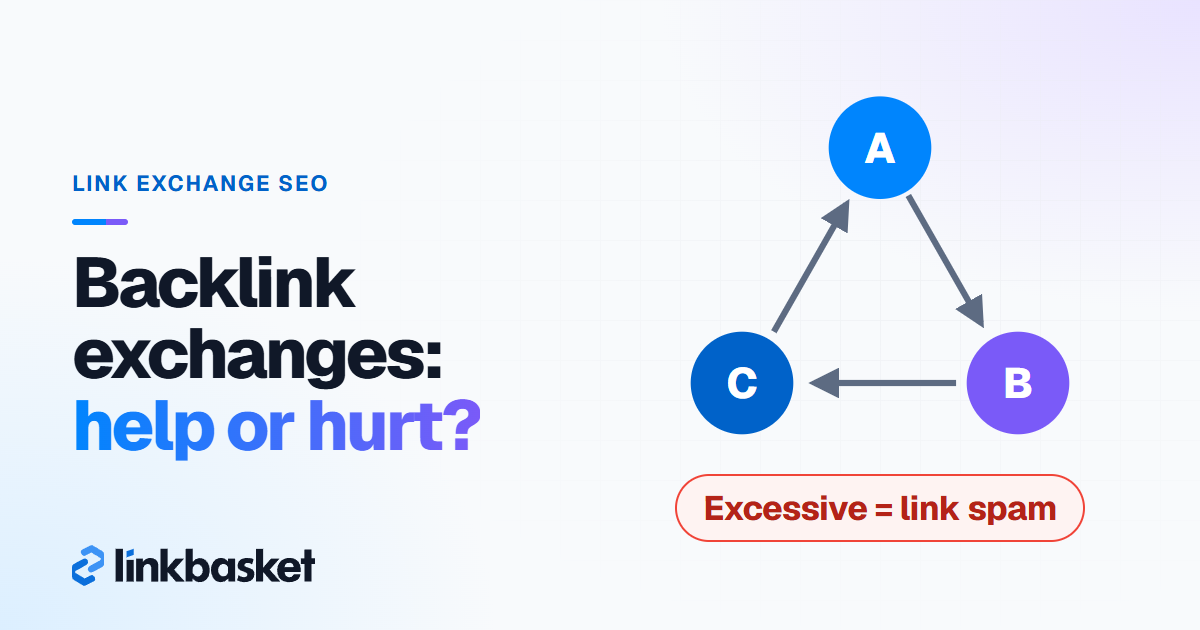
No. A directory lists you, often for free or a fee. A link exchange trades links both ways, and Google's policies name excessive swaps as link spam. Our guide to backlink exchanges covers that.
Next step: clean up your listings, then build real links
Fix your master NAP record this week and claim the listings customers use. Skip the bulk packages. Then move on to the links that carry more weight: our guide on how to get free backlinks covers earned links step by step, and our guest posting service places links in the body of relevant articles.