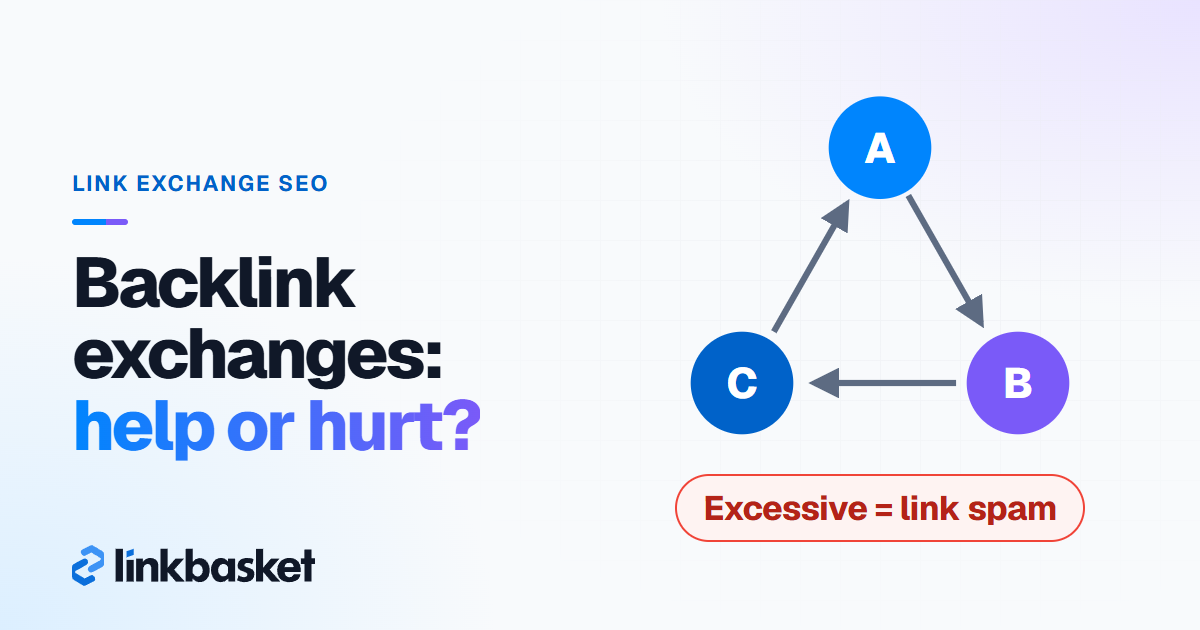
A backlink exchange is a deal between sites to link to each other, either directly, in a loop of three, or through a second site. Google's spam policies name "excessive" link exchanges as link spam. Natural reciprocal links are common and fine, but a swap made mainly for rankings is a risk, and a planned exchange network is easy to spot.
Last updated: November 9, 2026
What is a backlink exchange?
A backlink exchange is any arrangement where a link is given on the condition that a link comes back. The condition is what matters. Nothing else. Two sites that link to each other because they work together aren't trading; two sites that agree "I'll link to you if you link to me" are.
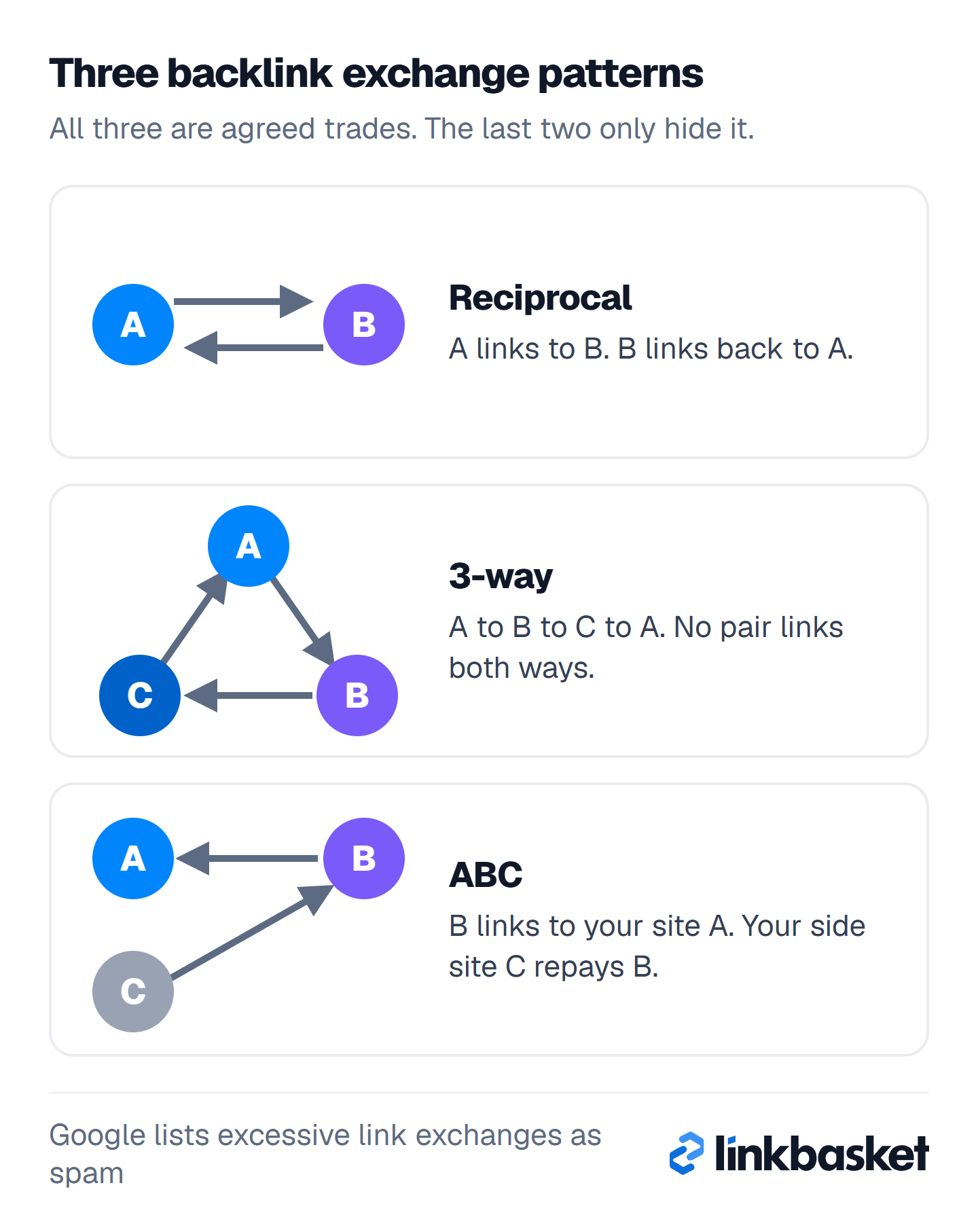
There are three common types:
- Reciprocal exchange: site A links to site B, and B links back to A.
- 3-way link exchange: A links to B, B links to C, and C links to A, so no pair links both ways.
- ABC exchange: you get a link to your main site (A) from a partner's site (B), and in return you link to the partner from a second site you own (C).
Link exchange SEO offers usually arrive by email, often from someone with "a portfolio of 40 sites in your niche." Don't reply yet. Most people who say yes never check what those 40 sites are, who owns them, or how many other businesses got the same email that morning, and that's where the trouble starts.
How do reciprocal, 3-way and ABC exchanges work?
Reciprocal, 3-way and ABC exchanges all trade links, and they differ only in how hard the trade is to see. A reciprocal swap is obvious. The other two are built to hide the pattern.
- Reciprocal: the simplest, and the one most people try first. Often a "partners" or "resources" page on each site, or a link in a guest post each way.
- 3-way: three owners rotate links so no two sites link to each other. It looks cleaner, and it's still an agreed trade.
- ABC: one party usually links from a weaker side site while taking the link on their main site. You often get the worse half of this deal. Honestly, it's rarely an accident.
Follow the arrows in each row. The 3-way and ABC rows hide the trade, but every site still gets paid back.
What does Google's spam policy say about link exchanges?
Google's spam policy lists excessive link exchanges as link spam. The link spam section of Google's spam policies, checked November 2026, includes "Excessive link exchanges ('Link to me and I'll link to you')" and partner pages made only for cross-linking.
When you read the policy, two words decide most cases:
- "Excessive." Google doesn't give a number. One swap with a real partner isn't excessive, but a page of 200 swapped links with keyword anchors, pointing at sites in a dozen unrelated niches, clearly is.
- "Exclusively." Partner pages are fine. Partner pages that exist only to trade links are not.
Google also explained how it handles this. In its December 14, 2022 link spam update post, Google said its SpamBrain system can detect sites that buy links and sites used to pass outgoing links, and that the credit those unnatural links pass is lost. So the usual outcome of a bad backlink exchange is wasted effort. Hours of emails, then nothing.
Are reciprocal links always bad for SEO?
No, reciprocal links are not always bad, and most ranking sites have some. Sites that work together, cite each other or cover the same topic link both ways all the time.
Ahrefs measured it. In a study updated in March 2020, Ahrefs looked at 140,592 domains with 10,000+ monthly visits from Google:
- 73.6% of those domains had at least some reciprocal links.
- 27.4% had 15% or more overlap between the sites they link to and the sites linking to them.
- In a second sample of 112,440 top-ranking pages, 43.7% had some reciprocal links.
Don't trust anyone who quotes these numbers as proof that swaps are safe. Ahrefs itself notes the study has survivorship bias: it only looked at sites already getting traffic, so it doesn't prove reciprocal linking is safe. What it does show is that some overlap is normal. The 15% figure is Ahrefs' cut-off for the study, not a Google limit. Remember that.
When is a link exchange natural?
A link exchange is natural when each link would exist even if the other one didn't. Ask that question about every reciprocal link you have. Most answer themselves.
Here are natural examples, the kind of reciprocal links that grow on their own when two businesses actually work together and have a reason to send readers to each other:
Natural
- A software tool lists you as an integration, and you list it on your integrations page.
- A supplier lists you as a stockist, and you name the brand on its product page.
- Two researchers cite each other's data.
- You review a tool you use, and the vendor features your quote.
Unnatural
- A dentist and a crypto blog swapping links.
- A "resources" page of 150 unrelated sites.
- An email offering 3 links for 3 links with set anchors.
- A swap group run from a shared spreadsheet.
When you built a real integration, the links came with it. If you've joined a swap group with a shared spreadsheet, you're in a network. Skip the rationalising.
How do backlink exchange networks get spotted?
Backlink exchange networks get spotted through patterns that real links rarely create. You can see many of them yourself in any backlink tool, so assume Google can too. In practice, it takes about 10 minutes.
- Overlap: many sites you link to also link to you, across unrelated niches.
- Rings: the same group of 10 or 20 sites all link to each other.
- Anchors: swapped links use exact-match keywords, because both sides asked for them.
- Timing: dozens of links appear in the same weeks, from sites that all link out to the same group.
- Footprints: shared themes, owners, hosting or "write for us" pages with the same wording.
A 3-way swap hides the direct pair, not the ring. The more sites a network adds, the clearer that shape becomes, because every new member brings the same outbound pattern, the same anchors and often the same hosting with it. Bigger is not safer.
Should you join a backlink exchange? Decision table
Whether you should join a backlink exchange depends on the relationship behind it, and this decision table covers the common cases.
| Situation | Exchange? | Verdict |
|---|---|---|
| Real partner, same topic, you'd link anyway | Reciprocal | Fine. Use natural anchors. |
| Supplier or integration listing | Reciprocal | Fine. |
| Cold email offering 3 links for 3 links | Reciprocal or 3-way | Decline. |
| Swap group or shared spreadsheet | Network | Leave it. |
| ABC offer from a "portfolio" owner | ABC | Decline. Usually the worse half for you. |
| Guest post swap with a relevant site | Reciprocal | Only if both posts stand on their own. Keep it rare. |
Worked example: checking your own overlap
Hypothetical example, round numbers. Say your site has 120 referring domains and links out to 300 domains. Say 45 domains appear on both lists. That's 15% of the sites you link to, right at Ahrefs' study cut-off, though Google has no stated limit.
Now look closer. Say 35 of the 45 are partners, suppliers and sources you'd link to anyway. The other 10 came from a swap group last year, all with exact-match anchors. Those 10 are your problem. Not the 15%. Remove your links to them. Stop trading. Then put the hours you would have spent on swap emails into the reclamation steps below, where every link you recover was already earned and nobody expects anything back.
Is link reclamation safer than a backlink exchange?
Yes, link reclamation is safer than a backlink exchange, because it recovers links you've already earned or lost: fixing broken backlinks, redirecting old URLs and turning unlinked mentions into links. It needs no trade, so it carries none of the risk. Most people skip it because it feels boring. It works.
How do you fix broken backlinks?
You fix broken backlinks by finding external links that point to pages on your site that now return a 404, then redirecting each old URL to the closest live page. Search Console's Links report shows your top linked pages, and Ahrefs Webmaster Tools, free for sites you verify as of November 2026, shows up to 1,000 backlinks at once.
Should you redirect backlinks to a new page?
Yes, redirect backlinks with a 301 when a page has moved or merged, and point each one at the closest match, not the homepage. Google's redirect docs say a permanent redirect signals that the target should be canonical, and its site-move guide says to keep redirects for at least 1 year. Our guide to 301 redirects for backlinks covers the details.
How do unlinked mentions help SEO?
Unlinked mentions help SEO once they become links: a site already names your brand, so you ask the author to add the link. It's one of the quickest wins in our guide to getting free backlinks.
Where do paid links fit compared with link exchanges?
Paid links carry their own risk, and they're not a clean substitute for a backlink exchange. Not even close. LinkBasket is our marketplace, so here's the honest version.
Google's spam policies treat links bought to manipulate rankings as link spam, just like excessive swaps. What lowers the risk of any placement is relevance, real organic traffic, editorial sites, a sponsored tag where the publisher adds one, and no link farms. LinkBasket checks each live link weekly for 12 months. Our niche edit service explains link insertions on existing articles.
Which edge cases change the backlink exchange rules?
Five edge cases change the backlink exchange rules: agency footer credits, sites you own, guest post swaps, affiliate partners and local business groups.
- Agency credits: a "site by" footer link on 50 client sites is a widely distributed footer link, which Google lists as link spam. Use nofollow or a brand-only credit.
- Your own sites: linking between 2 or 3 related sites you own is normal. Building 20 to pass links is a private network; see our guide to PBN backlinks.
- Guest post swaps: one honest swap with a relevant site is fine. A monthly swap rota is a network, so don't use one.
- Affiliates: an affiliate link is a paid relationship, so mark it
sponsoredornofollow. - Local groups: a chamber of commerce member list is not a swap. See our directory and citation guide.
When should you call a specialist about link exchanges?
Call a link audit specialist when Search Console shows a manual action for unnatural links, or when you've taken part in exchange networks at scale. Don't trust someone who sells links to judge that. Our guide on how to disavow backlinks explains when Google suggests a disavow.
FAQ
Is a backlink exchange against Google's rules?
Excessive ones are. Google's spam policies list "excessive link exchanges" as link spam. Occasional links between real partners are normal, and most ranking sites have some.
How many reciprocal links are too many?
Google gives no number. In practice, judge the reason, not the count: if each link would exist without the other, you're fine. If you agreed to the trade first, it's an exchange.
Is a 3-way link exchange safer?
No. It hides the direct pair but still forms a ring, and SpamBrain looks for sites that exist to pass links. It's still an agreed trade under Google's policy.
Should I reply to link exchange emails?
Usually not, honestly. Cold offers of "links for links" tend to come from networks with many sites, off-topic content and set anchors. Delete them. Reply only when it's a real business you'd link to anyway.
Next step: replace swaps with links you own
Run a link reclamation pass this month. Redirect broken URLs first, then turn unlinked mentions into links, because those two steps recover value you already earned before you spend a single hour chasing new links from strangers. Then see our list of backlink websites for earned link sources, or our guide to edu and gov backlinks for another tactic that gets oversold.