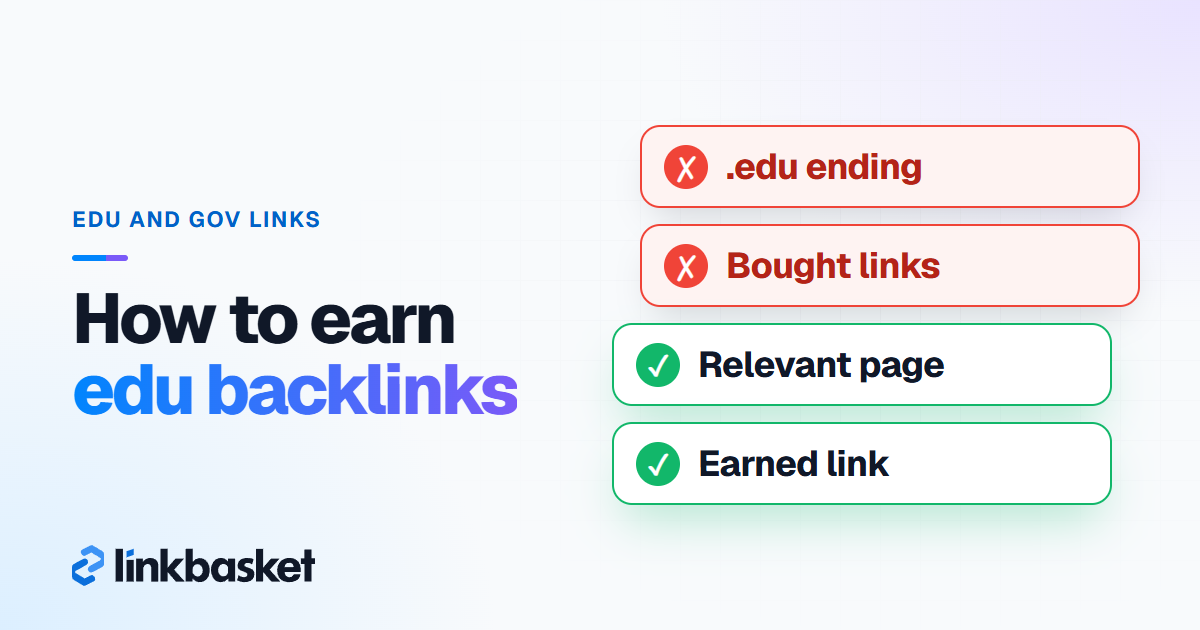
To get backlinks from edu sites, give a university something it would link to anyway: original research or data, a resource students or staff use, a job or event listing, or a real partnership. Edu and gov backlinks get no special credit from Google for their domain ending. They are worth having when they're relevant and earned, and a liability when they're bought or spammed.
Last updated: November 9, 2026
Are edu backlinks better than other backlinks?
No, edu backlinks are not better than other backlinks just because of the .edu ending, and Google has said so for years. A link from a university page is judged like any other link: by relevance, the page it sits on and how it was earned.
Here's what Google's John Mueller has said, in order:
- January 2008: in a Google Groups thread, Mueller said .edu backlinks generally don't get "additional credibility from Google."
- September 2018: he said Google ignores many links on edu sites because spammers target them, in his words "we ignore a ton of the links on those sites," as Search Engine Roundtable reported.
- July 2021: he pushed back on the idea that Google ignores a big share of edu links, and added that "People who focus on .edu links usually have bigger problems to worry about."
Put together, the message is plain. The TLD doesn't add value, and spam on edu sites gets ignored. A real link from a relevant department page is still a good link, for the same reasons a link from a good trade magazine is.
Why do edu and gov backlinks look so powerful?
Edu and gov backlinks look powerful because university and government domains are old and have huge backlink profiles, so tools show them with a very high DR. That score belongs to the whole domain, though, not to the page that links to you.
A university site can have 100,000 pages: course pages, staff profiles, student blogs, old event listings and forgotten subdomains. When you see DR 90 on a link from a student society page last edited in 2014, don't trust it; that page sits a long way from the homepage that earned the score. That's why a relevant, maintained department page beats a random corner of a big domain. Our guide on what makes a good backlink covers the checks that matter more than the domain ending.
Myth
- Edu links get extra credit from Google.
- Any edu link is a strong link.
- A high domain DR means a strong link.
- Free edu backlink lists work.
Reality
- No extra credibility for .edu, per Mueller in 2008.
- Google ignores many spammed edu links, per Mueller in 2018.
- The linking page and its topic decide the value.
- Comments, profiles and hacked pages get ignored or removed.
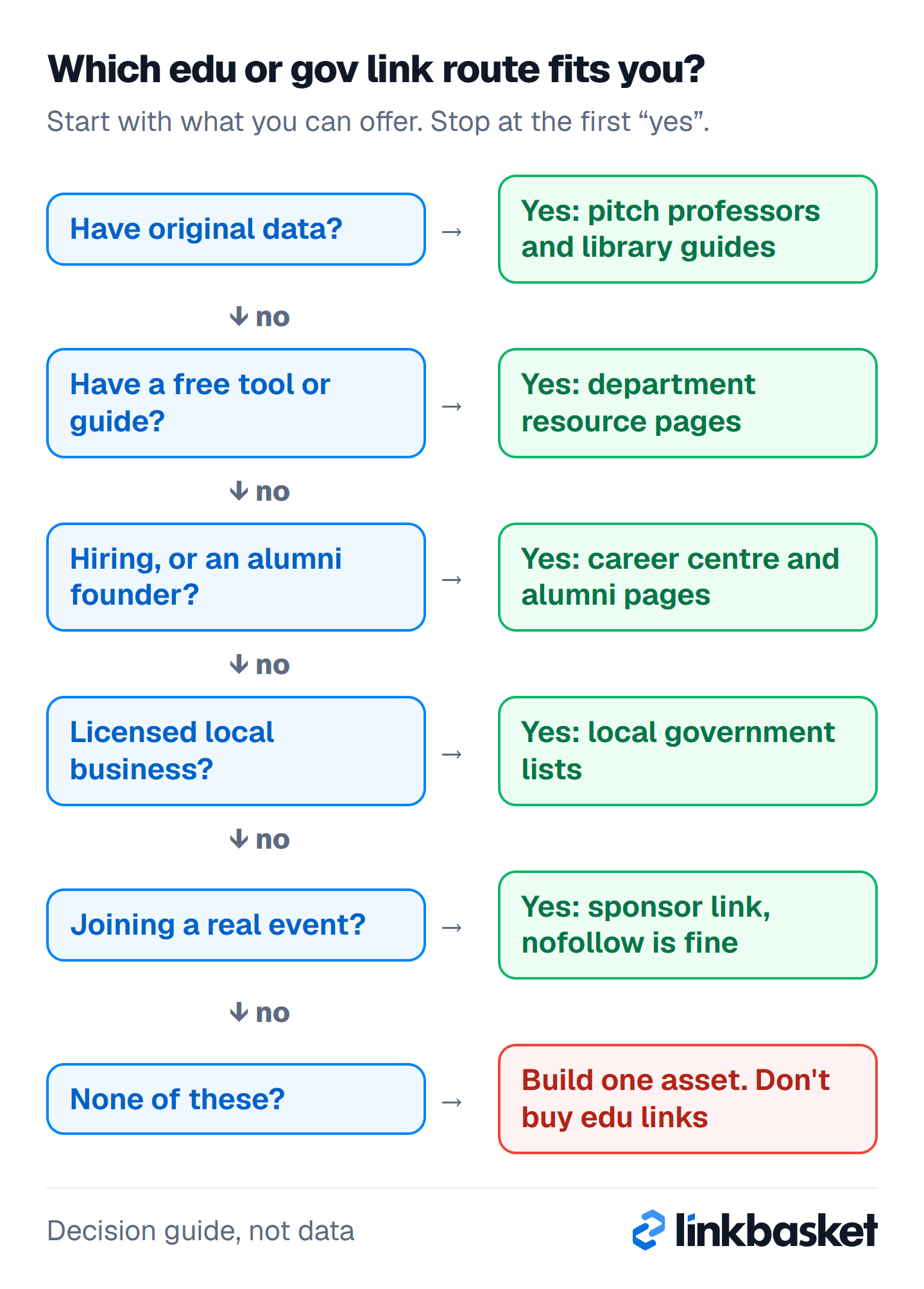
So where do real edu and gov links come from? Start with what you can offer. Follow the flow below from the top and stop at the first “yes”.
How do you get edu backlinks with research and data?
You get edu backlinks with research and data by publishing something academics and students can cite: an original survey, a dataset, a benchmark or a clear explainer of public data. It's the most reliable route, and also the slowest.
What works in practice:
- Original data: a survey of your customers or industry with a clear method section and a download link
- Open datasets: a cleaned, documented dataset that researchers can reuse, with a citation line
- Collaboration: offer anonymised data to a professor whose field matches yours, and let them publish first
- Expert input: offer a guest lecture or case study for a course that teaches your field
In practice, academics ignore sales pitches. Don't pitch "please link to us." Pitch "here's data your students can use." Academics cite sources; they don't promote vendors. If your data is good, the link follows on a course page, a library guide or a paper's references.
Can faculty, library and alumni pages link to you?
Faculty, library and alumni pages can link to you when you offer something useful to that exact audience. These are the most realistic edu link building targets for most businesses.
- Department resource pages list tools, associations and guides for students in a field. A free tool for engineering students fits an engineering department page.
- Library research guides link to databases and reference sources. Original data or a well-cited explainer can earn a spot.
- Career centres list employers, internships and job boards. A real job or internship listing is a normal reason to link.
- Alumni pages feature graduates who start companies. If your founder graduated there, ask the alumni office. Most people forget this one.
Don't skip the checks before you pitch. Each page should pass all four:
- It's maintained. If the last edit was 5 years ago, skip it.
- It covers your field, not campus life in general.
- It already links to other businesses, tools or guides.
- It sits on the main university site, not a forgotten subdomain.
How do you get gov backlinks from local government pages?
You get gov backlinks from local government pages by being a real local resource: a supplier on an approved list, a business in a local directory, a partner in a public program, or a source of useful public information. Gov links are about eligibility, not pitching.
Common routes, depending on your country:
- Local business directories run by a town, county or economic development office
- Approved supplier or contractor lists, where you qualify by licence or certification
- Small business resources that link to local training, lenders and advisers
- Tourism and event pages that list local venues and attractions
- Public programs such as recycling schemes or apprenticeships you take part in
The domain ending varies. US federal and many state sites use .gov, and other countries use their own patterns. The rule doesn't change: the page has to be relevant, and the link has to come from a real relationship. For more local routes, see our local link building guide.
Do events and sponsorships earn edu and gov backlinks?
Events and sponsorships can earn edu and gov backlinks when you take part in something real: a careers fair, a hackathon, a student club, a public workshop or a community event. Expect many of these links to be nofollow or sponsored, and that's fine.
A sponsor link marked sponsored is the honest way to handle a paid relationship. Google's spam policies say paid links are acceptable when they're qualified with nofollow or sponsored. The value here is the relationship, the students who meet you, and the press coverage that sometimes follows. Don't sponsor a club only for the link.
What is scholarship link spam, and why does it fail?
Scholarship link spam is creating a small "scholarship" mainly so university financial aid pages will list it with a link. It was a popular edu link building tactic, and it now fails for three reasons.
- Universities control the page. A financial aid office can stop listing outside awards, or drop the links, whenever it likes.
- Google ignores the pattern. A site with 200 links from financial aid pages and nothing else from its niche looks exactly like what Mueller described in 2018.
- The scholarship has to be real. If you promise a $1,000 award, you owe a student $1,000 every year. Running a fake one harms real students.
Honestly, if your business truly funds a scholarship, great. Announce it, run it honestly, and treat any links as a bonus.
Are free edu backlinks lists worth using?
Free edu backlinks lists are not worth using, because they point to open comment sections, forum profiles and student blogs where spam links get ignored or removed. Some go further and sell links on hacked or abandoned university pages.
Here's what you usually find in a "free edu backlinks list":
- Blog comment forms on old faculty blogs, links tagged
ugcornofollow - Forum and wiki profiles on edu subdomains, often already deleted
- Hacked pages selling casino or pill links next to yours
- "Edu guest posts" on subfolders a third party rents
That last one breaks two rules. Google's spam policies, checked November 2026, treat buying links for rankings as link spam, and the site reputation policy covers third-party pages published on a host site mainly to use its ranking signals.
How to get backlinks from edu sites: which route fits you?
The right route to edu and gov backlinks depends on your business, and this decision table compares the legitimate routes by effort and the kind of business each one suits.
| Route | Rough effort | Fits | Typical link |
|---|---|---|---|
| Original research or data | 40+ hours | B2B, SaaS, data-rich firms | Citation in a course or paper |
| Department or library resources | 2 to 4 hours per pitch | Tools, guides, reference content | Resource list link |
| Career centre and alumni pages | 1 hour | Employers, alumni founders | Listing or feature |
| Local government lists | 1 to 3 hours | Licensed local businesses | Directory or supplier link |
| Events and sponsorships | Varies, often a fee | Local and student-facing brands | Often sponsored or nofollow |
| Scholarship or free edu lists | Low | Nobody | Ignored or removed |
Effort figures are rough planning estimates, not measured data. When you have little time, start with the career centre and local government rows.
Worked example: one survey, 50 pitches
Hypothetical example, round numbers. Say you run an HR software company and survey 400 hiring managers about graduate salaries. The survey and write-up take 40 hours. You then spend 10 hours pitching 30 university career centres and 20 business school professors, about 12 minutes per email.
Say 6 of the 50 reply and 3 add a link: 2 career centre pages and 1 course reading list. That's 50 hours for 3 edu links. Expensive, honestly. The same data, though, also gets pitched to journalists, and say 4 news sites cite it. So the survey earns 7 links in total, about 7 hours each, and every one is relevant. That's how to get backlinks from edu sites without spam: the edu links are a by-product of something worth citing.
Where do paid links fit if you want edu-level authority?
Paid links don't fit on edu sites, and we'd steer you away from anyone selling them. If you want authority on a budget, relevance in your own niche matters more than a domain ending.
LinkBasket is our marketplace, and it lists guest posts and link insertions on publisher sites, not university pages. Be honest with yourself about the risk of any paid link: Google's spam policies treat links bought to manipulate rankings as link spam. What lowers the risk is relevance, real organic traffic, editorial sites, a sponsored tag where the publisher adds one, and no link farms. LinkBasket checks each live link weekly for 12 months.
Which edge cases change edu and gov link building?
Five edge cases change how edu and gov link building works: edtech companies, non-US domains, businesses near a campus, health research and nonprofits.
- Edtech and training firms: edu links are natural for you. Pitch course tools and teacher resources.
- Non-US universities: many use their own endings, such as .ac.uk in the UK. Same rules apply.
- Businesses near a campus: student discounts and housing guides often list local shops.
- Health research: cite peer-reviewed sources and use a qualified author, or don't pitch.
- Nonprofits: government grant and partner pages often link to delivery partners.
When should you call a specialist about edu links?
Call a specialist when you've bought edu links in bulk and Search Console shows a manual action, or when you want a research campaign but lack the data skills. Our guide on how to disavow backlinks explains the cleanup side, and our digital PR team builds data campaigns.
Before that call, gather three things:
- Any message in Search Console's Manual actions report.
- A list of edu links you bought, with seller and date.
- An export of your links from the Links report.
FAQ
Are edu backlinks good for SEO?
Relevant, earned edu backlinks are good for SEO, in the same way any relevant link from a trusted page is. The .edu ending itself adds nothing, according to Google's John Mueller. Bought or spammed edu links are usually ignored.
Can I buy edu backlinks?
You can find sellers, but don't. Google's spam policies treat bought links as link spam, and edu links for sale usually sit on hacked, abandoned or rented pages that Google already discounts.
How do I get gov backlinks?
Qualify for a real listing. Join your local business directory, an approved supplier list or a public program, and keep your details accurate. Gov links come from eligibility and real participation, not outreach.
Do .ac.uk links count the same as .edu links?
Yes. Neither ending gets special treatment. Judge any university link by the page it's on and why it links to you.
Next step: earn the links edu sites would cite
Build one piece of research or one free resource that a department would want, then pitch it to academics and journalists together. For the full list of free tactics, read how to get free backlinks, and our guide to backlink exchanges and link swaps covers another tactic that often gets pitched alongside edu links. To see where free link types come from, browse our list of backlink websites.