Backlink websites are the sites that can link to yours, and real links come from six types: business profiles, industry directories, review platforms, communities, publishers that accept contributors, and partner or supplier sites. A downloaded list of 5,000 "high DR" submission sites is not one of them. Most profile and community links are nofollow, so you check each one before you count it.
Last updated: November 9, 2026
What are backlink websites, and which types count?
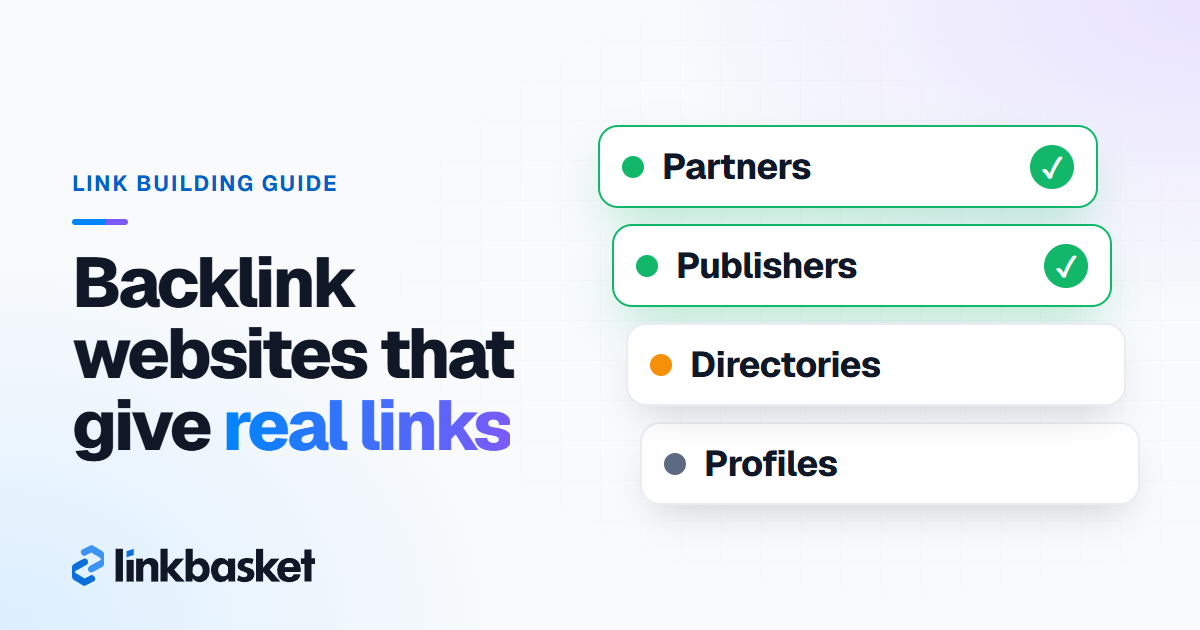
Backlink websites are any sites where a real person or business can earn, claim or be given a link to your site. Six types do the heavy lifting for most businesses:
- Business profiles: search and map listings, and review profiles you claim
- Industry directories: trade bodies, member lists, niche directories
- Review platforms: sites where customers rate your product or service
- Communities: forums, Q&A sites and groups where you answer questions
- Publishers that accept contributors: blogs and magazines with guest guidelines
- Partner and supplier sites: stockist pages, integration pages, case studies
The first four are mostly about visibility and trust. Links from them often carry nofollow or ugc. The last two are where most ranking value lives, because an editor or a business partner chooses to link to you inside real content.
The grid below places each type by rough time per link and ranking credit. Start in the top-left box.
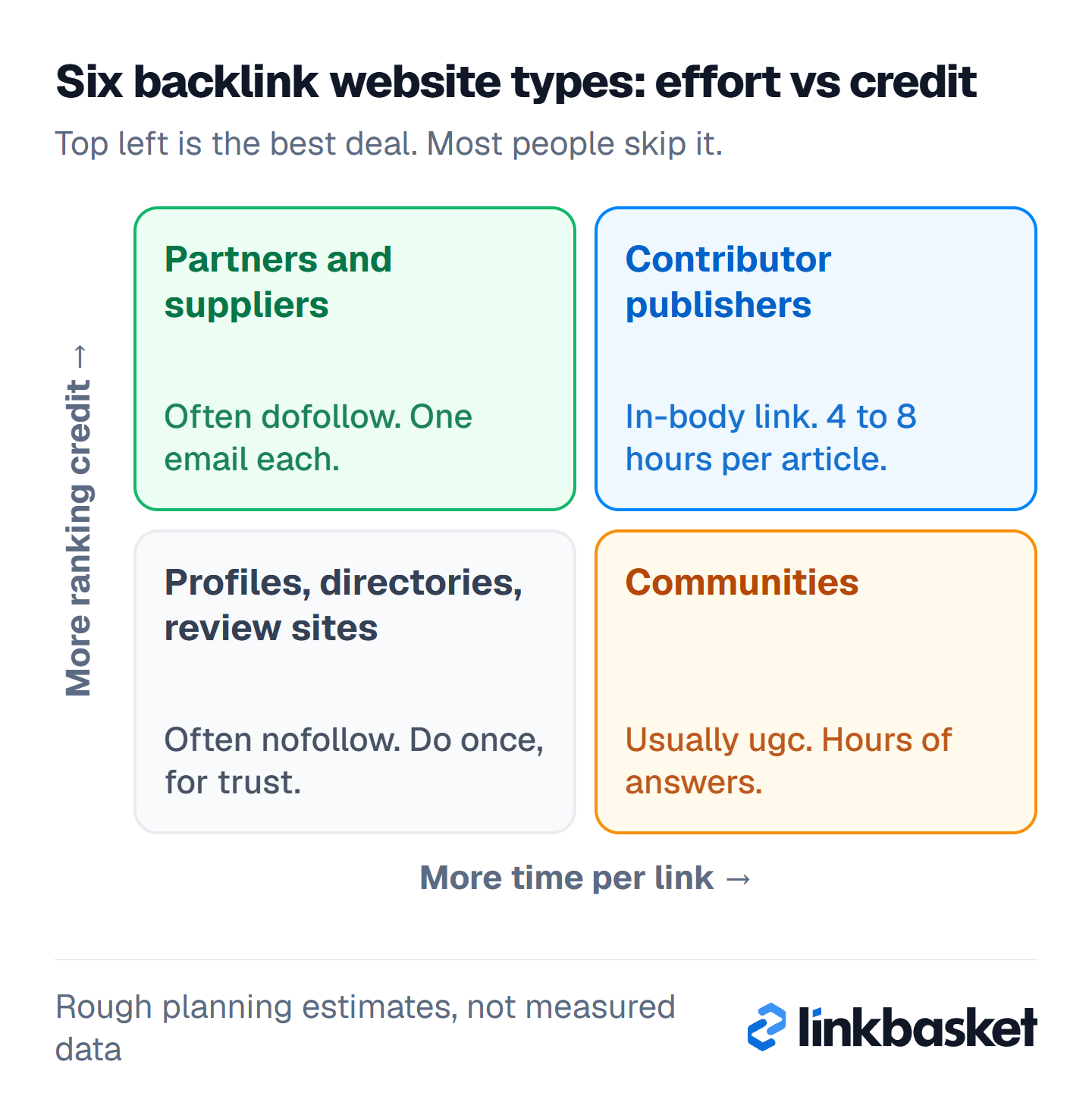
We don't publish a list of named sites with DR and traffic, and you shouldn't trust anyone who does without dates. Metrics change every month. Don't trust a list without a date; the method below holds up longer.
Which business profile sites give backlinks?
Business profile sites give you a listing with your name, address, phone number and usually a website link. We checked these four in November 2026, and each one is live and lets a business claim or manage its listing:
- Google Business Profile, Google's own listing for Search and Maps
- Bing Places for Business, which now sits at bing.com/forbusiness (the old bingplaces.com address redirects there)
- Apple Business, where a business can claim its location on Apple Maps
- Yelp, whose business page says "It's free to be on Yelp"
Honestly, don't expect much ranking credit from these links. Their job is accuracy and trust: customers find you, and your details match everywhere. Google's local ranking guide names complete and accurate info as something that helps a business show up. Profile links are often nofollow, so open each one and check the attribute before you add it to your report. Our guide on how to check dofollow links shows how to read the attribute in your browser.
Do industry directories still count as backlink websites?
Industry directories count as backlink websites when a real organisation runs them and people in your trade use them. A national trade association's member list, a licensing body's register or a curated directory of SaaS tools for accountants all qualify.
General "add your URL" web directories don't. Google's spam policies list "low-quality directory or bookmark site links" as a form of link spam. If a directory accepts any site in any niche for a $20 fee, the link is more likely to be ignored than counted. Our full guide to directory and citation link building covers how to vet one in 60 seconds.
Which review platforms work as backlink websites?
Review platforms work as backlink websites mainly for trust and clicks, because buyers read them before they contact you. We confirmed these three in November 2026:
- Trustpilot, an open review platform with a business account option
- Clutch, a B2B marketplace built around verified client reviews of service firms
- Product Hunt, where makers launch tech products on a daily leaderboard
A profile link on a review site rarely moves rankings by itself. The reviews do something else: they make your brand easier to trust when a journalist or blogger later decides whether to cite you. In practice, that second link is the one worth having, so don't skip the reviews.
Can communities and forums be backlink websites?
Communities and forums can be backlink websites, but the links are usually tagged ugc or nofollow, and spamming them breaks Google's rules. Google recommends marking links in comments and forum posts with the ugc value, and most large forums do it.
Google's spam policies also name "forum comments with optimized links in the post or signature" as link spam. So skip the 200-forum signature blast. Answer real questions in two or three communities where your buyers ask them, and link only when the link answers the question. Our guide to forum profile backlinks explains why mass profile links fail.
Which publishers accept contributors?
Publishers that accept contributors are blogs, magazines and news sites with a "write for us" or contributor page, and they're the backlink websites most likely to give an editorial, in-body link. You find them with a few Google searches:
"write for us" + your topic"contribute" + your topic"guest post guidelines" + your topicintitle:"submit an article" + your topic
Then filter hard, because most people skip this step. A real publisher has a clear topic, named authors, organic traffic and outbound links to sensible businesses. A link farm has a price list for every niche and 30 guest posts a week. Our list of guest posting sites and how to vet them goes deeper on that filter.
Journalist-request services are a close cousin. HARO, Qwoted and Source of Sources connect reporters with experts, and a good answer can earn a mention on a news site. We cover them step by step in how to get free backlinks.
Why are partner sites the best backlink websites?
Partner and supplier sites are often the best backlink websites because the relationship is real, the topic matches, and you can usually get the link with one email. Look for:
- "Where to buy" or stockist pages from brands you resell
- Integration or app directory pages from software you connect with
- Case studies a supplier writes about your project
- Testimonial pages where you review a tool you pay for
- Associations, events and clubs you already support
One warning. Google's spam policies call out "partner pages exclusively for the sake of cross-linking." A partner page listing 4 real partners is normal. A page of 300 swapped links isn't. Our guide to backlink exchanges explains where that line sits.
What are hidden backlinks, and why avoid them?
Hidden backlinks are links placed so visitors can't see them but crawlers can, and Google treats them as spam. People search for ways to add a "hidden backlink to other websites" through a theme, plugin or widget. Don't.
Google's spam policies, checked November 2026, give clear examples of hidden text and link abuse: white text on a white background, text moved off-screen with CSS, a font size or opacity of 0, and a link hidden on one small character such as a hyphen. The same page names keyword-rich or hidden links inside widgets spread across many sites.
Are backlink submission sites lists worth using?
Backlink submission sites lists are rarely worth using, because most entries are dead, nofollow, auto-approved or packed with spam. These lists promise thousands of "free backlinks sites" with high DR, and they get copied from blog to blog for years.
Here's what you usually find when you test one:
- Sites that no longer exist or no longer accept sign-ups
- Profile pages that never get indexed
- Bookmark and directory sites full of casino and essay links
- Links that arrive as
nofolloworugc
Google's spam policies list "using automated programs or services to create links to your site" as link spam. Pay someone $15 for "500 backlinks" and that's what you've bought. If you've already done it, don't panic; Google usually just ignores those links.
Backlink websites compared: which type fits your goal?
This decision table compares the six types of backlink websites by the link you'll usually get and when each one is worth your time.
| Site type | Typical link | Ranking value | Time per link | Use it when |
|---|---|---|---|---|
| Business profiles | Often nofollow | Low | 15 to 30 minutes | Always, once, for accuracy |
| Industry directories | Mixed | Low to medium | 20 to 40 minutes | A real trade body runs it |
| Review platforms | Often nofollow | Low | 30 minutes, then reviews | Buyers compare you there |
| Communities | Usually ugc or nofollow | Low | 1 to 2 hours of answers | Your buyers ask questions there |
| Contributor publishers | Often dofollow, in body | Medium to high | 4 to 8 hours per article | You have expertise to share |
| Partners and suppliers | Often dofollow | Medium | 1 email | You already work together |
Time figures are rough planning estimates, not measured data. The pattern still holds: the links that take the least effort usually carry the least ranking credit.
How do you vet a backlink website in 5 checks?
Vet a backlink website with five checks, in this order, so you drop bad sites in minutes:
- Indexed? Search
site:domain.com. If Google shows few pages, stop. - On topic? Read 5 recent pages. Do they serve your reader?
- Real traffic? Look at the 12-month organic graph in a backlink tool.
- Link attribute? Inspect an existing outbound link: dofollow, nofollow, ugc or sponsored.
- Neighbours? Scan 10 recent outbound links for casino, loan or essay sites.
Checks 1, 2 and 5 need only a browser. Checks 3 and 4 need a backlink tool, or a seller who shows the numbers up front.
Worked example: 10 hours, no budget
Hypothetical example, round numbers. Say you run a small accounting software company with 10 free hours a month and no link budget. You spend 2 hours claiming 6 profiles and review pages at 20 minutes each. When you check them, 4 of the 6 links are nofollow. Fine, they were for trust. Don't bother chasing a dofollow version.
Next, you spend 1 hour emailing 3 integration partners. Two add you to their app directory with a dofollow link. Then 6 hours go into one guest article for an accounting blog with steady traffic, and it lands one in-body link. The last hour goes to answering 3 questions in a bookkeeping forum.
Count the result: 3 dofollow links that carry ranking credit, from 9 of your 10 hours. The partner emails were the best deal by far. Most people skip them.
Where do paid placements fit among backlink websites?
Paid placements fit after the free options, when you need links to specific pages faster than outreach allows. LinkBasket is our marketplace, so read what follows knowing we sell these links.
Be clear on the risk first. Google's spam policies treat links bought to manipulate rankings as link spam, and no seller can make a paid link risk-free. What lowers the risk is relevance, real organic traffic, editorial sites, a sponsored tag where the publisher adds one, natural anchors and no link farms.
If a publisher rejects your order, the full price goes back to your wallet. Once a link is live, LinkBasket checks it weekly for 12 months. Our page on how to buy backlinks on LinkBasket explains the ordering steps.
Which edge cases change the backlink websites you pick?
Five edge cases change which backlink websites make sense: a brand-new site, a local business, a sensitive niche, a non-English market and an old profile full of spam.
- New site: start with profiles and partners. A brand-new site has little to show an editor yet.
- Local business: local news and chambers matter more. See our local link building guide.
- Health, finance, legal: editors check credentials. Lead with a qualified author.
- Non-English market: use directories and publishers in that language, not English lists.
- Old spam links: fix the past before you build. Clean up first.
When should you call a link audit specialist?
Call a link audit specialist when Search Console shows a manual action for unnatural links, or when you know someone bought thousands of submission links for your site. Don't use more bought links to fix that. An auditor checks whether you need a cleanup, and our guide on how to disavow backlinks explains when Google suggests it.
Before you call anyone, gather this so the audit starts fast:
- Any message in Search Console's Manual actions report.
- An export of your links from the Links report.
- A list of submission, bookmark and directory links you didn't earn.
- Who built those links and when, if you know.
FAQ
Are free backlink websites safe?
Most are safe but low value. Profiles, real directories and review sites are normal parts of the web, and Google expects businesses to have them. The risk comes from mass submission lists and automated tools, which Google's spam policies name as link spam.
How many backlink websites should I use?
There's no target number. Claim the 4 or 5 profiles your customers use, join 1 or 2 real trade directories, then spend the rest of your time on partners and publishers. Ten relevant links beat 500 submissions.
Do nofollow links from profile sites help SEO?
They help indirectly. A nofollow link generally passes no ranking credit, but it can send visitors and make your brand easier to find and trust. Count them as visibility, not authority.
Is there a free list of high DR backlink websites?
Lists exist, but treat them with suspicion. They're rarely dated, metrics change every month, and many entries are dead or spammy. Learn the 5 checks above and test any site yourself.
Next step: find backlink websites you can check first
Start with the free types: profiles, partners and one contributor pitch. When you need links to a specific page faster, create a free account on our link marketplace inventory to see each site's metrics, link type and price before you pay. For the earned side, read our step-by-step guide on what makes a good backlink next, or see how our guest posting service places links in the article body.