White hat link building is getting other sites to link to you by methods that follow Google's spam policies: links an editor chooses to give, and paid links marked as paid. Anything bought, traded or automated to pass ranking credit falls outside it. The cost of white hat work is mostly time.
Last updated: November 9, 2026
What is white hat link building?
White hat link building means earning backlinks that a site owner places by choice, because your page helps their readers. Nothing changes hands for the ranking credit. Google sets the line, so start with its own words.
Google's spam policies, checked in November 2026, define link spam as "the practice of creating links to or from a site primarily for the purpose of manipulating search rankings." White hat is everything on the other side of that sentence. The test is intent and payment, not the tactic's name. A guest post can be white hat. So can a press mention. Both can also be spam, depending on how the link got there.
The term comes from old westerns, where the hero wore the white hat. Some people call it ethical link building. Same thing.
How do white, grey and black hat link building differ?
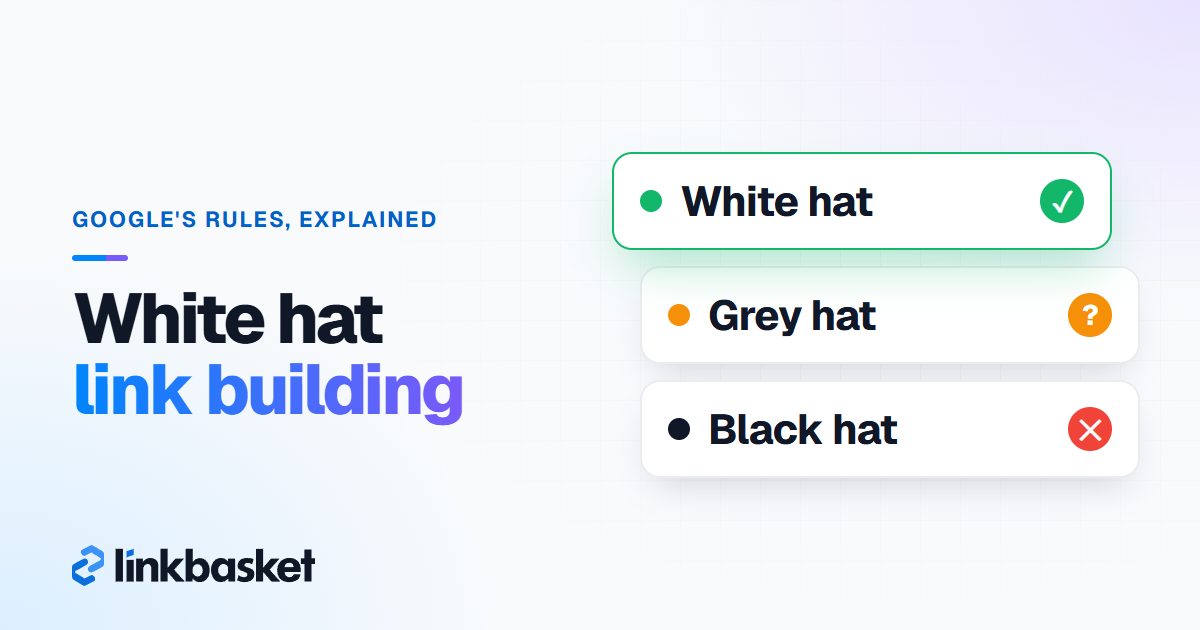
White hat link building follows Google's policies, black hat breaks them on purpose, and grey hat sits in between: technically against the rules, but built to look natural. The short version first.
White hat
Follows Google's spam policies.
- Earned editorial links
- Unpaid guest posts, natural anchors
- Paid links marked sponsored
Grey hat
Against policy, low footprint.
- Paid dofollow posts on real sites
- Excessive link swaps
- Guest posts at scale, keyword anchors
Black hat
Breaks policy on purpose.
- Private blog networks
- Automated link programs
- Forum, comment and widget spam
Here's how common tactics sort, with the reason for each.
| Tactic | Hat | Why |
|---|---|---|
| Earned editorial links (data, guides, tools) | White | Editor chooses; nothing traded |
| Unlinked mention requests | White | Writer already chose to cite you |
| Unpaid guest post, natural anchor | White | Editorial, as long as it's not at scale with keyword anchors |
Paid post with rel="sponsored" |
White | Paid, but qualified the way Google asks |
| Paid post, dofollow, on a real editorial site | Grey | Against policy; low footprint lowers the risk, not the rule |
| Excessive link exchanges | Grey to black | Google names "excessive" swaps as spam |
| Private blog networks (PBNs) | Black | Sites built only to pass links |
| Automated links, comment and forum spam | Black | Google lists automated link programs and optimized forum links as spam |
Grey hat isn't a safe middle. Honestly, in Google's eyes there's no grey column, only links that follow the policy and links that don't. "Grey" just means the odds of getting caught are lower. Our page on PBN backlinks covers the black hat end in detail.
What does Google's link spam policy ban?
Google's link spam policy bans links created mainly to manipulate rankings, and it lists the common patterns by name. As of November 2026, the examples include:
- Buying or selling links for ranking purposes, including paying with goods, services or free products
- Excessive link exchanges, or partner pages built only to cross-link
- Automated programs or services that create links to your site
- Terms of service or contracts that require a link the site owner can't qualify
- Text ads that pass ranking credit
- Paid advertorials, guest posts or press releases with ranking-passing or keyword-optimized links
- Low-quality directory and bookmark links
- Keyword-rich or hidden links in widgets spread across many sites
- Links placed widely in site footers or templates
- Forum comments with optimized links in the post or signature
Read the list twice. Notice what's missing. Guest posting itself isn't banned. Directories aren't banned, only low-quality ones. Link exchanges aren't banned, only excessive ones. The word that matters in almost every line is "manipulate."
What happens if you cross the line?
More often, though, nothing visible happens: Google's SpamBrain system, which it said in December 2022 can detect sites that buy links, simply neutralises them. You lose the money and gain nothing. Don't mistake silence for success.
Where do paid guest posts sit in white hat link building?
Paid guest posts sit inside white hat link building only when the link is marked rel="sponsored" or nofollow. Google's guide to qualifying outbound links says to mark ads and paid placements with the sponsored value, and that links marked this way "will generally not be followed."
So you face a real trade-off, and we won't pretend otherwise:
Paid and sponsored
Fully within policy. You get readers, brand exposure and referral clicks, but little ranking credit.
Paid and dofollow
What most buyers want, and what Google's policy calls link spam. No seller can make it risk-free. Not us, not anyone.
What lowers the risk on option 2 is how the link looks: a relevant site, real organic traffic, an in-body placement, a natural anchor and no link-farm neighbours. That's harm reduction, not a white hat badge. LinkBasket is a marketplace that sells guest posts and link insertions, and each site page tells you before you pay whether a sponsored tag is added and what link type you get. Make that call with open eyes. After a link goes live, LinkBasket checks it weekly for 12 months, and if a link sold as dofollow turns nofollow or vanishes, we restore it, move it to a comparable site or refund it to your wallet. That protects what you paid for. It doesn't change what Google's policy says.
Which white hat link building techniques work best?
The white hat link building techniques that work reliably are unlinked mentions, broken link building, expert commentary, unpaid guest posts, linkable assets, digital PR and partner links. They cost hours more than dollars. Times below are planning estimates for one person, not measured results.
| Technique | Effort per link | Time to first link | Cash cost | Best for |
|---|---|---|---|---|
| Unlinked mentions | Under 1 hour | Days | $0 | Brands people already write about |
| Partner and supplier links | 1 to 2 hours | 1 to 3 weeks | $0 | Businesses with real partners |
| Expert commentary | 1 to 5 hours | 2 to 6 weeks | $0 | Real specialists, YMYL niches |
| Unpaid guest posts | 3 to 6 hours | 2 to 6 weeks | $0 | Most sites |
| Broken link building | 3 to 8 hours | 3 to 8 weeks | $0 + a tool | Sites with one standout page |
| Linkable asset | 20 to 60 hours up front | 1 to 6 months | $0 to a few thousand | Long-term growth |
| Digital PR campaign | 30+ hours per campaign | 2 to 6 weeks | $0 to a few thousand | Original data, big outlets |
Partner links are the most overlooked line in that table, and most people skip them because they feel too easy to matter. If you supply, stock, integrate with or sponsor someone, ask whether their "partners" or "where to buy" page can list you. One email. Done.
For the step-by-step on each technique, see how to build backlinks. For combining them into a plan, read our link building strategies guide.
What does white hat link building cost in practice?
White hat link building costs mostly time, and time has a price. Here is a worked example with 10 hours a week, and every number in it is hypothetical.
Say you spend 10 hours a week for 12 weeks. That's 120 hours. You put 40 hours into one data asset, 50 into guest post pitches and writing, and 30 into broken link and mention outreach. Suppose that lands 3 links from the asset, 6 guest posts and 4 outreach links: 13 links in total.
At $50 an hour, those 120 hours are worth $6,000. That works out to about $460 per link. Cheap? Not really. But the asset keeps earning after week 12, the guest posts brought readers, and none of the 13 links carries policy risk. When you compare that with paid placements, compare the full figure, hours included. Most people only count the cash.
How do you tell if a link is white hat?
A link is white hat when the site owner chose to place it and nothing of value was traded for ranking credit, or when any paid link carries a sponsored or nofollow tag. Four questions settle almost every case.
- Did money, goods or a swap change hands? If yes, the link needs
rel="sponsored"ornofollowto stay white hat. - Did an editor choose to place it? Required links in contracts, widgets or terms don't count as chosen.
- Is the anchor natural? The same keyword anchor across dozens of guest posts is the exact pattern Google lists.
- Is it at scale? One guest post is outreach. Two hundred identical ones is a campaign Google describes as spam.
Pass all four? You have a white hat link. Fail one, and you're in grey or black territory, whatever the seller calls it.
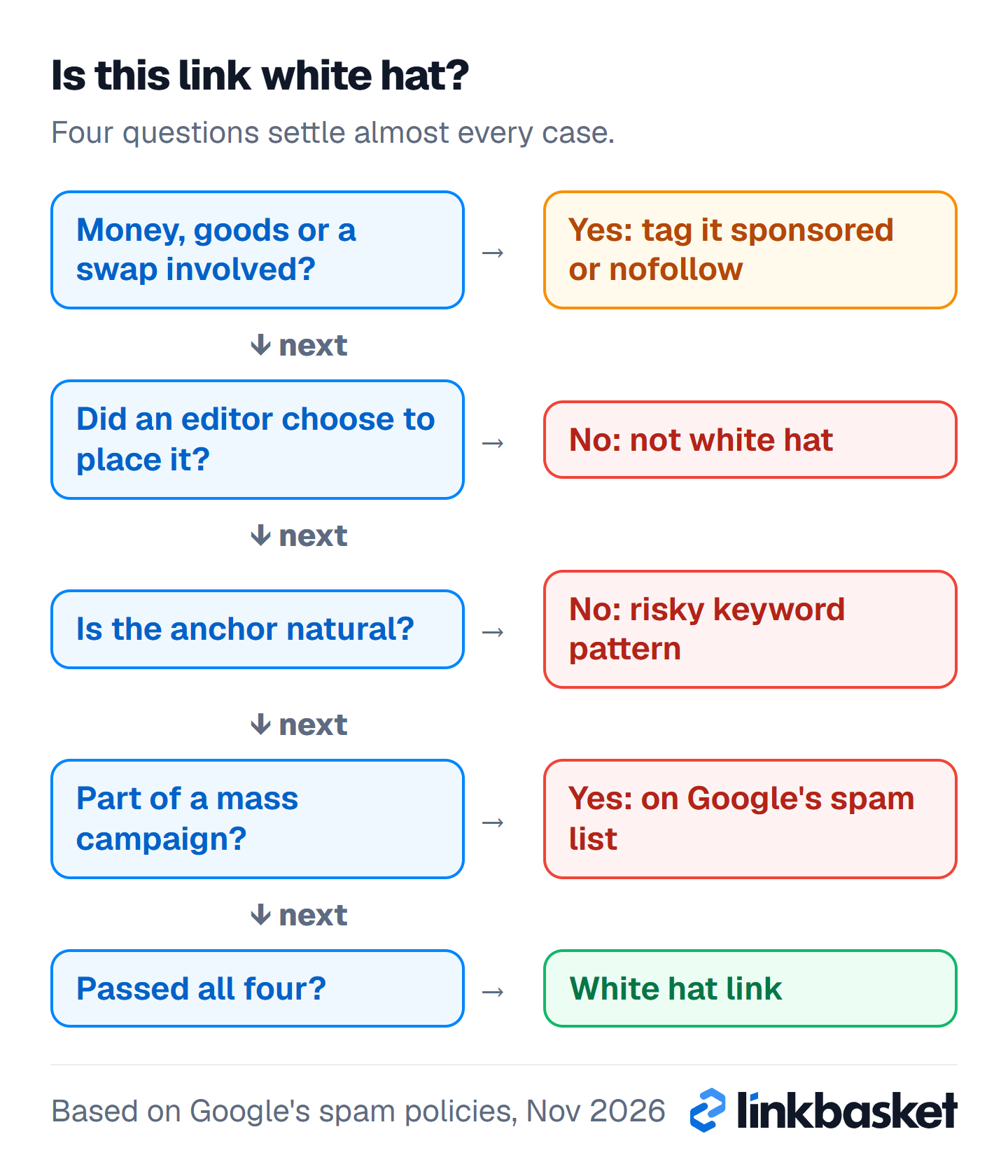
Follow the questions top to bottom. Only a link that clears every red box ends in the green one.
Which edge cases blur white hat link building?
Five situations blur the line in white hat link building: sponsorships, link exchanges, free products, affiliate links and press releases.
- Event and charity sponsorships: a sponsor logo link is fine when the sponsorship is real; when you pay mainly for the link, mark it sponsored
- Link exchanges: an occasional mutual link between related sites is normal, and Google only names "excessive" swaps; our guide to link exchanges shows where that line sits
- Free products for reviews: Google lists sending free products in exchange for a link as link spam, so reviewers should mark those links sponsored
- Affiliate links: in a July 2021 post, Google asked affiliate sites to mark these links
rel="sponsored", which is the publisher's job, not yours - Press releases: fine for news, but keyword-optimized links inside them are on the spam list
When should you not rely only on white hat link building?
Don't rely only on white hat link building when you need results on a fixed deadline and have no time to earn links. Earned links are slow. A 6-week product launch rarely gets there on outreach alone.
That's when businesses consider paid placements, with the policy risk stated plainly above. If you go that way, compare sites in our link marketplace inventory, where DR, organic traffic, link type and sponsored-tag status show before you pay. Before you order, tick every line:
- The site covers your topic or serves your buyer.
- It has real organic traffic from countries you sell to.
- Your link sits in the article body, with a natural anchor.
- Recent posts don't link to casinos, loans or essay mills.
- You've decided, knowingly, whether the link carries a sponsored tag.
Don't skip the last line. The list lowers the risk. It doesn't make a paid dofollow link white hat. And call a specialist, an independent SEO auditor with nothing to sell, when Search Console shows a manual action for unnatural links. Cleaning that up means removal requests, a careful disavow file and a reconsideration request. Our guide to disavowing backlinks explains the file, but a penalty is not the time to learn on the job.
FAQ
Is guest posting white hat?
Guest posting is white hat when an editor accepts your article on merit, no money changes hands, and the link and anchor are natural. Paid guest posts are white hat only if the link is marked sponsored. Large-scale guest posting with keyword-rich anchors is on Google's spam list.
Is white hat link building slow?
Yes, usually. Expect your first links within 2 to 6 weeks and steady results over 6 to 12 months, as planning estimates. A data asset can keep earning links for years, which is where the slow start pays off.
Can white hat backlinks hurt your site?
Rarely. A real editorial link from a relevant site doesn't trigger penalties. Problems start when "white hat" is a label on a paid, unmarked link at scale.
Are nofollow links white hat?
Yes. A nofollow or sponsored link is the compliant way to run paid or user-generated links. It still sends visitors. Our guide to dofollow vs nofollow links covers how each is treated.
Next step: pick your first white hat technique
Start with the cheapest line in the techniques table that fits you, usually unlinked mentions or partner links. Then judge every link you win against our guide to what makes a good backlink. If you also want earned PR coverage done for you, our digital PR service runs campaigns built on data and stories.