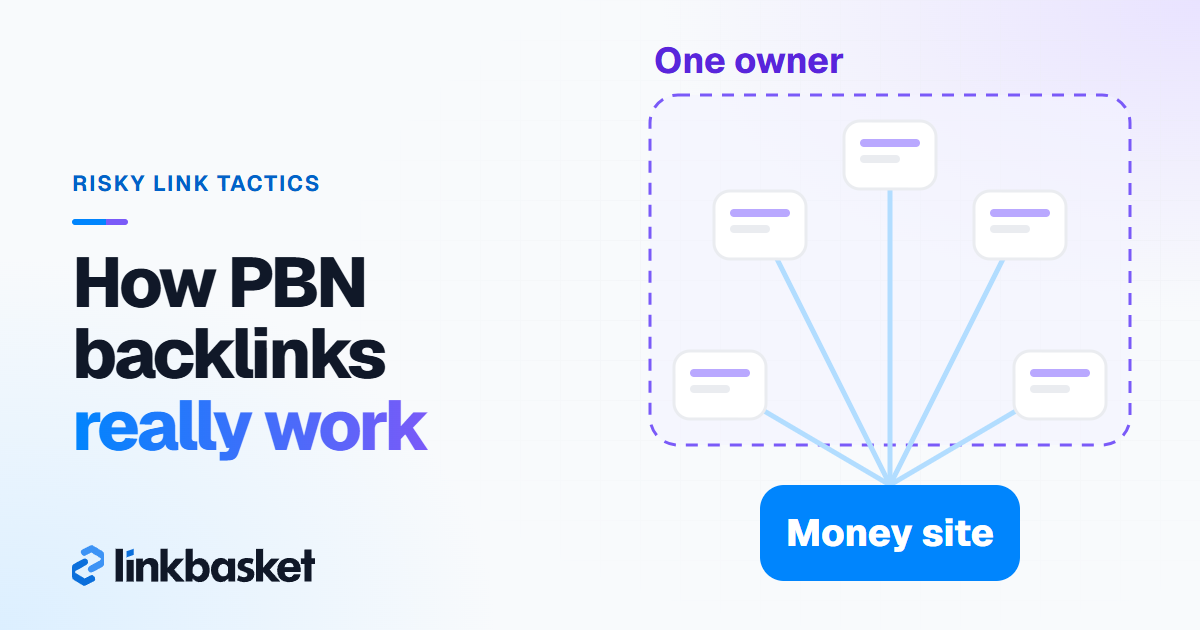
SEO PBN backlinks are links from a private blog network: a group of websites one owner controls, often rebuilt on expired domains, that exist mainly to link to the owner's or a client's money site. They can move rankings for a while. Google's spam policies treat them as link spam, though, and the risk lands on the site they point to.
Last updated: November 9, 2026
This is our pillar guide to risky link tactics. It covers what a PBN is, how sellers build one, the footprints that give it away, what Google's policies actually say, and what to buy or build instead.
What is a PBN, and what are PBN links?
A PBN (private blog network) is a set of sites that look independent but share one owner, and PBN links are the backlinks those sites place on purpose to pass ranking credit. Readers rarely matter to the owner. The links do.
The site getting the links is the money site. The network sites are sometimes called "feeder" sites. A buyer who orders from a PBN backlinks service usually gets a link from one of these feeders, inside a short post written around the anchor text the buyer asked for.
PBN links differ from ordinary backlinks in one way that matters. Nobody chose to link because your page was useful. The link exists because someone paid, or because one person owns both ends.
How do people build a private blog network?
People build a private blog network by buying expired domains that still carry backlinks, putting a blog back on each one, and adding links to money sites. A typical private blog network building service follows roughly these five steps:
- Buy expired domains at auction or from drop lists, picking ones whose old backlinks still show up in Ahrefs or Majestic.
- Check the history in the Wayback Machine, so the domain isn't a former spam site.
- Spread the hosting across different providers, IP ranges and registrars, so the sites don't look connected.
- Add content, often cheap or AI-generated posts, to make each domain look like a live blog.
- Place the links, one or two per post, pointing at the money sites with chosen anchors.
Steps 3 and 4 eat most of the budget. In practice they're also where networks get sloppy, which is how footprints appear. If you've ever seen ten blogs with the same odd footer, you've seen one.
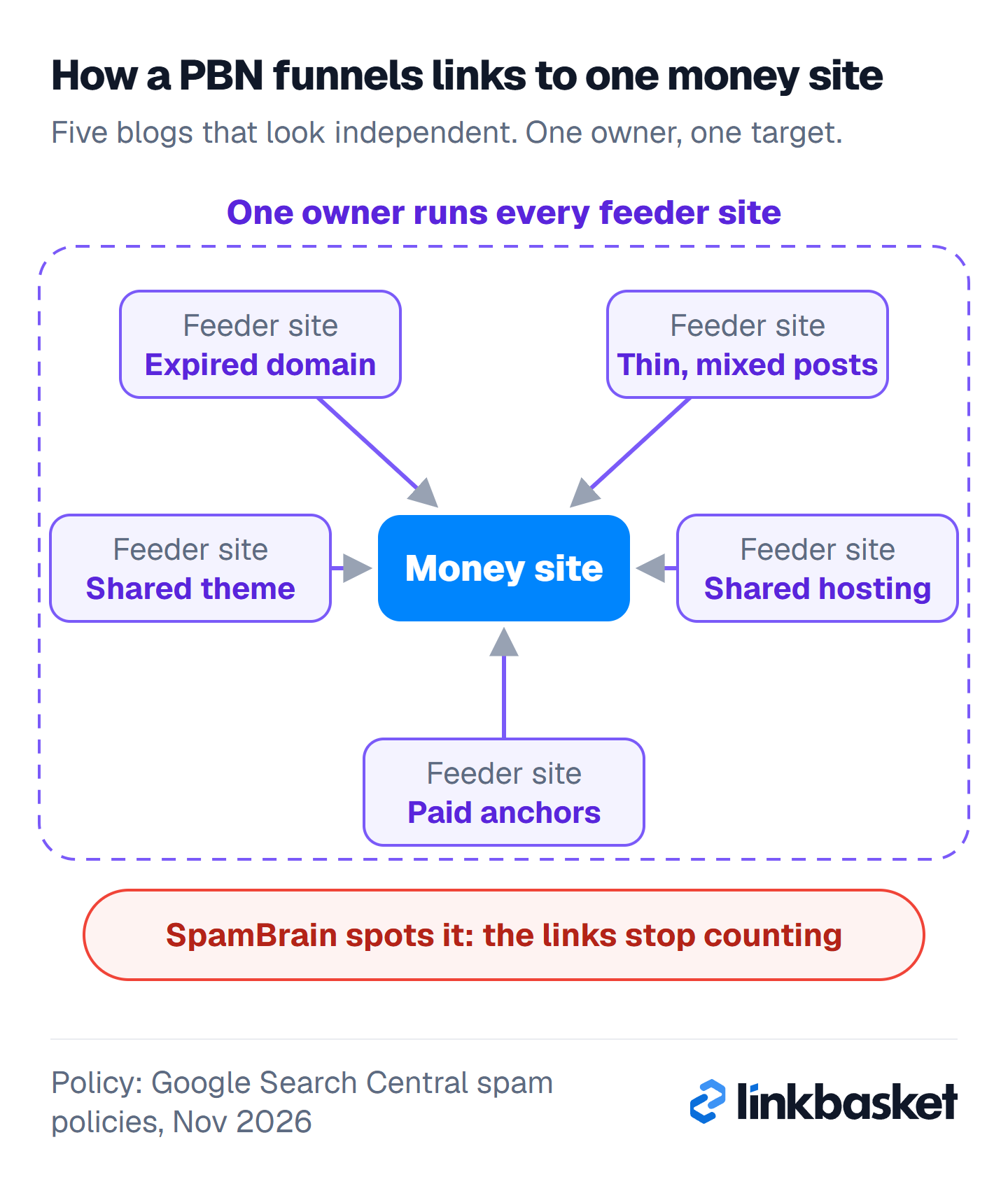
Look at the dashed box first. Every feeder sits inside it, because one person runs them all, and each feeder's label is a footprint that gives the network away.
Why do sellers push PBN backlinks?
Sellers push PBN backlinks because they're cheap to make and the seller controls every link, so the margins and the delivery speed beat outreach to real publishers. A seller who owns 50 domains can sell the same domain to dozens of buyers.
Here is the pitch you'll usually see on "PBN backlinks for sale" pages:
- High DR or DA, because the expired domain kept its old backlinks
- Dofollow guaranteed, since there's no editor to say no
- Any anchor you want, exact match included
- Delivery in days, not the weeks a real publisher takes
Don't trust any of those selling points. Each one is also a warning sign. A high DR with almost no organic traffic usually means the authority belongs to the domain's previous life. An editor who never refuses an anchor is no editor at all.
Do SEO PBN backlinks still work in 2026?
SEO PBN backlinks can still move rankings in 2026 when the network is well hidden, but the gains tend to be temporary and Google may neutralise them without telling you. That's the honest answer, and frankly not the one sellers give. Some do work, for a while.
The problem? When you buy, you can't see which outcome you bought. Google's December 2022 link spam update post, dated December 14, 2022, said its SpamBrain system "can now detect both sites buying links, and sites used for the purpose of passing outgoing links." Passing outgoing links is a PBN's entire job.
When SpamBrain catches a network, the links usually just stop counting. Rankings that leaned on them slide back. You paid for a boost that quietly expired, and nobody sent a notice.
What footprints give a PBN away?
PBN footprints are the shared patterns that show one owner runs a group of "independent" sites. Search engines and competitors both look for them, and here are the common ones:
- Thin, off-topic content. Posts on a former bakery domain about crypto, CBD and car insurance.
- Outbound links that only go to paying clients. Few links to sources, many links to unrelated businesses.
- Same theme, plugins or hosting. Ten sites on one cheap theme with matching footer text.
- Matching ownership signals. Shared analytics IDs, contact emails or author names across domains.
- High authority, no traffic. DR 40 or more next to a few dozen monthly visits.
- Wayback history gaps. A charity site in 2019, then a "lifestyle blog" in 2024.
Most people miss a PBN when they look at one site. When you open the second and third, the pattern repeats. Turns out the theme, the author bios and the outbound links rarely change much between them.
What does Google's policy say about PBN backlinks?
Google's spam policies don't use the words "private blog network" or "PBN", but three of the listed spam types describe how a PBN works. We checked the Google Search Central spam policies on November 9, 2026.
- Link spam. Google defines it as creating links "primarily for the purpose of manipulating search rankings." The examples include buying or selling links that pass ranking credit, and creating low-value content mainly to manipulate linking signals.
- Scaled content abuse. One listed example is creating multiple sites to hide the scaled nature of the content. That's a PBN described from the content side.
- Expired domain abuse. Google defines this as buying an expired domain and repurposing it "primarily to manipulate search rankings." Its examples include casino content on a former elementary school site.
The last two arrived with the March 2024 core update. Google's March 5, 2024 announcement added expired domain abuse, scaled content abuse and site reputation abuse together. Site reputation abuse is about third-party pages on trusted host sites rather than networks, so it matters less here. Google revised it on August 28, 2026 and now calls it the site reputation policy.
What is the real penalty risk of PBN backlinks?
The real penalty risk of PBN backlinks comes in two forms: algorithmic neutralising, which is common and silent, and a manual action, which is rarer but visible in Search Console.
Algorithmic neutralising means Google ignores the links. Your site isn't punished as such. Any ranking those links held up drops back, and the money you spent is gone. For most PBN buyers this is the likely outcome.
A manual action is different. Google's Manual Actions report says a human reviewer issues one after deciding a site breaks the spam policies. For PBN buyers the relevant notice is "Unnatural links to your site", which says Google found "a pattern of unnatural, artificial, deceptive, or manipulative links pointing to your site." Affected pages can rank lower or drop out. The network owner can get the mirror notice, "Unnatural links from your site."
When you get a manual action, recovery means removing or disavowing the links, then filing a reconsideration request. Google says reviews can take days or weeks. Our guide on how to disavow backlinks walks through the file format.
Worked example: what does a PBN order actually cost?
This worked example shows why cheap PBN links often cost more than they seem. Every number here is hypothetical.
Say you buy 10 PBN links at $60 each, so $600. The seller promises DR 40+ domains. Six months later, SpamBrain has neutralised the network, so the links count for nothing:
| Option | Spend | Links still counting after 6 months | Cost per counting link |
|---|---|---|---|
| 10 PBN links at $60 | $600 | 0 | No result for $600 |
| 4 guest posts at $150 on real publishers | $600 | 4 | $150 |
| 2 digital PR pitches at $300 | $600 | 1 to 5, uncertain | $120 to $600 |
Don't read the guest post row as risk-free either. Those are still paid links under Google's policy. The difference is that an editorial site with real readers looks like the links sites earn on merit, while a network built to pass links is exactly what SpamBrain was trained on.
Now add the worst case. If a manual action hits a page earning $3,000 a month and recovery takes 3 months, the $600 order cost you $9,600 in lost revenue. Hypothetical, again, but the shape is real.
When are PBN-style links harmless?
PBN-style links are harmless only when the sites are real, run in the open, and the links help readers more than rankings. That covers a narrow set of cases:
- A publisher with several real brands. A media group linking its own magazines in a shared footer, under a clear "Our brands" label.
- A business with genuine sister sites. A bakery linking to its catering site because customers want both.
- A domain you bought to continue the same purpose. Buying a closed competitor and redirecting it to the matching page, as covered in our 301 redirect backlinks guide.
If you've got two real businesses, link them. Nobody minds. What makes these fine is intent and honesty. The sites have readers, the links aren't hidden, and nobody rebuilt a dead charity domain to sell casino links. The moment you add sites mainly to pass links, you're back inside the policy.
PBN backlinks vs safer link options: which should you pick?
PBN backlinks lose to safer link options for any site you plan to keep, because the safer options carry less risk per dollar and keep working after Google's next spam update. This decision matrix sums it up:
| If your situation is | And you're tempted by | Then do this |
|---|---|---|
| Long-term business site | A PBN backlinks service | Skip it. Use real publishers or earned links. |
| Local or small site | Cheap "DR 50" links | Check traffic first; most fail. Try local links. |
| Affiliate site you'd lose anyway | Buy PBN backlinks | Know the expected outcome is zero, and never point them at a site you can't afford to lose. |
| Site under a manual action | More links to recover | Stop building. Clean up, disavow, file reconsideration. |
| Brand with something newsworthy | Fast authority | Digital PR, where editors cover you on merit. |
Both kinds of link can be paid. Only one has readers and an editor:
PBN link
- One owner behind many sites
- High DR, little organic traffic
- Posts on every topic
- Any anchor accepted
- Expired domain, new purpose
Real publisher link
- Independent site with its own readers
- Traffic in line with DR
- One consistent topic
- An editor who can refuse anchors
- Still a paid link, so some risk remains
LinkBasket is our marketplace, and it lists only guest posts and link insertions on publisher sites. Each site page shows its metrics before you pay, so you can run the footprint checks above yourself. After a link goes live, LinkBasket checks it weekly for 12 months and restores, moves or refunds it if it disappears or turns nofollow on a site sold as dofollow. Google still treats a paid link meant to lift rankings as link spam. What lowers the risk is relevance, real traffic, an editorial site, a sponsored tag where the publisher adds one, and no link farms.
Which edge cases change the PBN decision?
Four edge cases change how you should handle PBN links: links you didn't order, an agency that hid them, a competitor's network, and a site you bought with PBN history.
- Your old SEO agency used PBNs. Ask for the full list of links they built. When you find network sites, plan removal before you plan new links.
- A seller calls PBN links "guest posts". Check the site's traffic, its other outbound links and its Wayback history. Skip the order when any of the three looks wrong. A real publisher has readers and a past.
- A competitor ranks with PBNs. Don't copy them. Seriously. You can report spam to Google through its search quality report, then outwork them with links that last.
- You bought a site with network links pointing at it. Audit the profile in the first 30 days, while the cause is still easy to show.
The other tactics in this cluster often feed PBNs. Sellers pitch web 2.0 backlinks as cheap network sites and stack lower tiers on top through tiered link building.
When should you skip PBN backlinks and call a specialist?
Call a link audit specialist when Search Console shows "Unnatural links to your site", when traffic falls hard after a spam update, or when you find more than a handful of network links. Don't buy PBN backlinks at all for a site that earns your living.
If you've already bought PBN links, work through this list before you order anything new:
- Ask the seller or agency for every linking URL.
- Open each site and check its traffic, topics and outbound links.
- Check the Manual Actions report in Search Console.
- Pause new orders until the audit is done.
- Save the disavow file for a manual action or a large set of spammy links.
Don't hire a link seller for that job. That includes us. Honestly, the person cleaning up your profile shouldn't profit from what goes into it next.
FAQ
Are PBN backlinks illegal?
No. PBN backlinks break Google's spam policies, not the law. The cost is in search: links that stop counting, and in some cases a manual action against the pages they point to.
How can I tell if a seller's links come from a PBN?
Check four things on the linking site: organic traffic, topic consistency, outbound links and Wayback history. High DR with near-zero traffic, posts on every subject and links to unrelated businesses in most posts point to a network.
Do I need to disavow PBN links pointing at my site?
Only sometimes. Google's disavow help page says most sites won't need the tool, and that it's meant for a considerable number of spammy or artificial links that caused, or will likely cause, a manual action. A few stray network links usually get ignored, so don't bother filing for those.
What's the difference between a PBN and buying guest posts?
A PBN is a network one owner runs only to pass links. A guest post sits on a real publisher with its own readers and editor. Both count as link spam under Google's policy when bought to manipulate rankings, but the guest post carries far less detection risk.
Next step: build links that survive a spam update
To compare real publishers before you pay, browse our link marketplace inventory with a free account. Our page on how to buy backlinks on LinkBasket explains ordering, and the guest posting service covers placements in article bodies. For the rest of this cluster, read our guides to forum and profile backlinks and automated link building tools.