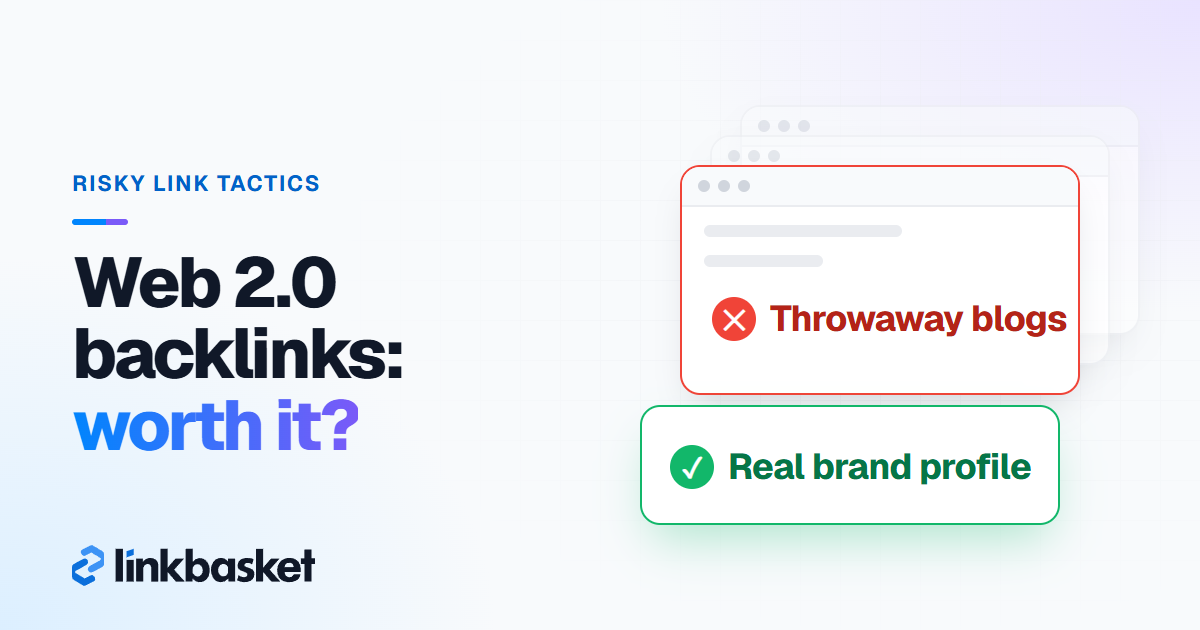
Web 2.0 backlinks are links you place on free, user-built sites such as Blogger, WordPress.com, Tumblr and Medium, usually on a blog created just to hold the link. Some platforms mark those links nofollow, some don't. Thin blogs built in bulk count as spam under Google's policies, while a real brand profile is fine.
Last updated: November 9, 2026
The term comes from the mid-2000s, when "web 2.0" meant sites where users publish content themselves. SEO sellers kept the name long after everyone else dropped it. Today it mostly means one thing: a free blog subdomain with a few posts and your link in them.
What are web 2.0 backlinks?
Web 2.0 backlinks are links from content you publish yourself on a free hosted platform, rather than links an outside editor gives you. Because you own the account, you control the anchor, the page and the link.
Common web 2.0 sites include:
- Blogger, Google's free blog platform, on a blogspot.com subdomain
- WordPress.com, the hosted version of WordPress
- Tumblr, a microblogging platform
- Medium, an open publishing platform with optional publications
- Smaller hosts such as free site builders and note-sharing sites
That control is the appeal. It's also the problem. Big one. A link you place on your own throwaway blog is a link you gave yourself, and search engines know the difference.
How do sellers build web 2.0 backlinks?
Sellers build web 2.0 backlinks by opening accounts on free platforms in bulk, publishing a few short posts on each, and adding your link with the anchor you ordered. A web 2.0 link building service usually follows this pattern:
- Create a new blog on each platform, often 10 to 50 of them per order.
- Publish 1 to 3 posts of 300 to 500 words, frequently spun or AI-written.
- Add your link in the body, plus links to "authority" sites to look natural.
- Point tier 2 links at the blogs to get them crawled and indexed.
Step 4 is the giveaway. When you need spam pointed at a blog just to get it indexed, the blog has no readers, and nobody at the seller expects it to get any, because the whole point of the post was the link sitting in its second paragraph. Sellers also use these blogs as the middle layer in tiered link building, which adds to the footprint.
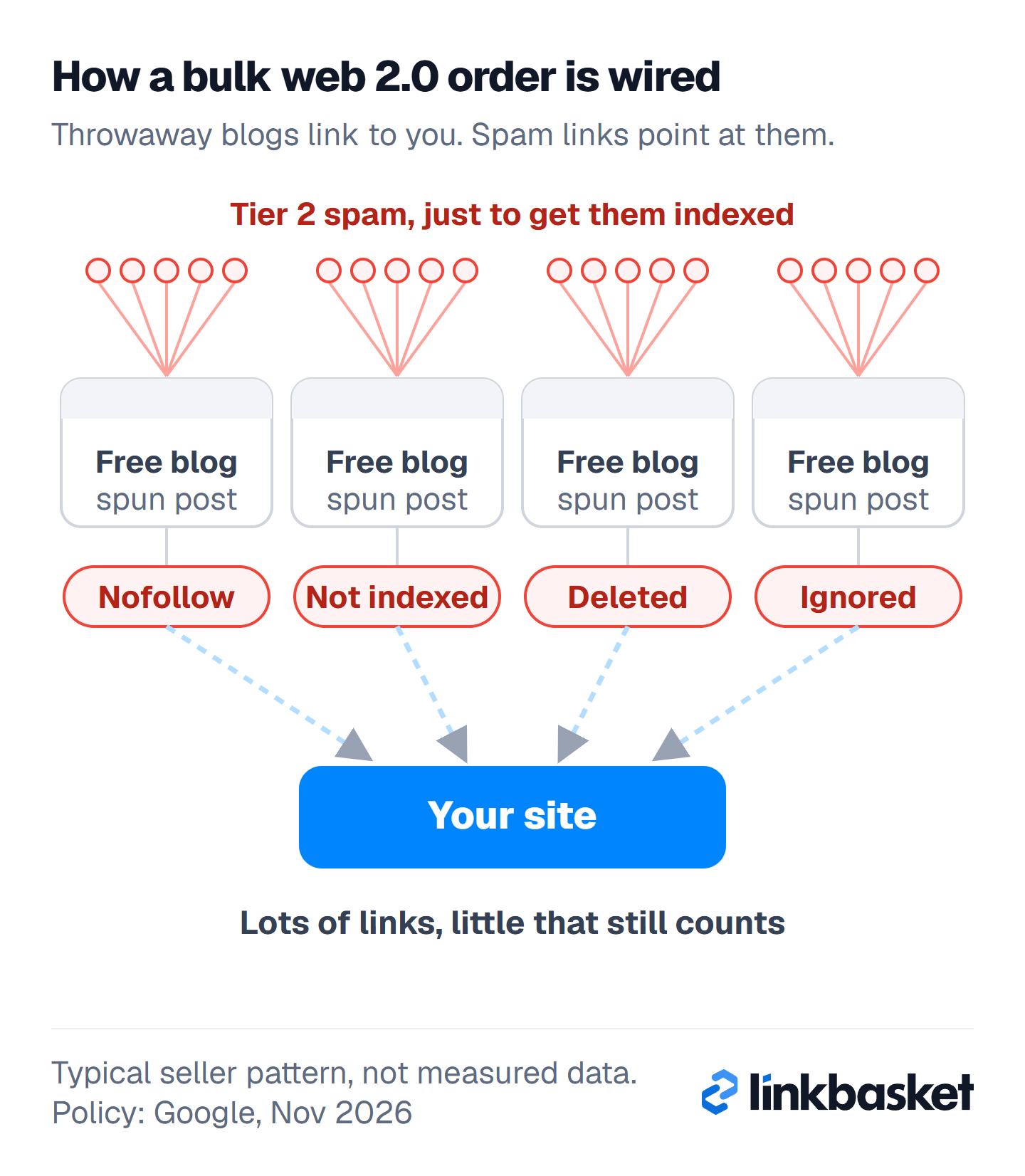
When you trace it from the top down, the wiring is plain. Spam points at the free blogs, the blogs point at you, and each red label shows how one of those links usually ends up.
Are web 2.0 backlinks dofollow?
Web 2.0 backlinks vary by platform: some are dofollow, some are nofollow or ugc, and platforms can change the setting at any time. Don't trust a seller's "dofollow" label. Check the live link before you assume anything.
Here's what we found when we checked in November 2026:
- Medium. Outbound links in the body of a live Medium story carried
rel="noopener ugc nofollow". So a Medium link is a ugc and nofollow link. - Blogger. External links in post bodies on Blogger's own official blog carried no rel attribute at all, which means they're followed by default.
- WordPress.com and Tumblr. We didn't verify these. Inspect a live post before you rely on either.
Even a followed link isn't a strong one. Google treats nofollow, sponsored and ugc as hints, a change it announced on September 10, 2019. A dofollow link on an empty blog with no traffic and no other links pointing to it passes very little. Our guide to dofollow vs nofollow links shows how to check any link's attribute in your browser.
What does Google's spam policy say about web 2.0 backlinks?
Google's spam policies don't mention web 2.0 backlinks by name, but several listed examples describe how sellers build them. We read the Google Search Central spam policies on November 9, 2026.
- User-generated spam. Google lists "spammy accounts on hosting services that anyone can register for" as an example. That's a bulk web 2.0 blog, described exactly.
- Link spam. Defined as creating links "primarily for the purpose of manipulating search rankings." The examples include automated link creation and low-value content made mainly to manipulate linking signals.
- Scaled content abuse. Added in March 2024. Examples include using generative AI to create many pages without adding value, and creating multiple sites to hide the scaled nature of the content.
The other two policies from Google's March 5, 2024 announcement matter less here. Expired domain abuse is about bought domains, not free subdomains. Site reputation abuse, now called the site reputation policy after an August 2026 update, targets third-party content published on a host site mainly to exploit that host's ranking signals. A spun post on your own free blog is more plainly user-generated spam.
What is the real penalty risk of web 2.0 backlinks?
The real penalty risk of web 2.0 backlinks is low for your own site and high for the links themselves: most get ignored by Google or deleted by the platform. A manual action against you is possible but rare.
There are three ways the links die:
- Google ignores them. Google's December 2022 link spam update post says SpamBrain neutralises unnatural links and that credit passed by them is lost.
- The platform removes them. Google's Manual Actions report includes a "Spammy free host" notice for hosting services where a significant fraction of sites are spammy. Platforms have strong reasons to purge spam blogs.
- Your site gets flagged. The "Unnatural links to your site" action applies when Google finds a pattern of manipulative links pointing at you. Hundreds of exact-match web 2.0 links can form that pattern.
In practice the first two are what you'll see. The links quietly stop mattering. Or the blogs vanish.
Worked example: a web 2.0 package vs a real brand profile
This worked example compares a bulk web 2.0 order with one real brand profile. Every number here is hypothetical.
Say you run a meal-prep business and buy 20 web 2.0 backlinks for $40. Each blog has 2 spun posts, zero followers and no traffic. Now compare that with spending 6 hours writing 2 real articles for your own Medium profile, shared to your 1,500 email subscribers.
| Option | Cost | Readers in 3 months | Ranking credit | Risk |
|---|---|---|---|---|
| 20 web 2.0 blogs, 2 posts each | $40 | Close to 0 | Little; many ignored | Blogs deleted, footprint |
| 1 Medium brand profile, 2 real articles | 6 hours | 300 to 600 | Little; links are nofollow | Very low |
| 1 guest post on a relevant food blog | $150 | Depends on the site | Possible | Paid link risk, lower if relevant |
The Medium links pass no ranking credit. Doesn't matter. They bring readers who already care about meal prep, and some of them link to you later from their own sites.
What is the legitimate use of web 2.0 sites?
The legitimate use of web 2.0 sites is a real brand presence: a profile or publication where you post useful content for people who follow you there. The aim is readers and recognition, not links.
Good uses include:
- A Medium publication where your team shares real case notes and opinions.
- A Blogger or WordPress.com blog for a side project, a community group or a hobby that actually has readers.
- A Tumblr presence for a brand whose audience is already active there.
- Republishing your own posts to reach a new audience, with a link back to the original.
When you republish, check that the platform lets you point to your original version. Otherwise you may compete with yourself in search. Most people forget this step.
Web 2.0 backlinks vs safer options: which wins?
Web 2.0 backlinks bought in bulk lose to safer alternatives every time, because the alternatives either bring readers or carry real editorial weight. Use this decision table:
| If your goal is | And you're considering | Then choose |
|---|---|---|
| Ranking credit | Buy web 2.0 backlinks | Links on relevant publisher sites |
| Brand visibility | A web 2.0 submission site list | 1 or 2 real profiles you'll keep active |
| Getting a page indexed | Web 2.0 blogs pointing at it | Internal links and Search Console |
| Fast cheap links | A web 2.0 link building service | Skip it. Spend the budget on one real link. |
| Reach a new audience | Medium or Tumblr | Post real content there, nofollow or not |
In practice, it's the same platforms with opposite outcomes:
Bulk web 2.0 blogs
- Throwaway blogs, no followers
- Spun or AI-written posts
- Links ignored or blogs deleted
- Matches Google's UGC spam examples
Real brand profile
- One profile you keep active
- Real articles with real bylines
- Readers who follow you
- Medium links are nofollow: reach, not rank
LinkBasket is our marketplace, and it lists only guest posts and link insertions on publisher sites, not web 2.0 blogs. Paid links carry risk too: Google's spam policies treat links bought to manipulate rankings as link spam. What lowers the risk is relevance, real traffic, an editorial site, a sponsored tag where the publisher adds one, and no link farms.
Which edge cases change the web 2.0 backlinks decision?
Four edge cases change the web 2.0 backlinks decision: an old blog you already own, a seller's site list, staff blogs, and someone else's spam pointing at you.
- You have a dormant Blogger blog from years ago. If it has real posts, keep it or redirect the useful ones. If it's thin, skip the rescue and delete it.
- A seller sends a "web 2.0 site list" with DA scores. The DA belongs to the platform, like Blogger or Medium, not to your new subdomain. Your blog starts at zero.
- Your team writes on Medium. Great, and don't stop them. Personal profiles with real bylines are the legitimate version of everything in this guide.
- Someone built web 2.0 spam pointing at you. Google mostly ignores it. Disavow only if a manual action appears.
Bulk web 2.0 blogs sit close to private networks in how they work. Our pillar on SEO PBN backlinks explains why sellers treat them as a cheap PBN substitute.
When should you skip web 2.0 backlinks entirely?
Don't buy web 2.0 backlinks in bulk for any site you plan to keep, and call a specialist when Search Console shows a manual action or you find hundreds of them in your profile. Those are the clear lines.
If you've been offered a web 2.0 package, run these checks first:
- Open three sample blogs. Do they have followers or comments?
- Inspect the rel attribute of the link on the live page.
- Search Google for each blog's URL to see if it's indexed.
- Ask whether tier 2 links come with the order.
- Skip any order priced per dozen blogs.
Don't hire a link seller for the audit. The specialist you want has nothing to sell you afterwards. That rules us out, honestly.
FAQ
Are web 2.0 backlinks still effective in 2026?
Not for rankings, frankly. Bulk web 2.0 blogs have no readers and match Google's user-generated spam examples, so the usual result is links that count for nothing. A real profile still works for brand reach.
Is a Medium backlink dofollow?
No. When we checked a live Medium story in November 2026, outbound links in the body carried rel="noopener ugc nofollow". Medium still has value for reach, just not for ranking credit.
Which web 2.0 sites are best?
The best web 2.0 site is the one your audience already reads. For writers and B2B brands, that's often Medium. For hobby and creative brands, Tumblr can fit. Pick one or two and post properly.
Do web 2.0 backlinks get indexed?
Many don't. A new free blog with no readers and no links pointing to it often never gets indexed, which is why sellers point tier 2 spam at them. An unindexed link passes nothing.
Next step: trade throwaway blogs for links with readers
To compare publisher sites by traffic and metrics before you pay, browse our link marketplace inventory with a free account. Our page on how to buy backlinks on LinkBasket explains ordering. For the tools sellers use to build web 2.0 blogs at scale, read our guide to automated link building, and for the cheap links often bundled with them, see forum and profile backlinks.