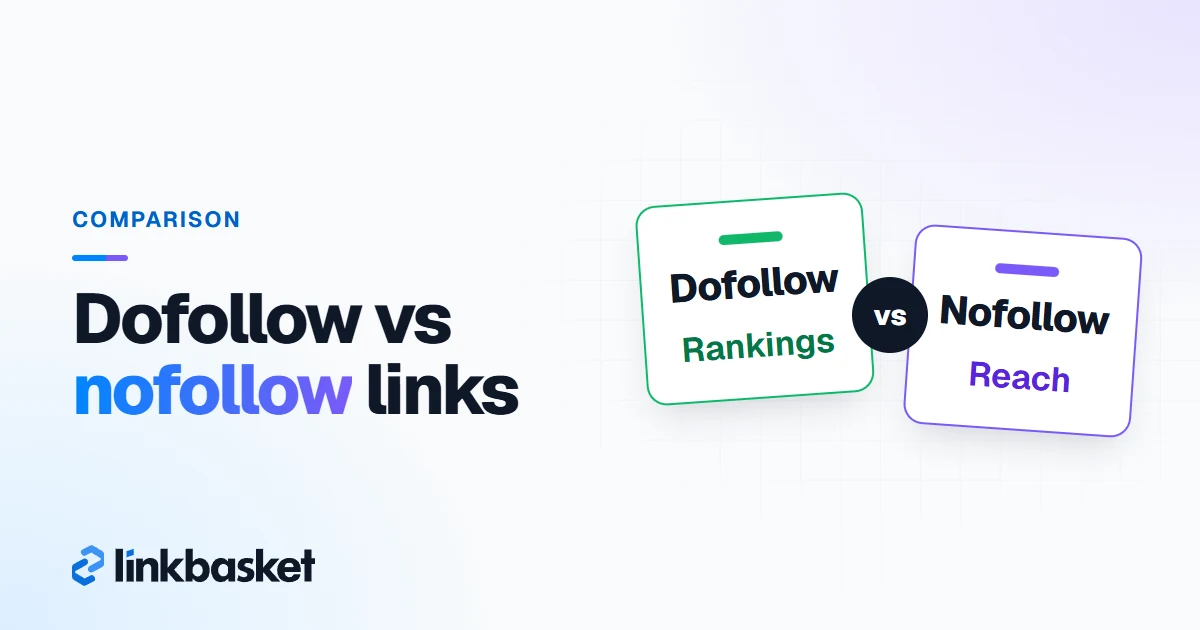
Dofollow and nofollow links in SEO differ in one way: a dofollow link can pass ranking credit, while a nofollow link generally doesn't, though Google has treated nofollow as a hint rather than a block since 2019. So dofollow usually wins for rankings. Usually. A nofollow link from a busy, relevant site can send more customers than a followed one from a quiet blog, and picking on the attribute alone is how most people waste a link budget.
Last updated: November 9, 2026
What are dofollow and nofollow links in SEO?
A dofollow link in SEO is a normal link with no qualifying rel value, and a nofollow link carries rel="nofollow", which asks search engines not to count it as an endorsement. "Dofollow" isn't a real attribute. It's slang for a link left in its default state.
Two more values joined nofollow in 2019:
sponsored: for ads and paid placements.ugc: for user-generated content such as comments and forum posts.
Google's guide to qualifying outbound links (checked November 2026) says links with any of these values "will generally not be followed." If you need the markup, our guide to dofollow link HTML has copy-paste code for each one. Here are all four values side by side:
| Link value | Markup | Use it for | Passes ranking credit? |
|---|---|---|---|
| Dofollow | No rel value | Editorial links you chose | Yes, by default |
| Nofollow | rel="nofollow" |
Links you won't vouch for | Generally not |
| Sponsored | rel="sponsored" |
Ads and paid placements | Generally not |
| UGC | rel="ugc" |
Comments and forum posts | Generally not |
What changed when nofollow became a hint in 2019?
On September 10, 2019, Google announced that nofollow, sponsored and ugc would all work as hints for ranking, not as strict rules. From March 1, 2020, nofollow also became a hint for crawling and indexing.
Google's 2019 announcement said the attributes are "treated as hints about which links to consider or exclude within Search." Three practical consequences follow:
- Google may count some nofollow links. It decides case by case and doesn't publish when.
- You don't need to change old links. The same post said there's "absolutely no need" to change existing nofollow links.
- Nofollow can't hide a page. If you relied on it to keep a URL out of the index, you need
noindexor another blocking method instead.
Here's what the hint model doesn't mean. It doesn't turn nofollow into dofollow. Nobody outside Google can measure how often a qualified link gets counted. Don't trust anyone who claims they can; treat it as a bonus, never a plan.
What's the common mistake in nofollow vs dofollow?
The common mistake in the nofollow vs dofollow debate is judging a link by its attribute before judging the site. A dofollow tag only lets value through; it doesn't create any.
People compare "dofollow: passes link juice" against "nofollow: worthless" and stop there. Big error. It skips the variables that really decide worth: topical fit, genuine visitors, placement on the page, and whether money changed hands. A dofollow link from a DR 70 site with 200 monthly visits and casino links in every post can be worth less than nothing. A nofollow mention in a national newspaper can bring sales, journalists and future editorial links.
A dofollow tag only lets value through. It doesn't create any.
Our checklist on what makes a good backlink covers those site-level checks in detail.
Which 4 conditions decide dofollow vs nofollow links?
Four conditions decide whether a dofollow or nofollow link matters more for a given placement.
- Your goal. Rankings favour dofollow. Referral visits, sales and brand reach couldn't care less about a tag.
- Site quality. On a relevant publication with real organic readers, both types earn their keep. On junk, neither does.
- Payment. Paid? Then Google expects
sponsoredornofollow, and a followed paid placement carries policy risk an earned mention doesn't. - Your site's stage. A young domain with 15 referring domains feels every followed vote. A household brand with 5,000 mostly gains from reach.
Dofollow links: what are they best for?
Dofollow links are best for building ranking strength to specific pages. Newer sites feel it most, especially when rivals hold 3 or 4 times as many referring domains.
- Best for: sites that need more authority to compete, and pages targeting commercial searches.
- Strengths: pass ranking credit by default; signal an editorial vouch; compound over time when they come from relevant pages.
- Weaknesses: bought ones carry policy risk; owners sometimes switch them to nofollow later; plenty of sites advertised as "dofollow" have no real readers.
For how to get real ones, see our guide to do follow backlinks.
Nofollow links: what are they best for?
Nofollow links are best for traffic, brand visibility and reaching people who later link to you on their own. Ranking credit? Generally none. Worthless? Not even close.
- Best for: brands chasing press coverage, communities and referral sales.
- Strengths: many large publishers and platforms qualify outbound URLs, so this is how you show up there at all. Readers arrive ready to buy. And a mix of tags is what a genuine brand's profile looks like.
- Weaknesses: little or no direct ranking effect. Google alone decides whether to use the hint. Easy to overvalue, too, when a famous name hides a tiny audience.
Digital PR campaigns are the usual route to high-profile mentions, followed or not.
Dofollow vs nofollow links compared side by side
This side-by-side comparison scores dofollow and nofollow links on the criteria that decide a placement. Skip the rows that don't match your goal.
| Criterion | Dofollow link | Nofollow link | Winner and why |
|---|---|---|---|
| Direct ranking credit | Yes, by default | Generally no (a hint since 2019) | Dofollow |
| Referral traffic | Depends on the site | Depends on the site | Tie: the site decides |
| Brand reach | Depends on the site | Often from bigger outlets | Nofollow, slightly |
| Google policy risk if paid | High without sponsored |
Low when qualified | Nofollow |
| Natural profile signal | Needed | Also needed | Tie: you want both |
| Cost when bought | Usually higher | Usually lower | Nofollow |
Read only the rows that match your goal. Most end in a tie or a narrow win, which is why the site matters more than the tag.
What is the verdict on dofollow and nofollow links in SEO?
Dofollow links are better for sites that need ranking strength, because they pass credit by default. However, if the dofollow site has no real traffic, or the link is paid and unqualified, a relevant nofollow link from a busy site is the better choice.
In plain terms: when two links come from equally good sites, take the followed one. When the sites differ, the better site wins, whatever its tag says. And don't pay a premium for "dofollow" on a domain that fails basic quality checks. You'd be buying an attribute attached to almost nothing.
When does the answer flip in favour of nofollow links?
The answer flips to nofollow when the nofollow site is far more relevant or busier, when you're paying, or when your profile already leans hard one way. Most people miss the third case.
- If the nofollow link sits on a news site your buyers read, take it over a followed link on an empty blog.
- If you're buying a placement, accept
sponsoredwhen the publisher adds it. It keeps you inside Google's rules. - If almost every link you have is followed and exact-match, a few nofollow brand mentions make the profile look natural.
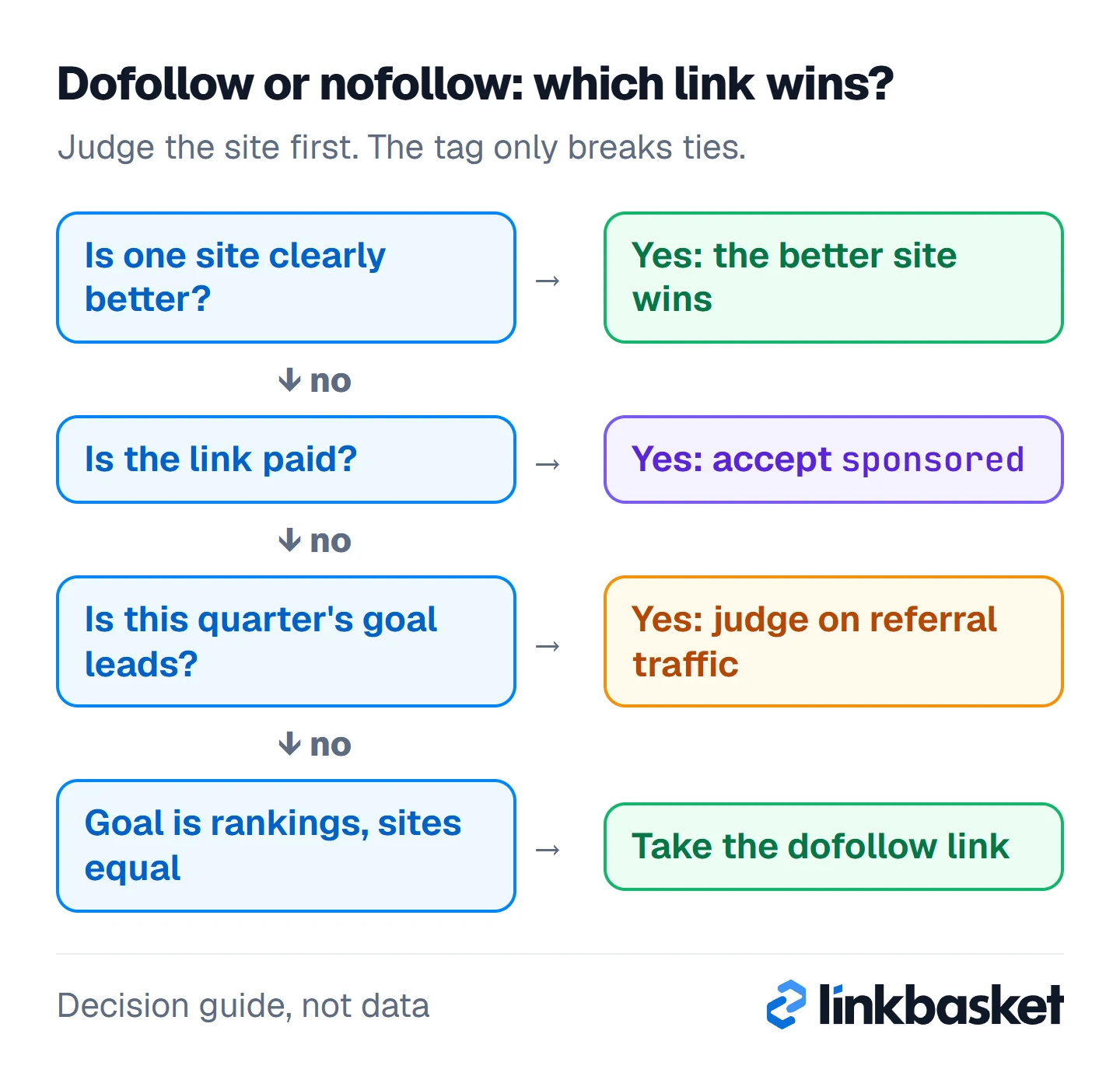
- If your goal this quarter is leads, not rankings, judge links on referral traffic only.
The flow puts those rules in order. Start at the top and stop at the first "yes".
Is there an ideal ratio of dofollow to nofollow backlinks?
No. There is no ideal ratio of dofollow to nofollow backlinks, and Google has never published one. Natural link profiles vary widely by niche, so anyone selling a "70/30 rule" is guessing.
Here is a hypothetical to show why. Every number in it is made up. Say a SaaS company has 200 referring domains, 150 followed and 50 nofollow, so 75% followed. A local bakery has 40 referring domains, 20 of them nofollow mentions in social and community sites, so 50% followed. Both profiles can be perfectly natural. What looks unnatural is a sudden pattern: 60 new followed links in 1 month, all with the same commercial anchor, on sites that sell to every niche.
So skip the ratio. When you audit a profile, watch anchors, relevance and pace instead. Our guide to your backlink profile explains which patterns raise flags.
Worked example: a dofollow link vs a nofollow link
This worked example compares one followed and one qualified placement, and every figure in it is hypothetical. Say you run an online store selling hiking gear and have 2 options this month.
Option A: dofollow
- DR 30 hiking blog
- 4,000 monthly organic visits, mostly in your country
- $150 for a link insertion
- Best for rankings
Option B: nofollow
- Feature in a national outdoors magazine
- 300,000 monthly visits
- Earned through a pitch
- Best for sales and reach
Option A adds a relevant followed link to your category page. Option B might send 400 visitors in its first week; if 2% buy at $60 each, that's $480 in sales, before counting the 20 other writers on that beat who now know your name. Take both if you can. Forced to choose? B for sales. A for rankings.
How should you treat paid dofollow and nofollow links?
Treat any paid link as a sponsored link under Google's rules. Google's spam policies list "buying or selling links for ranking purposes" as link spam, and paid links are acceptable only when qualified with rel="nofollow" or rel="sponsored".
Google said in December 2022 that its SpamBrain system can detect sites buying links and neutralise unnatural ones. In practice, then, a bad paid link usually just burns cash.
Which edge cases change the dofollow vs nofollow choice?
Four edge cases change the usual dofollow vs nofollow call.
- UGC links on your own site. Mark comment and forum links
ugc. Google also says trusted contributors can have that removed over time. - Internal links. Don't nofollow your own pages to "save" credit. If a page shouldn't appear in search, use
noindex; if it shouldn't be crawled, use robots.txt. - Page-level nofollow. A meta robots
nofollowon a page qualifies every link on it, even clean ones. Our guide on how to check dofollow links shows how to spot it. - Links switched after you got them. Followed today, qualified next spring after the owner's SEO clean-up. It happens. Check important ones every 1 to 3 months.
When should a specialist review dofollow and nofollow links?
Call a link audit specialist when Search Console shows a manual action for unnatural links, or when you're about to bulk-change rel values across thousands of outbound URLs. Both go badly wrong when rushed.
Don't bother re-tagging old links or chasing a ratio if traffic is fine and there's no manual action. Put that money into better pages. Or better sites. When you weigh your next link, run through these:
- The site is relevant, with real organic readers in your market.
- You know whether this quarter's goal is rankings or referral traffic.
- A paid link will carry sponsored or nofollow.
- Your recent anchors are mostly brand names and plain phrases.
- You've checked the attribute on your key links in the last 3 months.
FAQ
Do nofollow links help SEO at all?
Indirectly, yes. They send visitors, build brand searches and put you in front of writers who may cite you later with no tag at all. Since 2019, Google may also use a nofollow link as a hint, but you can't plan around that.
What is a dofollow backlink in simple words?
A link from another site to yours with no nofollow, sponsored or ugc value, so search engines may count it as a vote for your page.
Should all my external links be nofollow?
No. Google advises using nofollow only when you don't trust the source, not on every external link. Link normally to useful sources, and qualify only paid (sponsored) and user-added (ugc) links.
Is a sponsored link the same as a nofollow link?
Not exactly. Both generally don't pass ranking credit, but sponsored tells Google the link was paid for. Google prefers sponsored for paid links, though it still accepts nofollow.
Next step: compare link types before you buy
To see each site's link type and sponsored tag before you pay, browse the LinkBasket inventory of publisher sites with a free account. If you want followed links without the purchase risk, our guide to how to get high-quality backlinks covers earned methods.