Do follow backlinks are normal links from another site to yours that carry no nofollow, sponsored or ugc value, so Google may count them as a vote for your page. That is the whole definition. The hard part is that a dofollow link is only worth having when the site behind it is relevant, gets real visitors and placed the link on purpose. This guide shows how to judge any dofollow site, how to get real ones, and why the free "dofollow backlinks list" you found is mostly spam.
Last updated: November 9, 2026
What is a do follow backlink?
A do follow backlink is a plain HTML link with no rel value telling search engines to ignore it. There is no dofollow attribute. "Dofollow" is just SEO slang for a link left in its default state.
So a link counts as dofollow when its code says nothing. Add rel="nofollow", rel="sponsored" or rel="ugc" and it stops being one. If you want the exact markup, our guide to dofollow link HTML code has copy-paste examples for WordPress, Shopify and Blogger.
Three terms are worth keeping straight:
- Backlink: any link from another website to yours.
- Dofollow (followed) link: a backlink with no qualifying rel value.
- Referring domain: a unique site that links to you, however many links it sends.
Why do dofollow backlinks pass ranking value?
Dofollow backlinks pass ranking value because Google reads an unqualified link as one site vouching for another. Google built its early ranking on that idea, known as PageRank, and its spam policies still describe links that "pass ranking credit."
Qualified links work differently. Google's page on qualifying outbound links (checked November 2026) says links marked nofollow, sponsored or ugc "will generally not be followed." Since September 10, 2019, Google has treated all three values as hints rather than hard rules, so it may still use some of them. You can't plan around that, though.
Here's the catch most people miss. A dofollow tag doesn't create value. It only lets value through. A followed link from a page nobody visits, on a site Google barely trusts, passes close to nothing. The full trade-off between the two link types sits in our dofollow vs nofollow comparison.
Which do follow backlinks sites are worth a link?
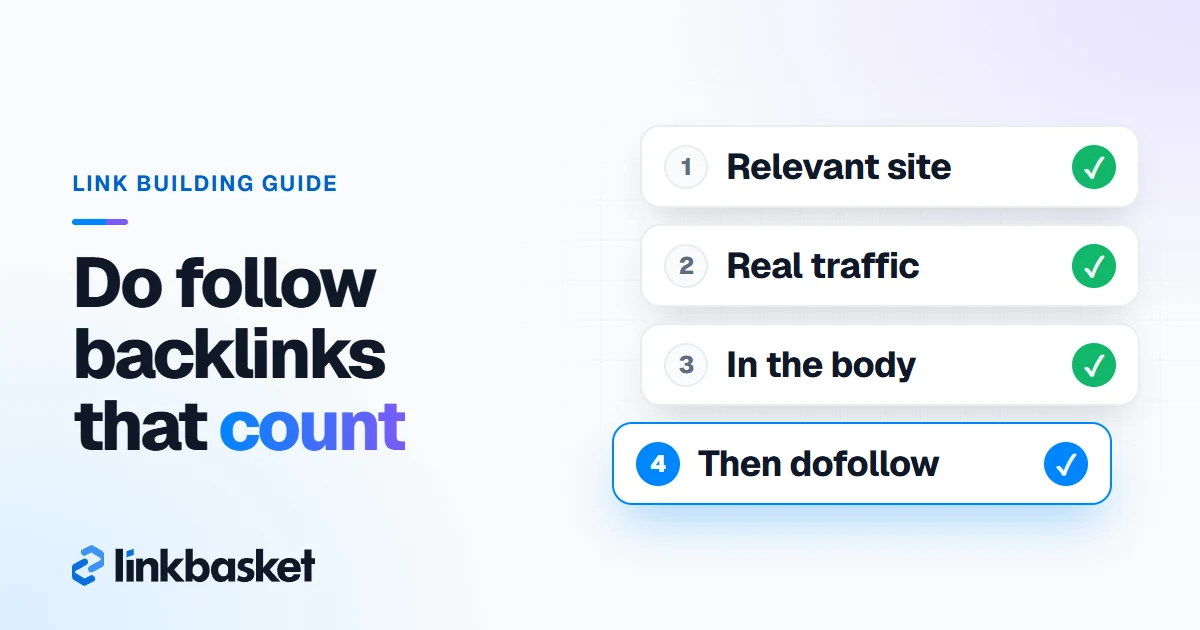
A do follow backlinks site is worth a link when it passes the same quality checks you'd run on any link: relevance, real organic traffic, editorial placement and clean outbound links. The dofollow attribute comes last, not first.
Run these in order, because the early checks kill bad sites fastest:
- Is the site indexed? Search
site:example.com. If a site claims 2,000 posts and Google shows 40, stop. - Is it relevant? Read 5 recent posts. Same topic or same reader? Keep going.
- Does it get organic traffic? Open the 12-month graph in Ahrefs or Semrush. Steady traffic in your countries is a pass.
- Does DR match the traffic? A Domain Rating (DR) of 60 with 300 monthly visits points to an inflated score.
- Will the link sit in the body? In-article, in a relevant paragraph, beats bio, sidebar and footer.
- Is the neighbourhood clean? Scan 10 recent posts for casino, loan and essay links.
- Is the link actually followed? Confirm it on the live page. Our walkthrough on how to check dofollow links covers the browser and tool methods.
Read the flow below from the top and stop at the first red box. In practice, the first three rows do most of the work. Notice where the dofollow question sits: last.
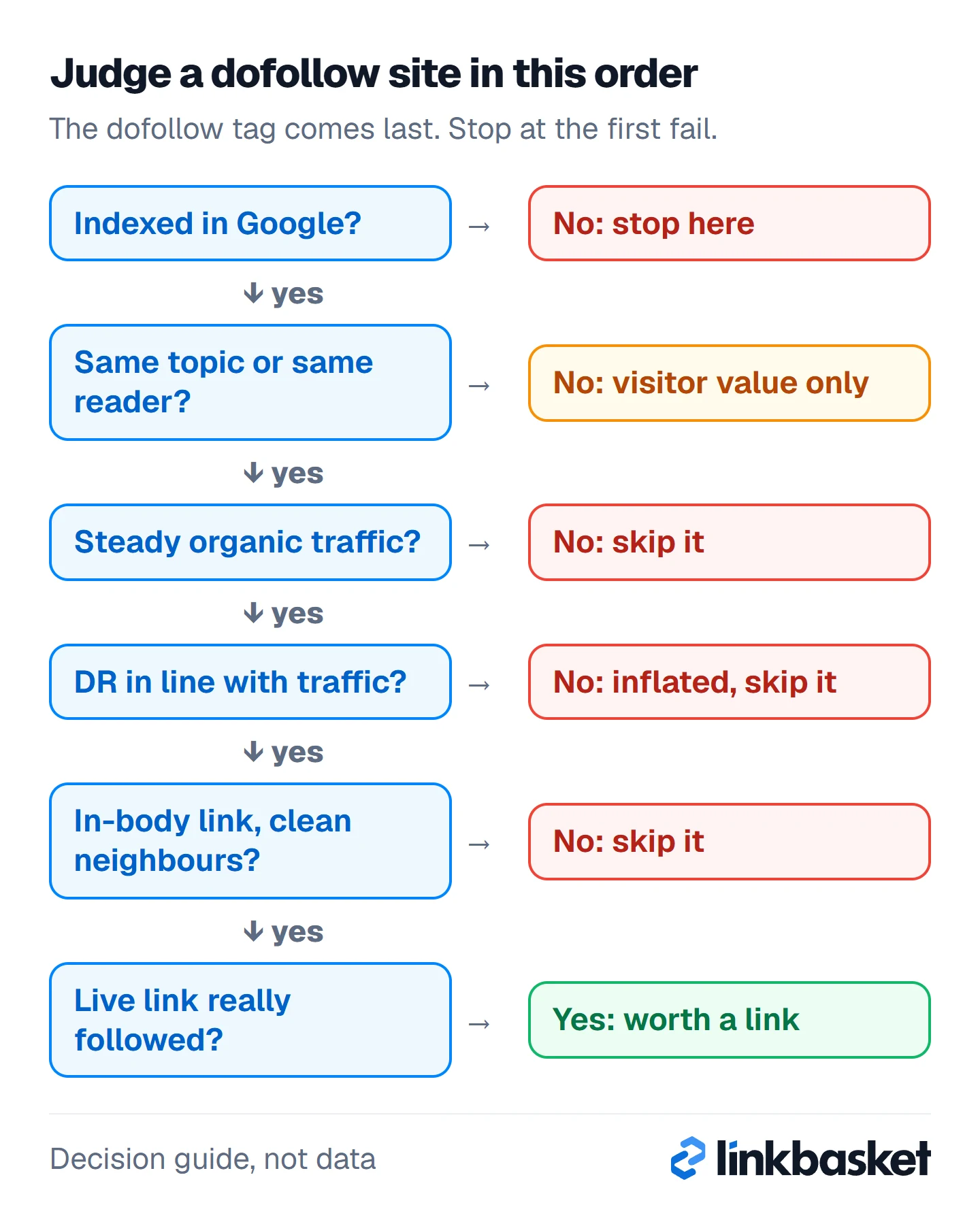
Our checklist on what makes a good backlink goes deeper on each check. The point here is the order. Don't trust "dofollow" as a selling point when the first 6 checks fail. When you skip straight to the tag, you pay for the wrong thing.
How do you get real dofollow backlinks?
You get real dofollow backlinks by giving relevant sites a reason to link, then asking them. Editors link to useful pages, original data and real businesses, and most editorial links are dofollow by default.
These methods work, roughly from cheapest to most expensive:
- Reclaim lost links. Find old links pointing at pages that now return a 404 and redirect those URLs. Our guide to 301 redirect backlinks shows how.
- Turn brand mentions into links. Search for your brand name without a link and ask the writer to add one. Little effort, and the writer already knows you.
- Get listed by partners. Suppliers, clients, software you integrate with and local associations often keep partner pages.
- Publish something worth citing. A survey, a calculator or a clear data table earns links for years.
- Write guest posts for relevant editorial sites. Pitch real articles to sites your buyers read. A guest posting service does the outreach for you if your time costs more than the fee.
- Run digital PR. Data stories pitched to journalists can win links from news sites, though some big publishers add
nofollowto outbound links.
Plenty of sellers still pitch shortcuts as dofollow link building. Skip them.
Why are dofollow backlinks lists mostly spam?
A dofollow backlinks list is mostly spam because every site on it is open to anyone, so thousands of people have already dropped links there. A link that anyone can create in 2 minutes carries no editorial vote.
Look at what these lists usually contain:
- Forum and profile pages where you sign up and add a URL
- Blog comment sections
- Free Web 2.0 blogs and bookmarking sites
- Social sites that switched outbound links to
nofolloworugcyears ago
Here's a hypothetical test you can run on any list. Every number in it is made up. Say a list promises 100 "high DA dofollow sites." You open 10 at random. Three are dead or redirect elsewhere. Four add ugc or nofollow to user links. Two accept links but sit on pages Google hasn't indexed. That leaves 1 of 10 that might pass anything, and its page is a user profile with no traffic. Scale that to 100 and you have perhaps 10 links worth nothing much, plus hours of work.
Dofollow blog posting sites are a separate case. A "write for us" page on a real, edited blog is a legitimate guest post target. A site that publishes anything from anyone, in every niche, is a link farm with a submission form. Our backlink sites list guide shows how to tell the two apart, and the forum and profile backlinks post explains where those links still have a narrow use.
Are paid dofollow SEO backlinks safe?
No paid dofollow link is risk-free. Google's spam policies (checked November 2026) list "buying or selling links for ranking purposes" as link spam, and Google wants paid links marked sponsored or nofollow.
Google also says it understands that buying and selling links is a normal part of the web for advertising. The line it draws is the attribute. A paid link qualified with rel="sponsored" is fine; a paid dofollow link is what the policy targets. In practice, Google mostly neutralises such links rather than penalising the buyer, so a bad paid link is often just wasted money.
If you buy anyway, these things lower the risk:
- A relevant, editorial site with real readers in your market
- A natural anchor, usually your brand or a plain phrase
- An in-body placement on a page Google indexes
- No sites that sell to every niche or advertise "dofollow guaranteed"
- Accepting a sponsored tag when the publisher adds one
None of these makes a paid link safe. They make it look like a link a site would give on merit.
Dofollow backlinks decision table
This decision table matches common dofollow backlink sources to a verdict. Use it before you spend time or money on any of them.
| Source | Usually followed? | Editorial vote? | Verdict |
|---|---|---|---|
| Relevant editorial article (earned) | Yes | Yes | Best link you can get |
| Guest post on a real niche blog | Usually | Partly | Good if the site passes the checks |
| Paid link insertion on a relevant site | As agreed | No | Policy risk; judge site quality hard |
| Partner or supplier page | Often | Yes | Easy win, ask for it |
| News site via digital PR | Often nofollow | Yes | Worth it for reach either way |
| Forum, profile or comment link | Mostly nofollow or ugc | No | Skip for SEO |
| Free "dofollow backlinks list" site | Varies | No | Skip |
Worked example: which dofollow backlink would you pick?
This worked example compares two dofollow offers, and every number in it is hypothetical. Say you sell project-management software and get 2 offers in the same week.
Offer A: general blog
- DR 72
- 1,500 monthly organic visits
- Posts on 30+ unrelated topics
- $250 for a dofollow link
- About $167 per 1,000 visits
Offer B: remote-work blog
- DR 38
- 9,000 monthly organic visits
- 70% of readers in the US and UK
- $180 for a dofollow link
- $20 per 1,000 visits
Price per 1,000 monthly visits tells the story. Offer A costs about $167 per 1,000 visits. Offer B costs $20. Offer A wins on one number, DR, and loses on relevance, traffic and neighbourhood. Pick B. If both were nofollow, B would still be the better buy, because its readers might actually click.
Which edge cases change the dofollow backlink rules?
Five situations change how you should treat do follow backlinks.
- Brand-new site (under 6 months): a handful of relevant dofollow links from DR 20 to 40 niche blogs beats one expensive high-DR link.
- Local business: your city's news site or chamber of commerce can matter more than a national blog, whatever the attribute.
- Health, finance and legal: editors are stricter and some publishers charge a surcharge for sensitive topics, which LinkBasket site pages disclose.
- Link switched after publishing: owners sometimes add
nofollowmonths later during an SEO clean-up. Check paid links on a schedule. - Too many exact-match anchors: 20 dofollow links that all say "best CRM software" look bought, even if each site is fine.
When should you call a link specialist about dofollow links?
Call a link audit specialist when Search Console shows a manual action for unnatural links, or rankings drop sharply after a spam update. More dofollow links won't fix either problem.
Don't build dofollow links at all when your page isn't ready. If the target page is thin, slow or doesn't answer the query, links won't hold it up for long. Fix the page first. And don't skip these checks before your next link:
- Search Console shows no manual action for unnatural links.
- The target page answers the query and loads fast.
- Your anchors are mostly your brand or plain phrases, not one money keyword.
- Content in a regulated field, such as medicine or financial advice, has been reviewed by a qualified professional.
FAQ
Are dofollow backlinks better than nofollow?
For rankings, usually yes, because Google generally doesn't follow nofollow links. For traffic and brand reach, a nofollow link on a busy site can beat a dofollow link on a dead one. Judge the site first, the attribute second.
How do I know if a backlink is dofollow?
Right-click the link, choose Inspect, and look for a rel value. No nofollow, sponsored or ugc means it's followed. Also check the page's meta robots tag, because a page-level nofollow overrides a clean link.
Do dofollow external links on my own site hurt my SEO?
No. Linking out to useful, relevant sources with normal dofollow links is fine. Google's guidance says to use nofollow only when you don't trust the source, and to mark paid or user-added links with sponsored or ugc.
Can I get dofollow backlinks for free?
Yes. Partner pages, unlinked brand mentions, reclaimed 404 links and genuinely useful content all earn dofollow links at no cost beyond your time. Free sites that let anyone post a link are a different matter, and rarely help.
Next step: find dofollow backlinks you can check first
To see link type, DR, traffic and top country before you pay, browse the LinkBasket link inventory with a free account and no card. Our link building packages page covers bulk orders, and digital PR campaigns suit brands that want news coverage. To understand the risk side, read our guide to PBN backlinks.