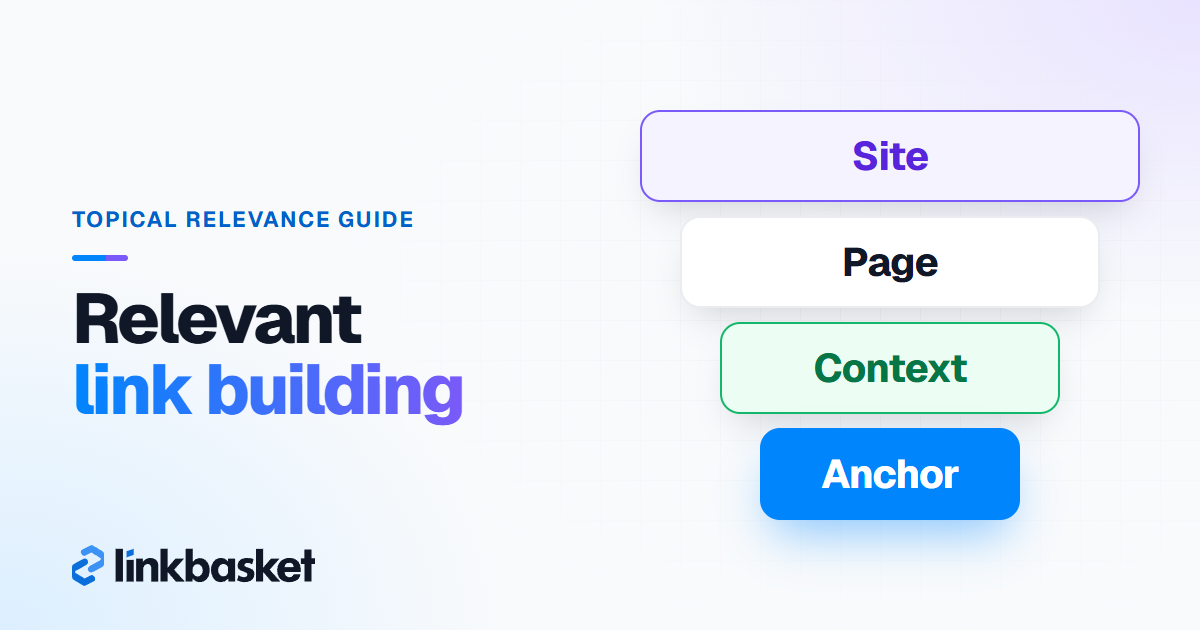
Relevant link building means getting backlinks from sites and pages that cover your topic or serve your buyer, so each link makes sense to a reader and sends a clear topical signal. Judge relevance on four levels: the site, the page, the text around the link, and the anchor.
Last updated: November 9, 2026
What is relevant link building?
Relevant link building is the practice of earning or placing links only where the linking page shares your subject or your audience. A cycling blog linking to a bike-fitting studio is relevant. A casino blog linking to it isn't, whatever the casino blog's DR.
Why does Google care? Its link best practices page, checked in November 2026, says "Google uses links as a signal when determining the relevancy of pages." The same page says good anchor text is "relevant to the page that it's on" and that "the words before and after links matter." So Google reads the link in context. Not just the fact that it exists.
There's a reader side too. A relevant link gets clicked by people who might buy. An off-topic one gets ignored, which tells you something about how much it's really worth.
What are the four levels of backlink relevance?
Backlink relevance works on four levels, from broad to narrow: the linking site, the linking page, the surrounding text and the anchor text. A strong link is relevant on at least the first three.
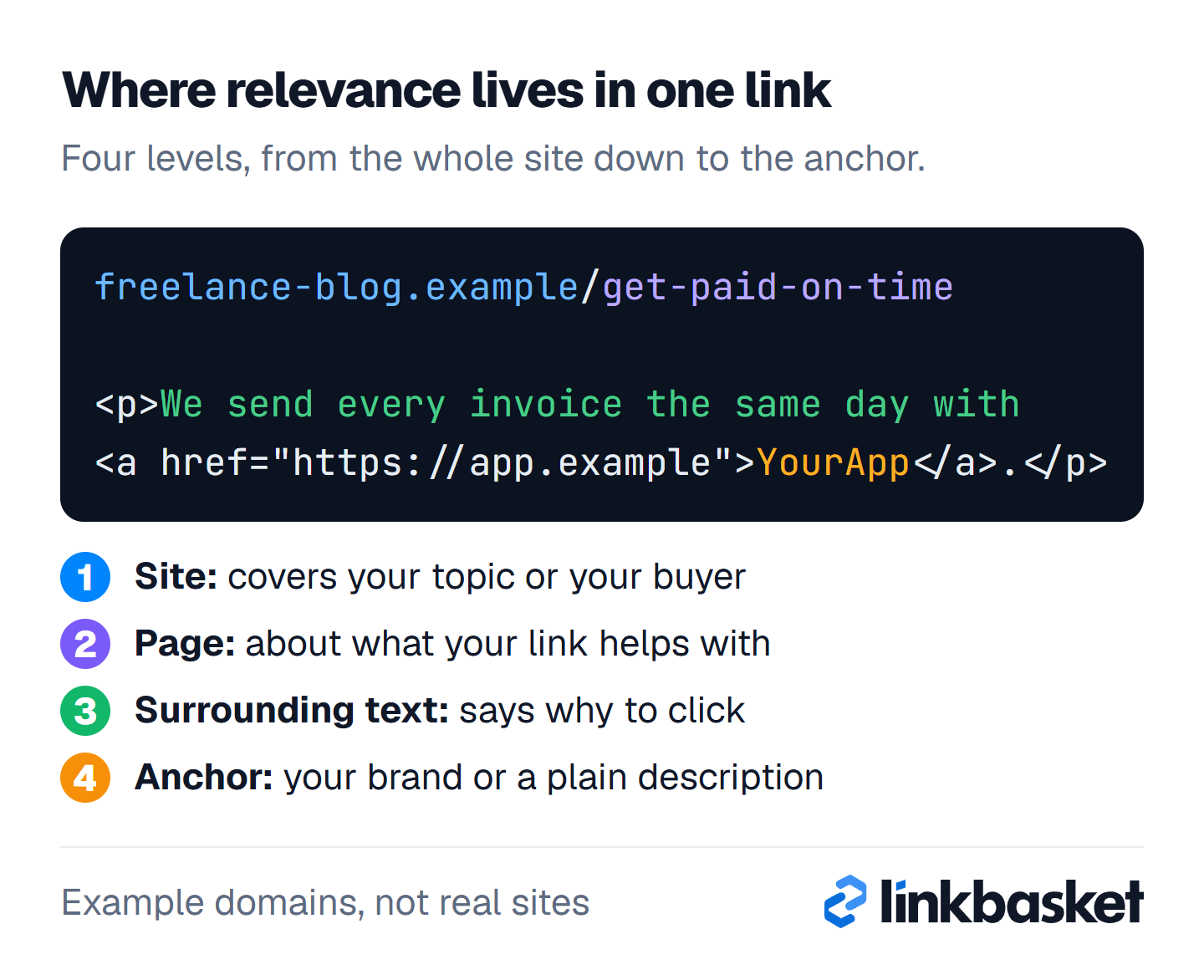
Each colour in the code matches a number below it. One link carries all four levels at once, so a single weak level can drag down a link that looks strong on the domain.
- Site relevance: does the whole site cover your topic or serve your buyer? A personal-finance blog is site-relevant for a budgeting app.
- Page relevance: is the specific page about something your link helps with? A finance blog's post on saving for a wedding fits; its post on celebrity net worth doesn't.
- Surrounding text: do the sentences around your link explain why a reader should click? "We tracked spending for 3 months with a budgeting app" beats a link dropped into an unrelated paragraph.
- Anchor text: does the clickable text describe your page? Brand names and plain descriptions work. A forced exact-match keyword looks placed.
Most people check only level 1. Don't stop there. Page and context relevance are where a general site can win, and where a "niche" site can quietly fail.
How do you judge whether a backlink is relevant?
Judge a backlink's relevance by scoring each of the four levels from 0 to 2, then reading the total against a simple threshold. It takes about 5 minutes per site once you've done a few.
| Level | 0 points | 1 point | 2 points |
|---|---|---|---|
| Site | Unrelated topic and audience | Same audience, different topic | Same topic |
| Page | Unrelated page | Neighbouring topic | Exact topic of your target page |
| Surrounding text | Link dropped in with no context | Loose fit | Sentence explains why to click |
| Anchor | Forced keyword or "click here" | Generic but harmless | Brand or descriptive phrase |
Read the total this way: 7 or 8 is a strong relevant backlink; 5 or 6 is fine, especially from a site with real traffic; 4 or under is a skip. These thresholds are our planning rule of thumb, not a Google number.
How to score the site level quickly:
- Read the titles of the last 10 posts. Count how many touch your topic.
- Look at the site's top ranking keywords in Ahrefs or Semrush. Are they your buyer's searches?
- Check the top traffic country. A relevant site in the wrong market is half relevant.
Relevance is still your call. Read the site.
Niche relevant backlinks vs general sites: which is better?
Niche relevant backlinks usually beat links from general sites, because both the site and the page match your topic. But a general site with a highly relevant page can match a niche link, and sometimes beat it on traffic.
| Site type | Site relevance | Page relevance | Typical strength | Watch out for |
|---|---|---|---|---|
| Niche blog in your topic | High | High | Strong topical signal | Low traffic on tiny blogs |
| Neighbouring niche (same reader) | Medium | High if the post fits | Good, often cheaper to win | Forced angles |
| General news or magazine | Low | High on the right section | Authority and readers | Off-topic sections |
| "General" blog posting every niche | Low | Low | Weak | Link-seller pattern |
The last row is the trap. A site that writes about health on Monday, crypto on Tuesday and roofing on Wednesday exists to sell links. It may call itself "general." It isn't a publication in any sense a reader would recognise.
Neighbouring niches are the underused middle. A running blog linking to a sports physio, a wedding blog linking to a budgeting app: same reader, different topic. Those links are relevant and easier to get, because fewer competitors pitch there.
How does relevant link building work in a real decision?
Relevant link building works by scoring each candidate and picking the best fit, not the biggest name. Here's a worked example with 3 candidate sites, and every number in it is hypothetical.
Say you sell invoicing software for freelancers and you're weighing three links:
- Site A: a freelance-writing blog, DR 38, 9,000 monthly organic visits. The post is "How to get paid on time as a freelancer." Your link sits in a sentence about sending invoices. Score: site 2, page 2, text 2, anchor 2. Total 8.
- Site B: a general business magazine, DR 72, 150,000 monthly visits. The page is a roundup of "10 apps for small teams," with your link in a list of 10. Score: site 1, page 1, text 1, anchor 2. Total 5.
- Site C: a "general" blog, DR 55, 1,200 monthly visits, posting casino and CBD content beside business tips. Score: site 0, page 1, text 1, anchor 1. Total 3.
Pick A. B is a reasonable second if you want reach. C fails, and its DR 55 doesn't rescue it. Notice that the bar order is almost the reverse of the DR order.
How do you get relevant backlinks?
You get relevant backlinks by mapping which sites share your topic or your reader, then pitching only content that fits their next post. Start with a list of 3 circles.
- Same topic: blogs, trade sites and newsletters about exactly what you do.
- Same reader: sites your buyer reads for other reasons. Freelancers read about pricing, tax and productivity, not only invoicing.
- Same place: for local businesses, city news, chambers of commerce and local events.
Then pick tactics that suit each circle. Guest posts and expert quotes fit circle 1, data studies reach circles 1 and 2, and sponsorships fit circle 3. Our guide on how to get high quality backlinks covers the tactics step by step, and local link building covers circle 3.
How do you get niche related backlinks in a tiny niche?
To make niche related backlinks in a small niche, widen the circle to sites that share your reader, then write content that ties your topic to theirs. A narrow niche has maybe 20 or 30 true niche sites. You'll exhaust them fast.
Here's the method we'd use. List 5 problems your buyer has that aren't your product. A freelancer using invoicing software also worries about tax, pricing, late clients and finding work. Each of those problems has its own blogs, newsletters and podcasts. Pitch each one an angle where your topic answers their reader's problem, such as "what to put on an invoice so clients pay in 14 days" for a freelance-pricing blog.
The link is then relevant at the page and text level, even though the site's main topic differs. That's a legitimate, relevant backlink. Don't stretch it further than a reader would. If you have to explain to yourself why the link fits, it doesn't.
Is link building still relevant to SEO?
Yes, link building is still relevant to SEO in 2026, because Google still uses links in ranking. Google's guide to its ranking systems lists link analysis systems and PageRank, and says PageRank "continues to be part of our core ranking systems."
What changed is which links count. Google has fought link spam for years: its Penguin system, announced in 2012, became part of the core ranking systems in 2016, and its SpamBrain system now looks for links bought or built to manipulate rankings. Volume alone stopped working long ago.
So the answer has two halves. Links still matter. Relevant, editorial links matter far more than many random ones, and a page with weak content won't rank on links alone.
Which edge cases change backlink relevance?
Four edge cases change how you judge backlink relevance: local businesses, big multi-topic publishers, brand-new niches and paid placements.
- Local businesses: geographic relevance counts, so a city news site with no topical match can still be a strong link for a local plumber
- Big multi-topic publishers: judge the section and page, not the domain; a national paper's tech section is relevant for a SaaS tool even though the paper also covers sport
- Brand-new niches: if no niche sites exist yet, the neighbouring-niche circle becomes your main source
- Paid placements: relevance lowers the risk but doesn't make a paid link compliant, because Google's spam policies treat links bought to manipulate rankings as link spam and ask for
rel="sponsored"
That last point matters for anyone searching "safe relevant backlinks."
When should you get help with relevant link building?
Get help with relevant link building when your niche is so narrow you can't find 20 relevant sites yourself, or when Search Console shows a manual action for unnatural links. The first is a research job for a link builder who knows your sector. The second needs an independent SEO auditor who doesn't sell links, us included.
Don't hire anyone who sells "relevant links" by DR band without naming the sites. When you can't see the site, you can't judge it. Ask these four questions first:
- Will you name every site before I pay?
- Can I see the page my link goes on, or one like it?
- What's each site's top traffic country?
- Who picks the anchor text, and can I change it?
A provider who dodges any of them is selling DR, not relevance.
FAQ
Do irrelevant backlinks hurt my site?
Usually not directly. Google tends to ignore or neutralise off-topic links rather than penalise them. A large pattern of irrelevant paid links can lead to a manual action, though, so don't build them on purpose.
Is a relevant nofollow link worth getting?
Often, yes. A relevant nofollow link sends readers who care about your topic, and it adds to a natural-looking profile. Our guide to dofollow vs nofollow links explains how Google treats each.
Is relevance more important than DR?
For most decisions, yes. DR measures a site's own link profile, not its topic. A DR 35 niche blog with real readers often beats a DR 70 general site. Our guide to DA vs DR explains what those scores do measure.
Are niche edits relevant backlinks?
They can be. A niche edit adds your link to an existing page, so relevance depends entirely on that page's topic and the sentence around your link. Check the page before you order, as our comparison of niche edits vs guest posts explains.
Next step: score your next five link targets
Take your next five link targets and score them on the four-level table above. Then check the survivors against our guide to what makes a good backlink. If you want to compare sites by niche and traffic country, browse the LinkBasket site inventory with a free account.