The best link building strategies match three things: your site type, your goal and your budget. A link building strategy is the plan, not the tactic. It decides which tactics you mix, how many links you aim for, how fast you add them, which anchors you use, and how you split money between earned and paid links.
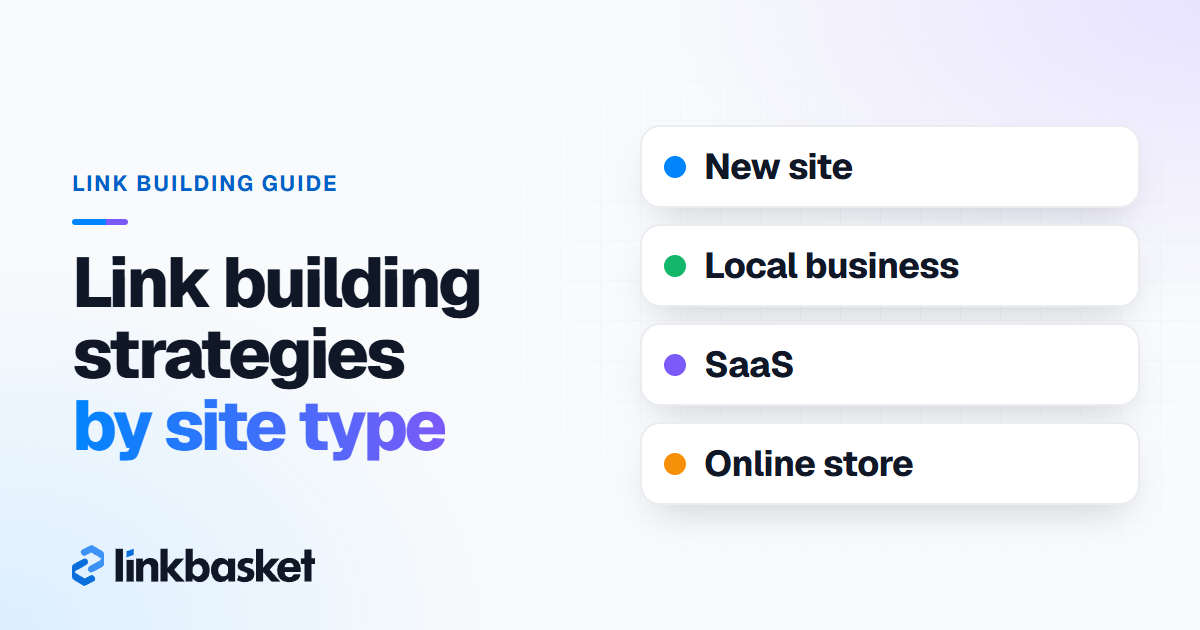
New sites need a slow, mostly earned base. Local businesses need local links, SaaS wins with data and partner pages, stores need links to category pages, and publishers need topic relevance above all. Paid placement is one branch. Never the whole plan. For budgeting, BuzzStream's data (updated October 2026) puts a guest post at $295 bought direct and a digital PR link at $1,250 to $1,500.
Last updated: November 9, 2026
This post covers planning. For step-by-step tactics like outreach and broken link building, see how to build backlinks.
What decides which link building strategies fit you?
Five variables decide which link building strategies fit you: site type, goal, competitor gap, budget and hours, and niche risk.
- Site type. A two-month-old blog and a 10-year-old store can't share a pace.
- Goal. One money page, the whole domain, the local map pack and referral traffic each need different links.
- Competitor gap. How many more relevant linking domains do the top results have? That number sets your target.
- Budget and hours. Earned links cost time. Paid ones cost cash.
- Niche risk. Finance, health and legal sites face tighter editorial rules and fewer willing publishers.
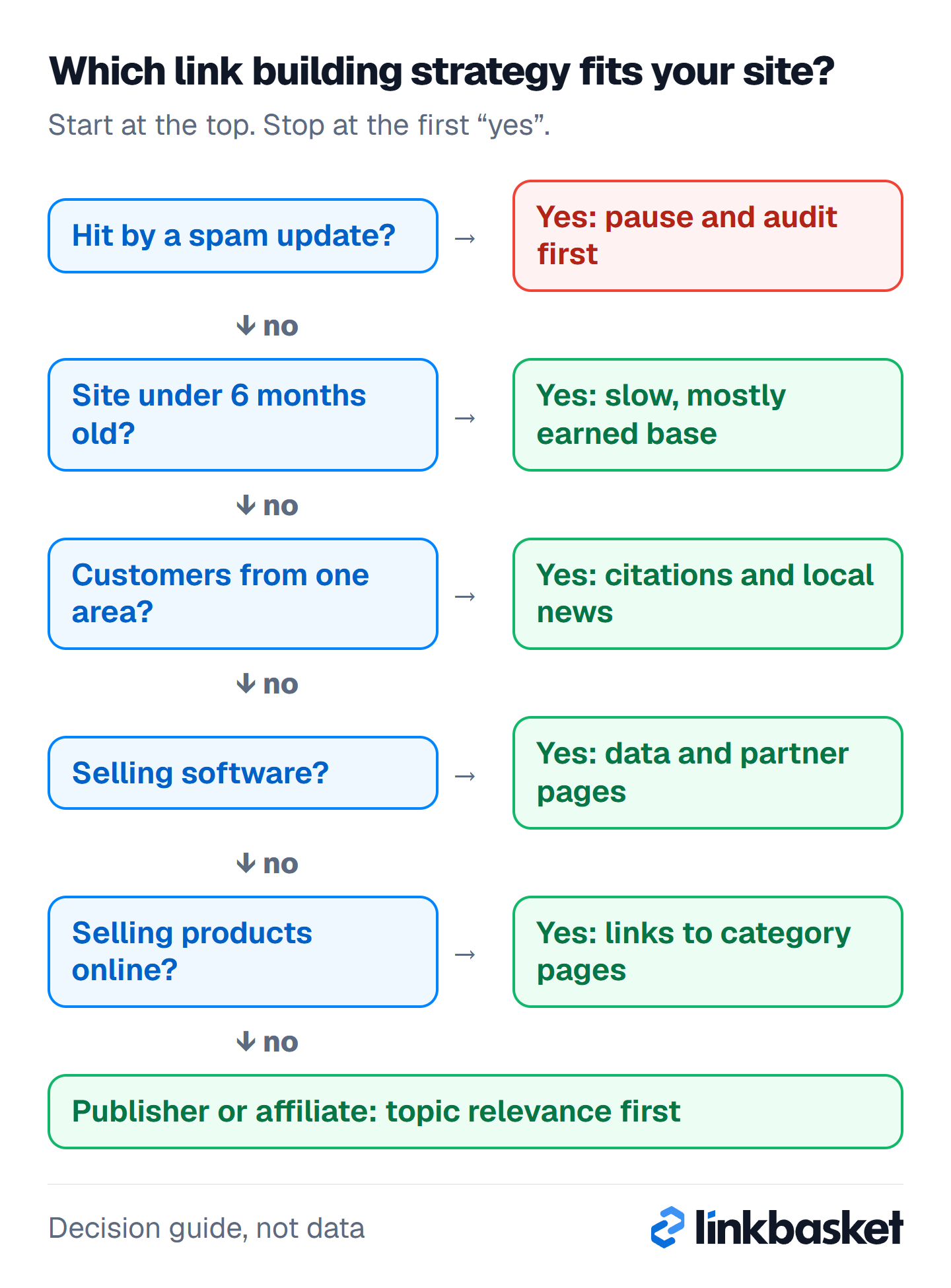
Find your branch in the tree first. When you have it, read that site type's section below for the mix and the pace.
How do you set link targets from a competitor gap?
You need about as many relevant referring domains as the pages already ranking, minus the ones you have. A competitor gap gives you that number, so don't pick one out of the air.
- Pick one target page and its keyword. Strategy works page by page.
- List the top 3 to 5 results that are real competitors, not Wikipedia or Reddit.
- Count referring domains to each in Ahrefs, Semrush or a similar tool; our guide on how to check backlinks walks through it.
- Run a link gap. Domains linking to two or more competitors but not to you are your warmest prospects.
- Set the target. Take the median of the top 3, subtract your own count, and keep only relevant domains. That's your 6-month target.
Relevance beats raw count. In practice, ten placements on sites in your topic often do more than thirty on sites that have nothing to do with you, and our post on what makes a good backlink shows how to judge each one.
What does a competitor-gap target look like?
A competitor-gap target is the median of the top 3 pages' referring domains, minus yours, filtered for relevance and spread over 6 months. The numbers below are a hypothetical with round figures.
Say your invoicing software page sits at position 9 and you want it in the top 3 within 6 months. Here's the math in four steps:
- Measure: 60 The top 3 pages have 40, 60 and 90 referring domains, so the median is 60.
- Subtract: 45 Your page has 15, which leaves a raw gap of 60 − 15 = 45.
- Filter: 30 Drop directories, scrapers and off-topic sites. About 30 are worth matching.
- Pace: 5 a month Spread 30 links over 6 months. Start with the 12 that link to two rivals.
Swap in your own numbers. In practice, the filter step is where most targets shrink, and most people skip it. Don't.
What link building strategy fits an established site?
For an established site stuck on page two, the best link building strategy is a 6-month plan: earn the cheap links, build one linkable asset, then close what's left.
- Months 1 to 2: fix and earn. Claim unlinked brand mentions, reclaim broken backlinks, and pitch the warmest gap prospects.
- Months 3 to 4: build a linkable asset. A data study, a free tool or a strong guide gives outreach something to point at, and it keeps earning links after the pitching stops if it answers a question people in your niche keep asking.
- Months 5 to 6: fill the remaining gap. Where the gap is made of sites that take guest posts or insertions, a well-chosen paid placement can close it faster than another round of cold email.
If your gap is mostly news and media sites, lean on digital PR. Read digital PR vs link building first, because BuzzStream's link building pricing data puts a PR link at $1,250 to $1,500, several times a guest post.
If it's mostly niche blogs and industry sites, mix outreach with guest posts and insertions on domains you pick.
Can't tell what the gap is made of? Then don't spend on paid links yet.
Which link building strategies fit your site type?
Site type changes the rules. Bend the main path to fit yours.
What link building strategy fits a new site?
A new site under 6 months old needs a slow strategy built on earned links, because it has no link history and little worth citing. Spend months 1 to 3 on content plus a small base: social profiles, founder bylines, partner pages, a few relevant guest posts. Tempted to buy 20 links in month one? Don't. With so few other links, each paid one becomes a big share of your profile.
What link building strategy fits a local business?
A local business needs local links: citations, local news, trade bodies and sponsorships. Google's Business Profile help says local results are "mainly based on relevance, distance, and popularity," so a national guest post does little for a plumber in Leeds. Our local link building guide covers each tactic. Buy rarely, and only on sites with local readers.
What link building strategy fits SaaS?
SaaS link building works best around things other sites want to cite: original data, integrations and honest comparisons. Build partner and integration pages, publish data reports, and point links at feature and comparison pages, not only the homepage. When outreach stalls, SaaS link building placements on tech sites can close the rest.
What link building strategy fits an ecommerce store?
An ecommerce link building strategy has to reach category pages, since products rarely earn links and categories carry the money keywords. Earn coverage with gift guides, product-led PR and brand collaborations, then pass that strength along through internal links. Paid insertions in relevant buying guides can reach key categories directly; our upcoming guide to ecommerce link building goes further.
Which strategy fits a publisher or affiliate site?
Publisher and affiliate sites need a strategy that puts topic relevance first, because they have the least room for error. Google's spam policies name "thin affiliation" as its own problem, and a paid link pointing at a thin review page stacks two risks. Earn links with original testing data and expert quotes. If you buy, buy few, in your exact topic.
How fast should you build backlinks?
Build backlinks at roughly the pace your top competitors gained them over the last 6 months, because Google hasn't published a safe number and anyone who quotes you one is guessing. Don't trust them.
- Match the field. Check new referring domains for your top 3 competitors over 6 months, and aim for a similar or slightly faster rate.
- Stay steady. Ten links a month for six months looks more natural than 60 in week one and none after.
- Tie growth to publishing. Links that arrive when you release something worth citing look earned, because they often are.
- Slow down on new and YMYL sites. Thin trust plus fast growth is a bad mix.
What anchor text should a link building strategy use?
Use anchor text that describes the target page naturally. Google's guidance on crawlable links says: "Good anchor text is descriptive, reasonably concise, and relevant to the page that it's on and to the page it links to." The same page warns against cramming in every related keyword.
We don't publish target percentages. Without data behind them, nobody should. The principle is simpler: write the anchor the way the publisher would naturally refer to your page, which usually means your brand, your URL or a plain description, with exact-match money phrases kept rare.
When you control the anchor (guest posts, insertions, partner pages), vary it on purpose. When you don't (digital PR, mentions), take what you get. Those mostly arrive as brand anchors. That's healthy.
How should a strategy split earned and paid links?
Split earned and paid links by site type and risk, with earned links as the majority for most sites. Neither kind is free.
Earned links cost hours. Plenty of sites ask for a fee anyway. When Ahrefs pitched guest posts to 180 sites without offering money, the fees they asked for averaged $77.80 (updated July 2024). Paid placements cost cash: BuzzStream puts guest posts at $295 direct, $461 through a vendor, and insertions at $179.
The site you buy on is what lowers that risk: topic relevance, real organic traffic, an editorial standard, a sponsored tag where the publisher adds one, and no link farms. LinkBasket checks every live link weekly for 12 months. Each listing shows DR, DA, organic traffic, spam score, top country, link type and price before you pay.
Read the table below with care. It's a hypothetical starting point, not LinkBasket data and not a rule. Adjust it to your situation, your niche and your competitors' profiles.
| Site type | Earned share (illustrative) | Paid share (illustrative) | Why it might start here |
|---|---|---|---|
| New site (0 to 6 months) | 80 to 100% | 0 to 20% | Too little content and history to justify buying |
| Local business | 80 to 90% | 10 to 20% | Citations and community ties do most of the work |
| SaaS | 60 to 70% | 30 to 40% | Data and partner pages earn well; paid fills tech gaps |
| Ecommerce | 55 to 65% | 35 to 45% | Category pages rarely earn links on their own |
| Publisher or affiliate | 70 to 80% | 20 to 30% | Thin affiliate pages plus paid links stack risk |
Going the paid route? Buy backlinks on sites you can see first, and read how to outsource link building to choose between a freelancer, an agency and a marketplace.
Which edge cases change a link building strategy?
A spam-update drop, a sensitive niche, a spammy competitor, a domain move or client work can each change a link building strategy.
- Rankings fell after a spam update? Stop all paid links and audit first.
- Finance, health or legal? Expect fewer publishers and higher prices; lean harder on expert content.
- A competitor's profile is built on spam? Don't copy it. Match only the relevant domains.
- Migrating domains? Redirect old URLs and ask your best linkers to update before any new outreach.
- Planning for agency clients? Build a separate plan and site list per client, and see our white-label link building service.
Decision matrix: which strategy should you run?
Find your site type and goal, then run the mix and pace in that row.
| If your site is | And your goal is | Then run | At this pace |
|---|---|---|---|
| New (0 to 6 months) | Build a base | Partner pages, bylines, a few relevant guest posts | A handful of links a month |
| Local business | Map pack and local terms | Citations, local news, sponsorships, trade bodies | Steady, tied to local events |
| SaaS | Rank feature and comparison pages | Data reports, integration pages, niche tech guest posts | Match top 3 competitors' growth |
| Ecommerce | Rank category pages | Product-led PR, gift guides, paid insertions in buying guides | Steady, with lifts at launches and sales |
| Publisher or affiliate | Lift topic authority | Original data, expert quotes, few paid links in your exact topic | Slow and steady |
| Any | Recover from a penalty | No new paid links; audit and clean up | Pause |
When should you bring in a link cleanup specialist?
Bring in a link cleanup specialist if Search Console shows a manual action for unnatural links, or if you've bought links before and traffic fell after a spam update. Hire a technical SEO consultant who has filed reconsideration requests, and ask for a past example. Big stores with faceted navigation should get an internal linking audit before buying anything.
If you've bought links before, run these checks before any new campaign:
- Search Console shows no manual action.
- Traffic didn't drop after a spam update.
- You know which links past agencies built.
- Your target page deserves to rank before links point at it.
- You've set a 6-month target from a competitor gap.
FAQ
What is the best link building strategy?
No single strategy wins everywhere. The best one closes your competitor gap with relevant links at a pace your site can support: for most established sites, earn first, then buy what outreach can't close.
Are white hat link building strategies enough to rank?
Often, if you have time and something worth citing. Speed is the catch. Backlinko's 2019 study of 12 million outreach emails found only 8.5% got a reply, so outreach alone may outlast your budget when competitors are far ahead.
How many backlinks do I need per month?
There's no fixed number. Spread your gap over 6 months and compare it with competitors' monthly growth; if the two are far apart, stretch the timeline.
Is buying links part of a good SEO strategy?
It can be. Treat it as one part, with clear eyes on the risk. Pick relevant sites with real traffic, use natural anchors, and keep paid links a minority of your profile.
Where should your link building strategy start?
Start your link building strategy with one money page: run the gap, set a 6-month target, then decide what you'll earn and what you'll buy. Ready to fill the paid share? Browse our link inventory or check per-site link pricing.