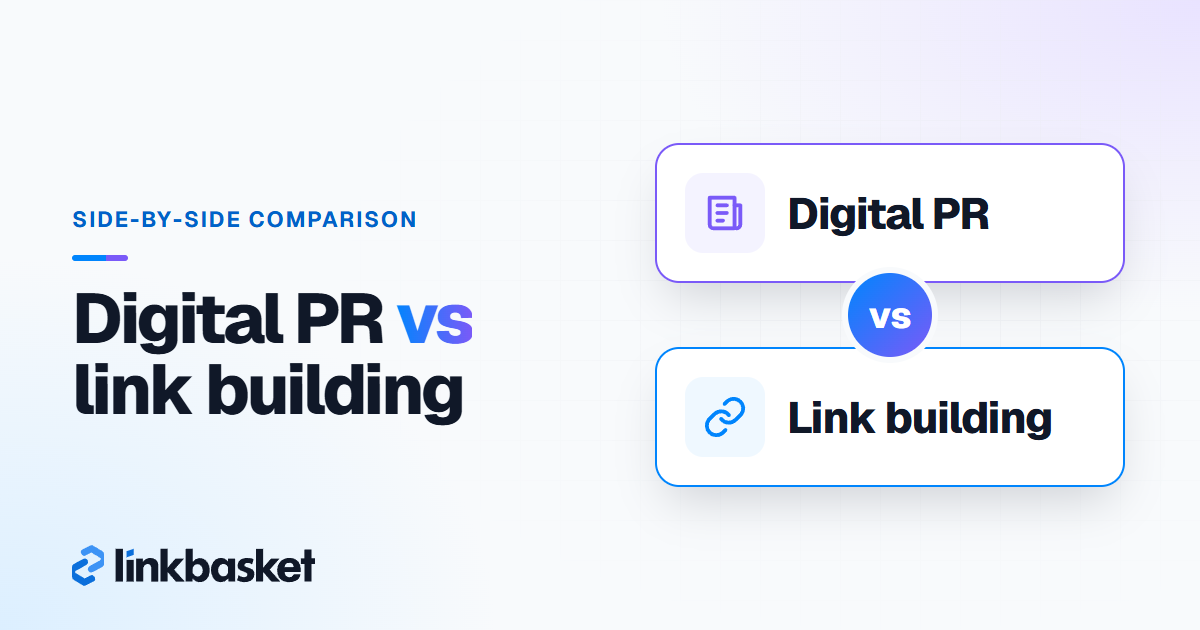
Digital PR vs link building is a trade-off between press links you can't control and placed links you can: digital PR pitches stories to journalists, while placement-based link building buys a link on a site you pick. PR links cost more. They also land less predictably. BuzzStream's survey of about 70 agency leaders and freelancers, updated in June 2026, put the average at $597 per PR link, against a $150 midpoint for guest posts. Our verdict: placements win when specific pages need links on a fixed budget and timeline. Digital PR wins when you have a real story, a brand to build, and money to absorb a campaign that misses.
Last updated: November 9, 2026
What is the difference between digital PR and link building?
Digital PR is one type of link building, so the fair comparison is digital PR vs placement-based link building, where you pay a publisher for a specific guest post or link insertion.
The difference that matters is control. With PR link building, a journalist decides whether to cover you, which page to link and what words to use. Often they point to your homepage with your brand name as the anchor. Sometimes they mention you and skip the hyperlink entirely. When you order a placement, you pick the site, the target URL and the anchor text before you pay.
That one gap drives cost, speed and risk.
What decides digital PR vs link building for your site?
Four things decide digital PR vs link building for most sites: which page needs links, whether you have a story, how much variance your budget can take, and how soon you need results.
Most comparisons skip those and judge on link authority alone, reasoning that a national newspaper beats a DR 50 blog every time, so digital PR wins and the case is closed.
That's only half right. A strong link to the wrong page does little for the page you need to rank, and that's the part most people miss when they chase big logos. Say your revenue comes from a "commercial cleaning in Leeds" service page. A news link to your homepage helps a bit. Three relevant links pointing straight at that service page, with anchors a real editor might write, often help more than one famous masthead ever will.
Here's which way each of the four leans:
- Which page needs links. Homepage and brand authority lean toward PR. Product, service and category pages lean toward placements.
- Whether you have a story. No data, no expert and no angle means no coverage. B2B software and insurance are harder to pitch than travel or food.
- Budget and tolerance for variance. A PR campaign can land 2 links or 40. A placement lands 1, at a known price.
- Timeline. Do you need links live this month, or can you wait a quarter for a campaign to build momentum?
Answer those four honestly and the choice usually makes itself.
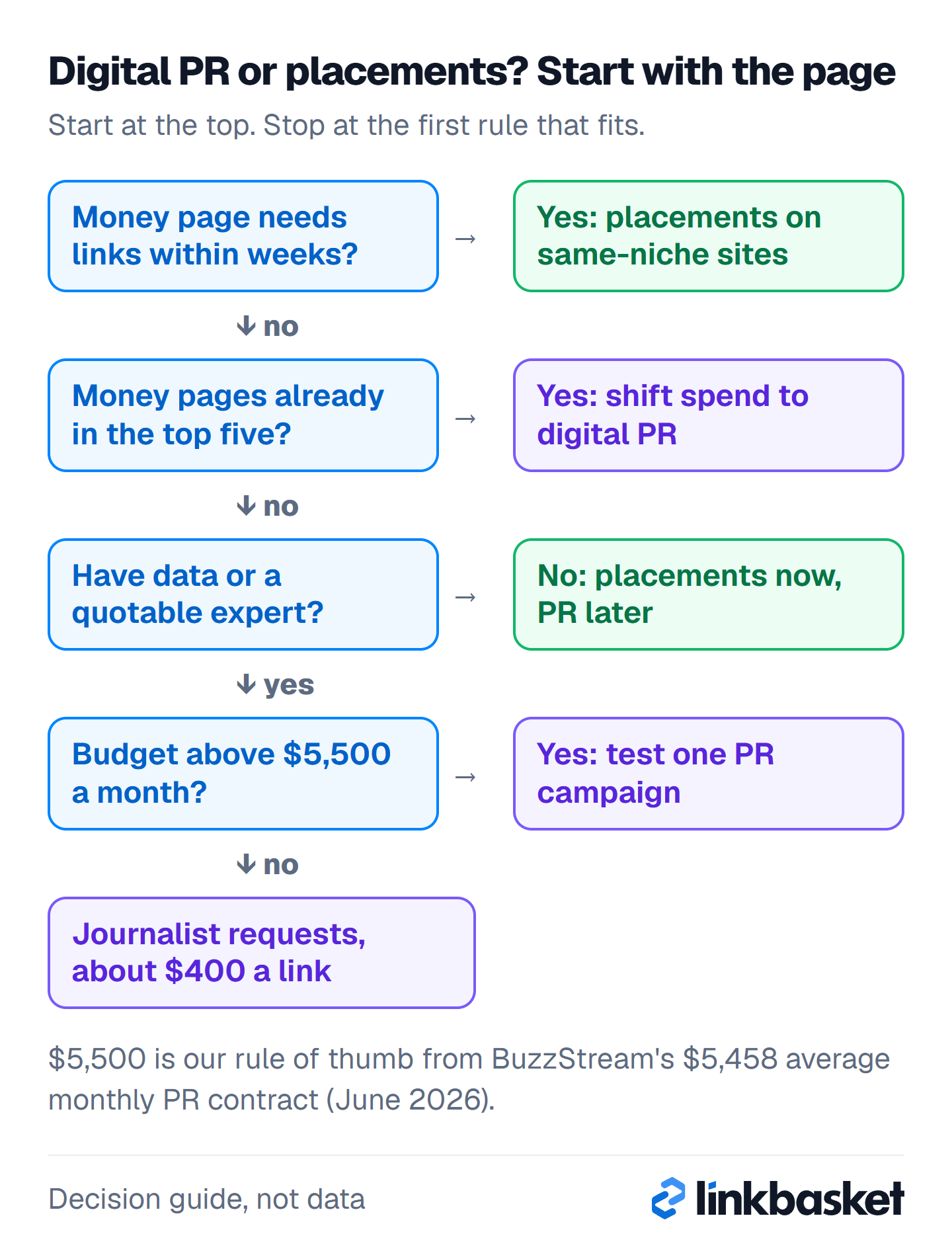
Stop at the first rule that fits. Note that the page comes first and budget fourth.
How does digital PR earn links?
Digital PR earns links when a journalist covers your data, expert comment or campaign and cites your site as the source. It suits brands with original research or a spokesperson who can reply fast.
Strengths:
- Backlinks you can't buy. National and trade press rarely sell them. Coverage puts you on outlets with editorial standards and big audiences.
- Brand value beyond SEO. Coverage drives referral traffic, brand searches and sales calls, and gives AI search tools more independent places that mention you.
- Lower spam-policy exposure. A journalist chose to cite you. Editorial links like that are not what Google's link spam policy targets.
Weaknesses:
- Unpredictable output. You pay for the campaign, not the links. A campaign can take six weeks of research, design and pitching, then go out the same week as an election result or a celebrity scandal, and nobody writes about it. Bad luck. You still pay.
- Little control over target page and anchor. Most links go to your homepage or campaign page, with your brand as anchor. Links to a service page are rare, so don't bother with PR when one page needs links by next month.
How does placement-based link building work?
Placement-based link building means paying a publisher for a guest post or a link insertion (niche edit) on a site you chose. It suits pages that need links now: ecommerce categories, SaaS feature pages, service pages and local firms with no national story.
Strengths:
- You see the site before you pay. Every listing in our link marketplace inventory shows DR (Ahrefs), DA (Moz), organic traffic, referring domains, spam score, top traffic country, link rules, typical delivery time and price.
- You choose the target page and anchor. Both go in the brief when you order. Publishers may decline anchors that look spammy, which protects you as much as them.
- Fixed price, known terms. Each site has one published price. If the publisher rejects the order, the full price, add-ons included, goes back to your wallet.
Weaknesses:
- Paid links carry policy risk. We'll say it plainly, in the box below.
- Less brand value. A guest post on a niche blog won't get your CEO onto a podcast.
- Quality swings wildly across the market. Plenty of sellers push link farms with bought traffic, recycled articles and outbound links to any casino or crypto site that will pay, and those links do nothing for you, or worse.
In practice, you cut that risk at the selection stage:
- Match the site's topic to your page.
- Check that organic traffic is steady, not one spike followed by a slide.
- Prefer editorial sites that publish for readers.
- Accept a sponsored tag when the publisher adds one.
- Walk away from anything that looks like a link farm.
Anchors matter too. Don't use exact-match money keywords as your default; brand names, bare URLs and partial phrases look like links people actually write. Our guide to what makes a good backlink walks through each check. Once a link is live, LinkBasket checks it weekly for 12 months. If the link is removed, switched to nofollow or the page goes offline, we restore it, move it to a comparable site or refund it to your wallet.
How much does PR link building cost per link?
PR link building costs about $597 per link on average, according to BuzzStream's digital PR cost survey, last updated in June 2026. The same survey found an average monthly contract of $5,458. That's per month, not per campaign.
BuzzStream breaks the cost down by type of work:
Treat those as rough guides. BuzzStream calls the service figures weighted midpoints, and the sample is small and self-reported. About 54% of respondents were UK-based, and they reported $818 per link on average, against $350 in the US.
BuzzStream's State of Digital PR report, updated in February 2026, adds context. The most common known cost per link was $300 to $500, chosen by 19.6% of respondents. The share paying $750 or more rose from 3% to 10.2%. And 39.2% of practitioners don't know their cost per link at all, down from 51.4% a year earlier. That last number tells you how hard PR output is to forecast.
Worked example (hypothetical, round numbers). Say you have $6,000 a month for links. At BuzzStream's $597 average, an average PR month returns about 10 links. A quiet month returns 3. Now each one costs $2,000, and you won't know which kind of month you bought until it ends. Spend the same $6,000 on guest posts at the $150 midpoint and you get about 40 placements, each on a site and page you picked. The PR links may sit on national news sites; the placements sit where your revenue pages need them. They buy different things.
When you buy placements, you decide how many links you want and add up the listed prices; our page on how publishers set placement prices explains what drives each one.
Digital PR vs link building compared head to head
Head to head, digital PR wins on authority, brand value and policy safety, while placement-based link building wins on cost, control and predictability.
| Criterion | Digital PR | Placements (guest posts, niche edits) | Winner and why |
|---|---|---|---|
| Cost per link | $597 average (June 2026); $300 to $500 most common (February 2026) | $150 guest post midpoint (June 2026); fixed price per site | Placements, on price |
| Predictability | Links per campaign unknown until it runs | One order, one link; refund to wallet if rejected | Placements |
| Control of page and anchor | Low; mostly homepage and brand anchors | Full; you choose both | Placements |
| Authority ceiling | National and trade press | Set by the site you choose; DR shown before you pay | Digital PR, for news-grade trust |
| Brand and referral value | High when coverage lands | Low to moderate | Digital PR |
| Speed to a live link | First coverage within a week for 81% of teams | Delivery time shown on each listing | Close; placements are more certain |
| Spam-policy exposure | Low for earned coverage | Real; relevance and natural anchors reduce it | Digital PR |
On timing, the State of Digital PR report found that 81% of teams land first coverage within a week of pitching. Yet 51.4% say measurable results take 3 to 6 months. A fast link and a ranking gain run on separate clocks.
Digital PR vs link building decision matrix
Find the row that matches your situation and begin with the method on the right.
| Your situation | Monthly link budget | Start with |
|---|---|---|
| Service, product or category page close to page one | Any | Placements on same-niche sites |
| Original survey or usage data, brand needs authority | Above about $5,500 (one average retainer) | One digital PR campaign as a test |
| Expert who can answer press requests within hours | Any | Journalist requests (about $400 per link) |
| No story, no data, no spokesperson | Below about $5,500 | Placements only; revisit PR later |
| Money pages already rank in the top five | Any | Shift spend to digital PR |
| Launch in under two weeks | Any | Placements |
The $5,500 line is our rule of thumb, based on BuzzStream's $5,458 average contract, and the logic is simple: below it, a single PR campaign can swallow several months of spend before you learn whether it worked.
Which is better, digital PR or link building?
For most small and mid-size sites, placement-based link building is better, because you control the page, the anchor, the price and the timing. Digital PR is the better pick when you have a newsworthy story, a brand you want known, and budget to absorb a campaign that lands few links.
Why do we land there? Honestly, a newspaper link is a nice-to-have for most small sites. Their gap isn't homepage authority. It's links to the three or four pages that make money, and digital PR rarely reaches those pages, however well a campaign performs. Placements do reach them. The catch: you have to pick relevant sites with real traffic.
PR earns its price once your money pages already have links, or when your story is good enough that coverage turns into brand demand. Plenty of brands end up doing both, in sequence, and the plan below shows the order we'd use.
When does the digital PR verdict flip?
The verdict flips when your money pages already rank, when you own data journalists want, or when your niche or deadline makes one method impractical.
- Your money pages already rank in the top five. Extra placements bring smaller gains there. Shift budget to digital PR.
- You own proprietary data. Survey results, pricing data or usage stats make strong PR hooks. Data stories travel further than opinion pieces.
- Your niche makes placements awkward. Some publishers charge extra for sensitive topics such as finance or health, and some refuse them outright. Expert commentary through journalist requests can cost less, near $400 per link in BuzzStream's survey.
- You run a local business. Neither national PR nor broad niche placements may fit. Local news, sponsorships and citations usually matter more, as our guide to local link building by business type explains.
- You need links live before a launch in two weeks. Skip the PR retainer for now; it's too slow and too uncertain.
How do you combine digital PR and link building?
Combine digital PR and link building in sequence: place links on the pages closest to ranking first, then fund one PR asset that lifts the whole domain.
- Audit your pages List the pages that drive revenue, then check which of those URLs have few or no backlinks compared with the pages that outrank them. Our walkthrough on how to check backlinks to your site shows the steps.
- Place links on pages closest to page one Choose same-niche sites with real traffic, through guest posting or niche edits.
- Build one linkable asset A survey, a data study or a calculator. Without one, you have nothing to pitch, and no amount of outreach will fix that.
- Pitch it, then watch the news Reactive PR means commenting on breaking stories within hours, which only works if someone with real expertise can drop what they're doing, write three useful sentences and send them before the journalist files.
- Reclaim unlinked brand mentions Find articles that name you without linking, and ask the writer to add the link.
- Track cost per ranking gain for each page After 6 months, compare the two honestly and cut whichever delivers less, even if the PR coverage felt more exciting when you shared it with the team.
More tactic ideas sit in our roundup of link building strategies by site type.
FAQ
Is digital PR safer than buying guest posts?
Usually, yes, because a journalist's choice to cite you is editorial. Bought links that pass ranking credit count as link spam under Google's policy. No seller can promise zero risk. PR isn't immune either: the same policy names press releases with optimized anchor text.
How long does digital PR take to get links?
First coverage often lands within a week of pitching, but ranking movement usually takes a quarter or two. Guest posts and niche edits show a typical delivery time on each listing instead.
What are unlinked brand mentions?
They're articles that name your brand without linking to your site. Find them with a brand-name search or a mention tracker, then ask the author for a link. Don't skip this after a campaign. These writers already chose to cover you, so a polite request is far warmer than cold outreach.
Can you do digital PR in a boring niche?
Yes. The story just has to come from data or people, not the product. A payroll software firm can publish salary data. A plumber can survey homeowners about repair costs. With neither data nor an expert voice, put the budget into placements first and revisit PR later.
Next step: plan your link building page by page
List the pages that earn your revenue, then plan their links with our guide to a 90-day link building campaign. Ready to pick sites? Browse publisher sites with metrics shown with a free account.