No number of backlinks per day is safe or unsafe on its own, because Google sets no link velocity limit. What matters is whether your new links look natural for the content and attention your site actually gets. So when people ask how many backlinks per day is safe, the honest answer is that the question is slightly wrong, and this guide shows the better one to ask.
Last updated: November 9, 2026
What is link velocity, or backlink velocity?
Link velocity, also called backlink velocity, is the rate at which a site gains new backlinks or referring domains over a set period, such as a day, a week or a month.
SEO tools chart it as a line of new referring domains over time. The term comes from the SEO industry. Not Google. Google's documentation doesn't use it. Nor has Google published a rate that triggers a penalty.
When you see the idea discussed, it comes in two forms:
- Raw speed: 10 links a day, 300 a month.
- Relative speed: links gained compared with your site's history and with competitors.
Relative speed is the one worth watching. A news site gaining 500 links a week? Normal. A two-month-old blog doing the same is not, unless something it published genuinely took off and you can point to the post, the mentions and the traffic that came with them.
Does Google limit how many backlinks per day a site can get?
No. Google publishes no limit on how many backlinks per day a site can gain. Its spam policies judge the kind of links you get, not how fast they arrive.
We read Google's spam policies in November 2026, line by line, looking for any mention of speed. The link spam section lists buying links for ranking purposes, excessive link exchanges, automated link programs, keyword-rich guest post campaigns and widget or footer links. It names no daily or monthly cap.
Google's John Mueller made the same point in a 2019 video. As Search Engine Roundtable reported on November 1, 2019, he put it this way:
It is not the number in the period of time, it is really the type of activity instead.
John Mueller, Google, 2019
Speed itself isn't the problem. It's a symptom.
Google also doesn't need a speed rule to catch bought links. In its December 2022 link spam update post, Google said SpamBrain can detect both sites buying links and sites used to pass outgoing links, and that it neutralises unnatural links.
What makes a backlink pattern look unnatural?
A backlink pattern looks unnatural when new links outpace the attention your site gets, or when they share traits real links rarely share: the same anchors, the same kind of site, the same placement.
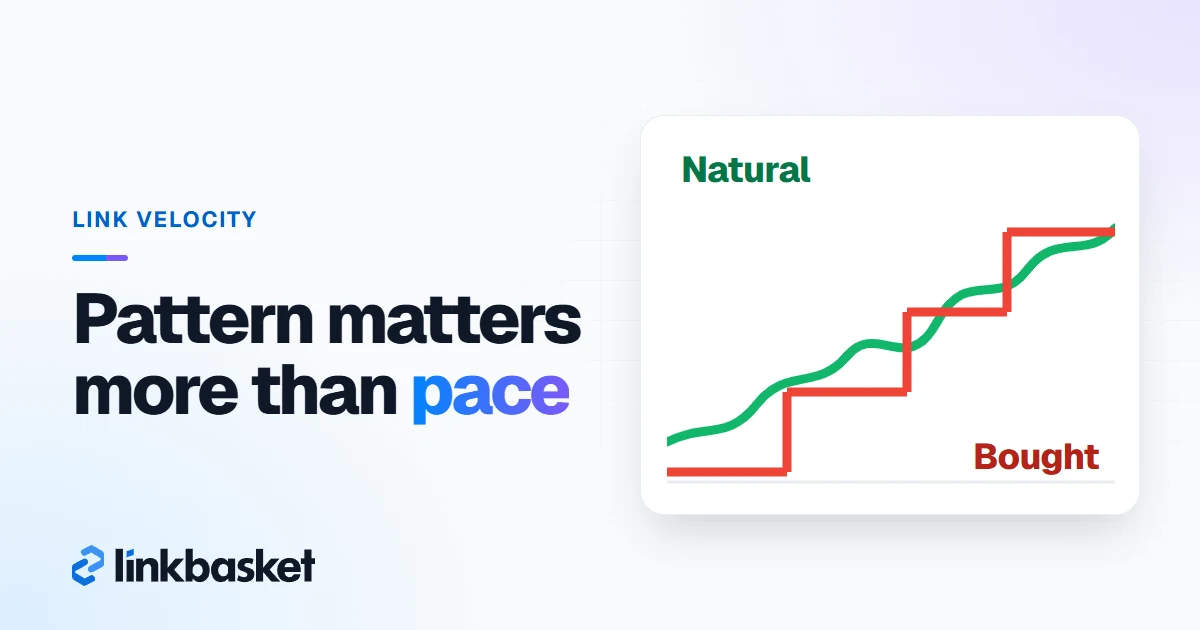
Natural links follow attention. You publish something useful, people find it, and a few of them link to it. The line on the chart wobbles. Bought links follow a budget, so the line steps up neatly on the day the invoice gets paid and stays flat in between, which is a shape almost no real marketing produces.
Six signs that make a pattern look bought. If you've seen three or more in your own data, stop and review:
- A jump in links with no new content, news or launch behind it
- Exact-match money anchors on most new links
- Links from sites on unrelated topics
- Every link from the same format, such as guest posts with author bio links
- Footer, sidebar or sitewide links arriving in batches
- Linking sites that sell to every niche and publish dozens of posts a day
Our guide to your backlink profile explains how to read these traits in your own data. To test your own graph, run it through the flow below. Each "no" points to a fix.
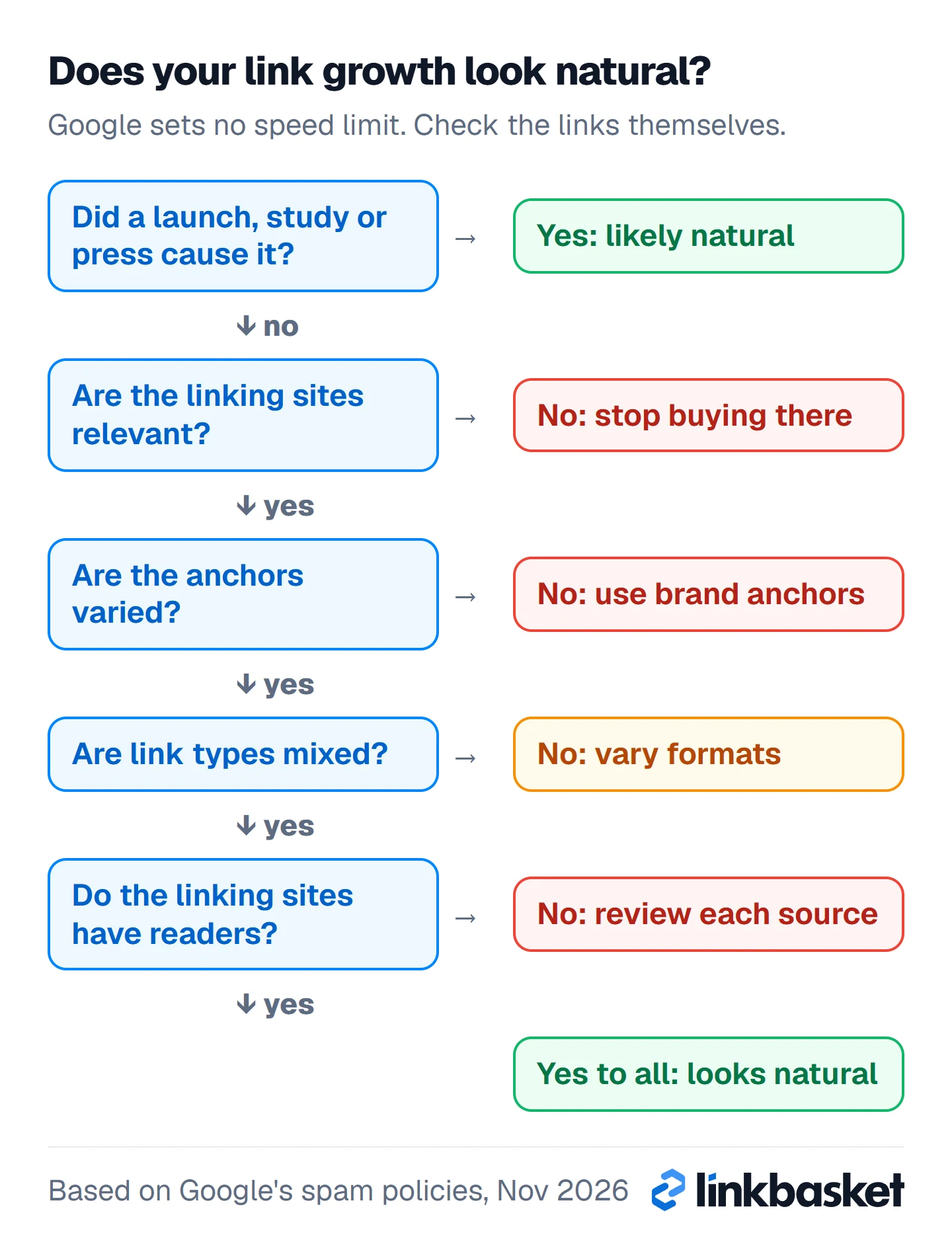
How many backlinks per day is safe for a new website?
For a new website, no daily number is safe by itself, but a slow, relevant start fits best. Why? A site with almost no content or traffic has little reason to attract dozens of links a day.
Getting too many backlinks on a new website is mostly a relevance problem. Not a speed one. Think about what a real new site earns: a few links from partners, suppliers, local directories, maybe one blog that liked a post. That is the baseline Google sees for most new businesses.
Our advice for a new site:
- Publish useful pages first. Links need something to point at.
- Start with links you'd earn anyway: partners, associations, local press.
- Add paid placements slowly, and only on relevant sites with real traffic.
- Keep anchors mostly branded for the first months.
- Don't trust any seller who promises a "safe" daily quota.
Don't panic over a natural burst. If a post goes viral and earns 80 links in a day, that is exactly what natural looks like. Most people forget this. They see a spike in Ahrefs, assume a penalty is coming and start disavowing good links, which does real damage while the spike itself did none.
How many backlinks per month suits an established site?
An established site can usually add more backlinks per month, because it already has content and traffic that attract links. Measure new links against your own history. Ignore forum numbers.
When you open the referring domains history in Ahrefs or Semrush, or your Search Console links export, find your normal monthly gain over the last 12 months. That's your baseline. Write it down. Now compare:
- New links in line with your baseline, from relevant sites: normal growth.
- A big jump tied to a launch, a study or press coverage: also normal.
- A big jump with no cause, from unrelated sites with keyword anchors: the pattern to avoid.
For a fuller view of the numbers you need, read our guide on how many backlinks you need to rank.
Does drip-feed link building make bought links safer?
Drip-feed link building does not make bought links safer. Spreading 50 low-quality links over 50 days still gives you 50 low-quality links. Google judges links. Not calendars.
Three drip-feed myths, and what's true instead:
- "Slow links can't be spotted." SpamBrain looks at the sites that sell and pass links, not just at your timeline.
- "There's a safe number per day." No such number exists in Google's documentation.
- "Faster links rank faster." Not really. Every link takes time to be crawled and counted.
Drip-feeding does have honest uses, though. In practice, they're about money and checking, not hiding. It spreads spending, gives you time to check each live link and lets you see what moves rankings before you buy more. Those are budget and quality reasons, and they're good ones.
Backlink velocity table: what does your pattern signal?
This backlink velocity decision table matches common link patterns to what they likely signal and what to do next.
| Pattern you see | Likely meaning | What to do |
|---|---|---|
| Steady growth, relevant sites, mixed anchors | Natural | Keep going |
| Spike after a launch, study or news story | Natural attention | Nothing; promote the content |
| Spike with no cause, unrelated sites | Bought or spam links | Stop buying; review each source |
| Sudden flood of junk links you didn't build | Possible negative SEO | Watch Search Console; act only on a manual action |
| Same exact-match anchor on most new links | Manipulative anchors | Switch to brand and plain anchors |
| Links appear, then vanish within weeks | Low-quality sellers | Stop using those sellers |
Worked example: a hypothetical 6-month link plan
Every number in this worked example is hypothetical. Say you run a 9-month-old online shop with 40 product pages and 6 buying guides, earning about 3 new referring domains a month on its own.
| Month | Earned links (estimate) | Paid placements | New guides published | Anchor focus |
|---|---|---|---|---|
| 1 | 3 | 2 | 1 | Brand |
| 2 | 3 | 2 | 1 | Brand and URL |
| 3 | 4 | 3 | 2 | Brand, plain phrases |
| 4 | 5 | 3 | 1 | Mostly brand |
| 5 | 5 | 4 | 2 | Brand, 1 partial match |
| 6 | 6 | 4 | 1 | Mostly brand |
Look at the shape. Then look at the content column, because that's the part people skip. Paid links grow slowly, from 2 to 4 a month, while content and earned links grow alongside them. By month 6 the shop has about 26 earned links and 18 paid ones, a ratio that resembles a site doing real marketing. Each paid link still carries policy risk under Google's rules. The plan doesn't remove that risk. It keeps the overall pattern believable, keeps the spend small enough to check link by link, and gives you six monthly checkpoints to stop, rethink or move budget into content if rankings don't respond.
Side by side, the two patterns look like this.
Natural link growth
- Spikes follow content or news
- Sites on related topics
- Mostly brand and plain anchors
- A mix of mentions, posts and citations
- A wobbly line over months
A pattern that looks bought
- Jumps with no cause
- Sites on unrelated topics
- Exact-match money anchors
- The same format every time
- Steps up on the day you pay
Which edge cases change link velocity?
Turns out the calendar matters less than context. Five situations change how link velocity should look: viral content, digital PR, a site migration, negative SEO and seasonal businesses.
- Viral content: hundreds of links in a week is natural when a post spreads.
- Digital PR: a data story can earn 30 news links in 2 days. Normal. Expected, even.
- Site migration: redirected old links can look like a jump in some tools. It's a reporting quirk.
- Negative SEO: a flood of spam links you didn't build. Google says SpamBrain neutralises unnatural links, so watch rather than react. See our guide on how to disavow backlinks if a manual action appears.
- Seasonal businesses: a gift shop earns more links in November than in March, and that's fine.
When should you call a specialist about link velocity?
Call an SEO specialist about link velocity when Search Console shows a manual action for unnatural links, or when rankings fall sharply right after a Google spam update.
Also get help if you've bought links at volume from sellers you can't vet, or inherited a site with thousands of exact-match anchors. Hire an independent auditor who sells no links. Us included.
When you're not in either situation, you probably don't need a specialist. Skip the panic. A wobbly link graph on a healthy site is just a site getting noticed at an uneven pace, which is how attention works for almost every business that publishes, launches and pitches in bursts.
FAQ
Can too many backlinks hurt a new website?
Too many low-quality or bought backlinks can hurt a new website, because they make up a big share of a small profile. The number alone doesn't. A viral post earning 50 links? Fine.
Is 10 backlinks a day too many?
It depends on the links. Honestly, the count tells you very little. Ten links a day from relevant sites covering your new research is normal. Ten bought links a day on unrelated sites with keyword anchors is the pattern Google's spam policies describe.
How many backlinks per month should I build?
Start from your own baseline: your normal monthly gain over the last 12 months. If you've never measured it, do that first. Grow from there in line with new content and attention. Small site? A handful of relevant links a month is a realistic start.
Does Google penalize link velocity?
Google publishes no link velocity limit. It acts on link spam at any speed. Bought links. Automated links. Fast growth only draws attention when the links themselves look manipulative.
Next step: build links at a pace you can check
Before adding links, review what makes a good one in our guide to good backlinks. To add placements one at a time and see each site's metrics first, browse the LinkBasket inventory with a free account, or order through our guest posting service. LinkBasket checks every live link weekly for 12 months.