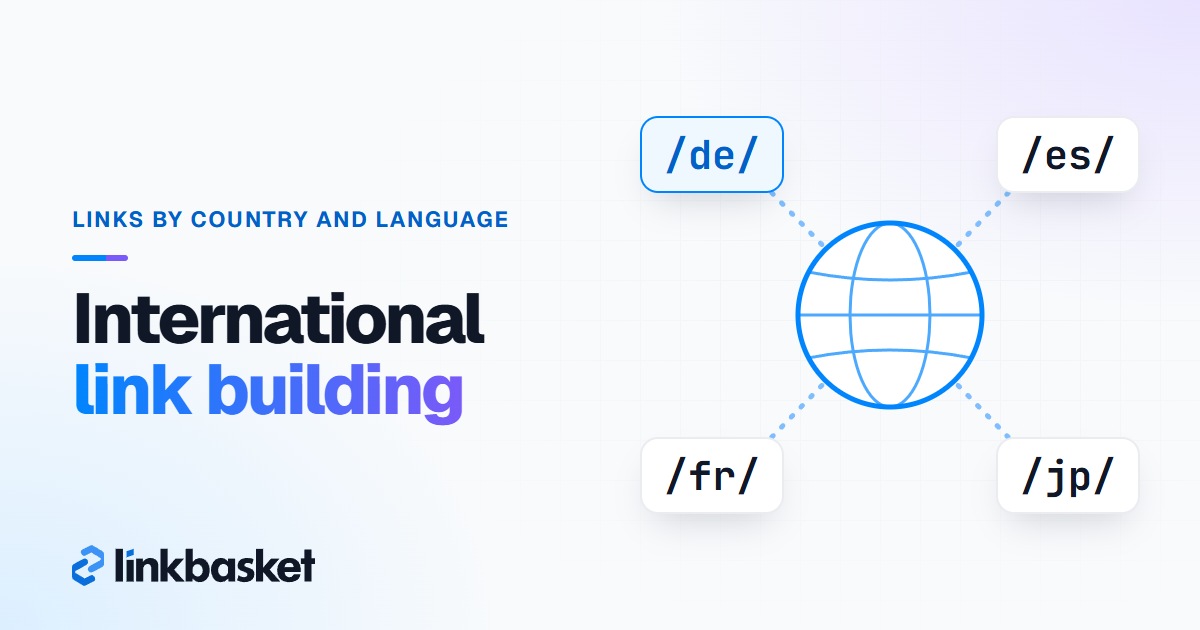
International link building is the practice of earning backlinks from sites in the countries and languages you target, so each market version of your site gains local authority. It works best when the linking site's readers live in that market, the article is in their language, and the anchor matches the language of the page it points to.
Last updated: November 9, 2026
What is international link building?
International link building means building links country by country and language by language, instead of treating "backlinks" as one global pool. A link from a German news site to your German page does one job. A US blog link to your homepage does another.
Two terms get mixed up:
- Multilingual link building: links to pages in several languages, such as English, Spanish and German versions of one product.
- Multi-regional link building: links aimed at specific countries, even in one language, such as the US, UK and Australia.
Most international sites need both. Few plan for it. Global link building, in the sense of buying any high-DR link anywhere, misses the point: the reader's country and language matter as much as the score.
Do links from local sites help international SEO?
Yes. Google lists links from local sites among the signals it uses to work out which country a page is for. Its guide to managing multi-regional and multilingual sites, checked November 2026, names "local addresses and phone numbers on the pages, the use of local language and currency, links from other local sites" as signals, along with signals from your Business Profile where available.
So international SEO link building isn't only about authority. It's about place. For how links sit beside reviews and citations in general, see our guide to off-page SEO and link building. Links from French sites to your /fr/ pages help tell Google who those pages serve. Links from the wrong country blur it.
How does site structure change international link building?
Your URL structure decides whether links to one market help the others. With subfolders, every link strengthens one shared domain. With country-code domains, each domain has to earn its own links from scratch.
Google's international guide compares four options. Here they are, with what each means for links:
| Structure | Example | Google's main pros and cons | What it means for links |
|---|---|---|---|
| ccTLD | example.de | "Clear geotargeting"; "Expensive"; "Can only target a single country" | Each domain needs its own link profile |
| Subdomain | de.example.com | "Easy to set up"; users may not tell language from country | Links build partly separate profiles; plan per subdomain |
| Subfolder | example.com/de/ | "Easy to set up"; "Low maintenance (same host)"; "Single server location" | All links strengthen one domain |
| URL parameter | example.com?loc=de | "Not recommended" | Avoid |
Google also says ccTLDs "provide a strong signal to both users and search engines that your site is explicitly intended for a certain country." That clarity costs links. Launch 5 ccTLDs and you start 5 link profiles at zero. That's five budgets, not one.
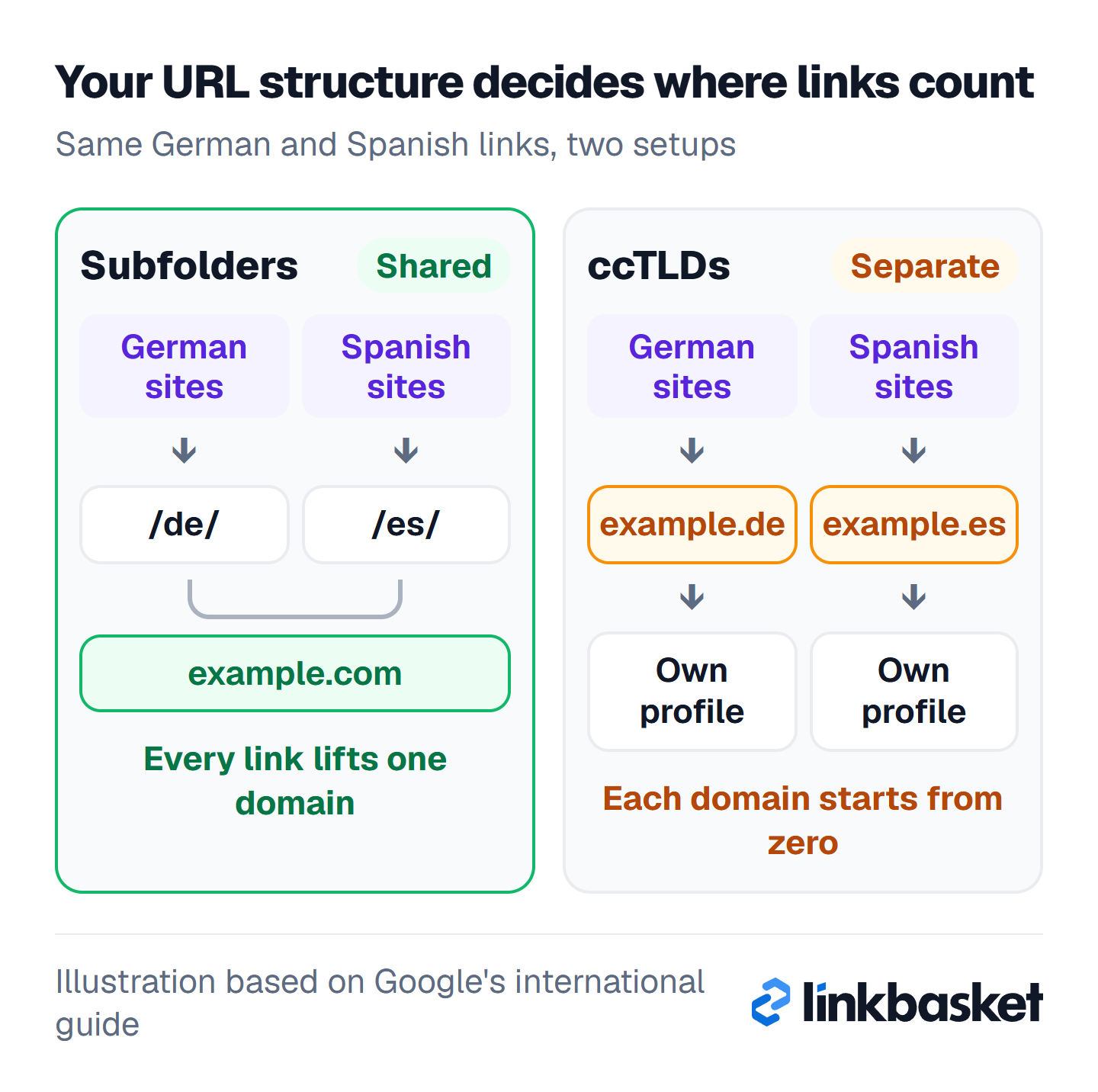
In practice, the difference shows at the bottom of each panel. On the left, every German and Spanish link ends up in one domain. On the right, the same links split into two profiles that each start from zero.
Our view? If you're entering 2 or 3 markets on a limited link budget, subfolders make each link work harder. Choose ccTLDs when local trust in the domain is worth several link budgets.
How do you find local publishers for international links?
Find local-language publishers by searching in the target language, on the local Google, for the topics your page covers, then checking that each site's traffic actually comes from that country. English search results won't show you most of them, and most people skip this step, then wonder why every "local" site they find looks the same.
- Translate your topic terms with a native speaker. Locals search differently.
- Search on the local Google, for example google.de or google.es, set to that language.
- Look for local equivalents of "write for us", such as "Gastbeitrag" in German. Ask a native speaker for the right term in each market.
- Check each site's organic traffic and country split, not just DR.
- Read 3 recent posts. Are they written for locals, or machine-translated filler?
Don't trust DR alone here. A sign to walk away: a "local" site whose posts read like rough translations and whose traffic mostly comes from somewhere else.
What anchor text works for multilingual link building?
For multilingual link building, write anchor text in the same language as the linking article and the target page, and point it at the matching language version of your site. A Spanish article should link to your Spanish page with a Spanish anchor.
When you write anchors for a new market, follow four rules:
- Match three things: article language, anchor language and target page language.
- Point to the local version: never send a German anchor to your English homepage when a /de/ page exists.
- Keep the mix natural: mostly brand names, bare URLs and descriptive phrases, with exact-match keywords rare in every language.
- Check with a native speaker: a keyword that looks right in a translation tool can read oddly to a local editor.
Google's spam policies name "links with optimized anchor text in articles, guest posts, or press releases distributed on other sites" as link spam. That rule holds in every language.
How do you judge a site's traffic by country?
Judge a site's traffic by country by checking where most of its organic visitors come from before you order a link. No local readers, no local value.
On LinkBasket, each site page shows the top traffic country and language next to DR, DA, organic traffic and price. You can filter the inventory by country. There's also a "US traffic" filter. Domain names appear once you create a free account, no card needed.
Here's a rule of thumb, ours rather than Google's: for a market-specific link, at least half the site's organic traffic should come from that country. Consider these three hypothetical sites, all pitched as "German":
| Site (hypothetical) | DR | Monthly organic traffic | Traffic from Germany | Verdict for a /de/ page |
|---|---|---|---|---|
| Site A | 45 | 20,000 | 70% | Good fit |
| Site B | 60 | 50,000 | 15% | Weak fit; most readers are elsewhere |
| Site C | 30 | 6,000 | 85% | Good fit, cheaper, smaller reach |
Site B has the highest DR and the worst fit. Pick A or C. Honestly, it's not close, because a link only earns its price when the people reading that page are the people you want to reach, and Site B's readers mostly live outside the market you're paying to enter.
What should you ask international link building services?
Ask international link building services to show you each site, its country split and its language before you pay, and to write in the local language with a native speaker. If a provider won't name sites up front, you can't judge fit.
Here's the short checklist we'd use on any provider, us included:
- Can I see the domain, DR, organic traffic and top traffic country before paying?
- Who writes the article, and are they native speakers?
- Can I set the anchor and the target page for each market?
- Is the link dofollow, nofollow or sponsored, and does that show up front?
- What happens if the link disappears after 3 months?
Vague answers to questions 1 or 2? Then walk away. A provider selling "European links" as one bundle isn't doing international SEO link building, whatever the sales page says, because Europe isn't a market with one language, one search habit or one set of publishers your buyers actually read. It's selling volume.
International link building decision table
Use this table to match your setup to a link plan.
| Your setup | Link plan | Watch out for |
|---|---|---|
| One language, several countries (US, UK, Australia) | Links from each country's sites to each country page | Hreflang between near-identical pages |
| Several languages, subfolders | Local-language links to each /xx/ folder | Anchors in the wrong language |
| ccTLD per country | A full link plan per domain | Budget spread too thin |
| New market, no local content yet | Build local content first, then links | Links to English pages from local sites |
| One global page in English | English links from your strongest markets | Paying for links in markets you don't serve |
Then run each market through the same five steps, in order. Don't skip the fourth; it's the one that catches Site B.
- Pick the market Country first, then language.
- Check the URL structure Subfolder links are shared; ccTLD links stay separate.
- Find local publishers Search in the language, on the local Google.
- Check traffic by country Our rule of thumb: 50% or more from that market.
- Match the anchor Article, anchor and target page in the same language.
Worked example: a hypothetical two-market link plan
Every number here is hypothetical. Say you run a US project-management SaaS with a $6,000 link budget for one quarter, and you've just added German and Spanish subfolders.
- Split by opportunity: Germany gets $3,600 and Spain $2,400, matching expected revenue of 60% and 40%.
- Germany: 15 placements at an average of $240 on German business and software sites, each with at least 50% German traffic.
- Spain: 12 placements at an average of $200 on Spanish tech and small-business sites.
- Anchors: brand name on 12 of the 27 links, descriptive local-language phrases on the rest, exact match on 2 at most.
Both markets live in subfolders. So all 27 links also lift the main domain. If the company had used example.de and example.es instead, the same $6,000 would have built two separate profiles of 15 and 12 links, with nothing shared.
In practice, there's one more cost to count.
Which edge cases change international link building?
Some situations need a different approach, and they're the ones people miss:
- Same language, many countries: Spanish for Spain and Mexico, or English for the US and UK, needs country-specific links, not just language-matched ones.
- Non-Latin scripts: Japanese, Arabic or Russian markets need native-speaking help to vet sites and anchors.
- Countries with few publishers in your niche: neighbouring-niche sites in that country beat on-topic sites abroad.
- Local disclosure rules: some countries have their own advertising-disclosure laws. Check before ordering paid content.
- Local-first businesses: if each market is a physical branch, start with our local link building guide.
When should you hire an international SEO specialist?
Hire an international SEO specialist when you're choosing between ccTLDs, subdomains and subfolders, migrating structures, or fixing hreflang errors across several markets. Those mistakes cost more than any single link. Much, much more.
Don't start building international links until you can tick every box. Many people miss the second one:
- Each local page is written or edited by a native speaker, not machine-translated.
- Hreflang is set up between the language versions.
- Your URL structure is settled, with no migration planned this quarter.
- You have a shortlist of local sites with their country split checked.
Anything less is wasted budget. For managed help across markets, see our link building services.
FAQ
How does international link building differ from local?
Yes. Local link building targets one city or region, often for a physical business. International link building targets countries and languages, usually for a website that sells across borders.
Should I build links to each language version separately?
Yes, where you can. Each language version competes in its own results. It needs its own local links. Subfolders let those links also lift the whole domain.
Do English links help my German pages?
A little, through overall domain strength, especially with subfolders. German links to German pages send the clearer local signal.
How do I check a site's traffic by country?
Use an SEO tool's country breakdown of organic traffic. On LinkBasket, each site page shows the top traffic country and language, and the inventory can be filtered by country.
Next step: plan your international link building
Pick your first market, then shortlist sites with the right country split. Browse publisher sites filtered by country with a free account, check what makes a good backlink before you order, and use our guide to planning a link building campaign with a tracking sheet for the rollout. LinkBasket checks each live link weekly for 12 months and restores, moves or refunds it if it's removed.