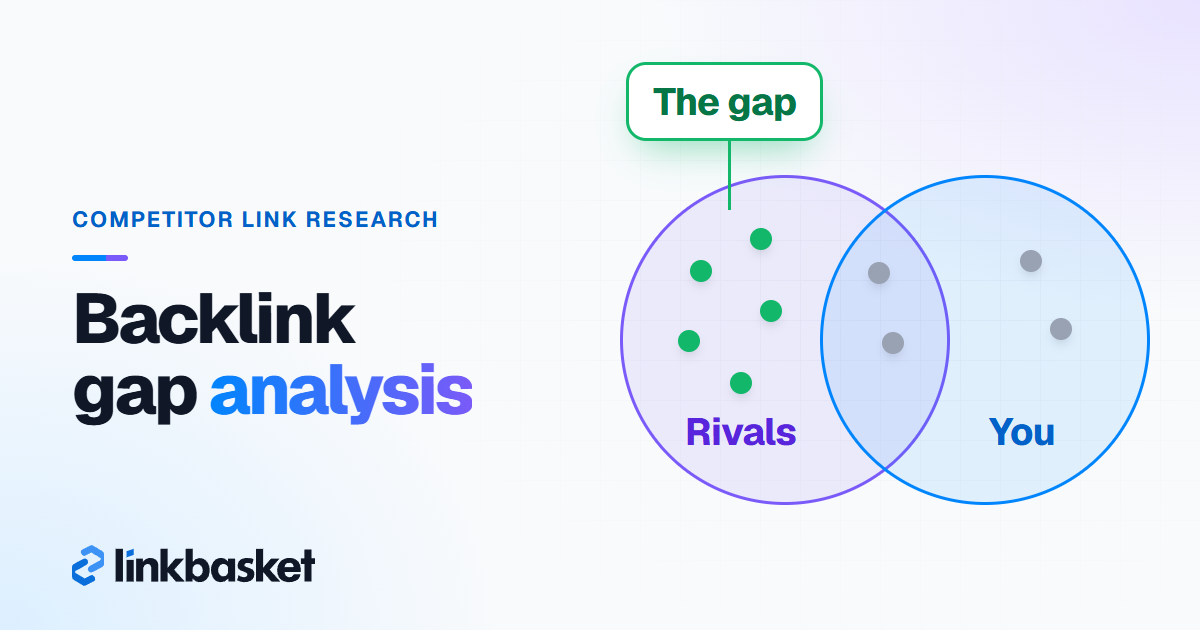
A backlink gap analysis is a side-by-side check of your referring domains against two to four competitors, so you can list the sites that link to them but not to you. Those sites already link out on your topic, which makes them your warmest prospects for outreach or a placement.
Last updated: November 9, 2026
We checked every tool step and price below on the vendor's own help or pricing page on November 9, 2026. Blocked? We cut the claim.
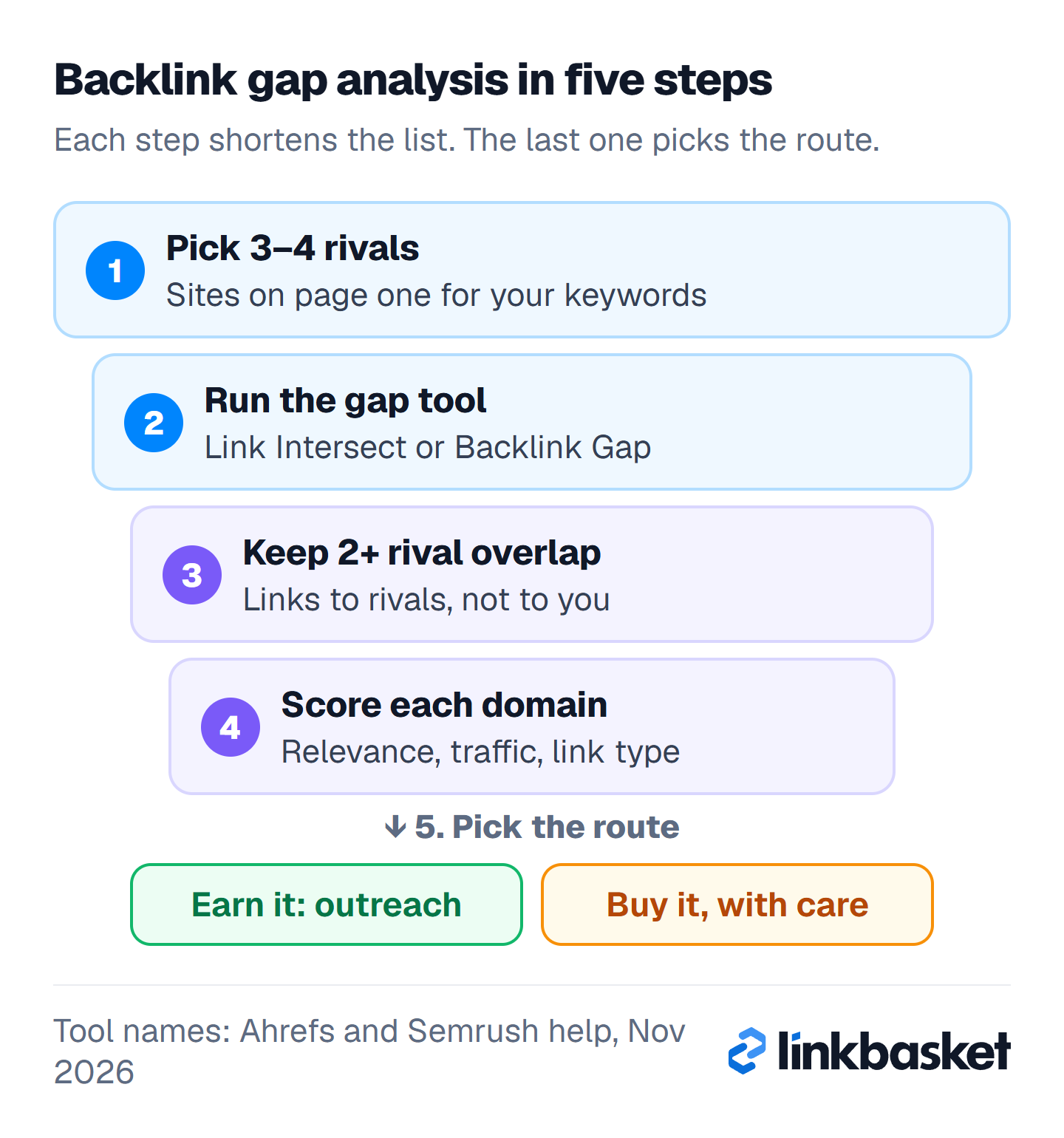
Read the funnel from the top. Each step shortens the list, and only the last one decides how you ask for the link.
What is competitor backlink analysis vs a gap analysis?
Competitor backlink analysis is any study of who links to a rival site. A backlink gap analysis is the narrower version: it compares several link profiles at once and keeps only the domains you're missing.
Why does that matter? Time. A plain competitor review hands you thousands of rows, and most of them are noise you'll never act on. A gap report filters on overlap instead. When a site links to three of your four competitors, it covers your topic, it links out freely, and it simply hasn't found you yet. Short list. Warm leads.
If you only want to see one rival's links, start with our guide on how to check backlinks. This post picks up where that one stops.
Which competitors belong in a backlink gap analysis?
Pick three or four sites that outrank you for the keywords you want, not the biggest brand in your market. Don't use your business rivals by default. Your real search competitors are whoever sits on page one for your target terms, and when you check, they're often blogs or review sites you've never thought of as competition.
Run this filter before you open any tool:
- Search your top keywords. Look up your three most valuable keywords in a private window.
- Note the repeat rankers. Write down every domain in the top 10 for two or more of them.
- Drop the giants. Wikipedia, Amazon and Reddit go. Nobody can copy their links.
- Drop other business models. A news site is no model for a software company.
- Keep three or four. Most tools cap you there or a little higher.
Mixing page types quietly ruins a gap report. Most people miss this. If your target is a product page, compare it with other product pages, and use the page-level (exact URL) mode rather than the whole domain.
How do you run a backlink gap analysis in Ahrefs?
Open Link Intersect from the Competitive Analysis menu, add your domain and up to 10 competitors, and click "Show link opportunities". Ahrefs then lists sites that link to the competitors but not to you, per its Link Intersect help article.
Here are the steps as Ahrefs' help centre describes them in November 2026:
- Choose whether you want referring domains or referring pages. Pick domains. It's the cleaner view for outreach.
- Enter your own domain or URL first.
- Add competitor domains or URLs. Comparing one page with another? Use the Exact URL scope.
- Click Show link opportunities.
- Use the filter for how many targets a domain intersects with, and start with domains that link to at least two of your competitors, because a site that has linked to two rivals in your niche is far more likely to link to a third.
- Narrow with the upper filters, such as DR and traffic.
- Click Export for the intersecting referring domains. Backlinks for each domain come out separately.
Check your plan first. As of November 2026, Ahrefs' plan comparison lists Link Intersect among the Standard plan's extra reports ($249/mo), while the tool's own help article says it's available on all subscription plans. Lite costs $129/mo. The free Ahrefs account doesn't include it.
How do you run a backlink gap analysis in Semrush?
Semrush's Backlink Gap tool compares up to five domains: yours plus four competitors. Enter them, click "Find prospects", then pick your domain in the "Prospects for" dropdown to see who you're missing.
Its tabs sort the results, according to the Semrush Backlink Gap guide:
- Best: domains linking to all competitors but not to you.
- Weak: domains linking to you less than to competitors.
- Strong: domains linking to you but not to competitors.
- Shared: domains linking to you and to competitors.
- Unique: domains linking to only one of the sites.
Start on Best. Then scan Weak, because those sites already know you, and a second link from a site that has linked once is often the easiest win in the whole report. Skip the Strong tab. You own those already. Semrush's blog says you can select prospects and click "Start outreach" to send them to its Link Building Tool. Exports to Excel or CSV work too.
Price? As of November 2026, the Semrush SEO plan costs $139/mo billed monthly, or $117.33/mo billed annually, and the free account allows 10 reports a day across its tools, which is enough to test the workflow on one competitor before you pay.
How do you find competitors' backlinks for free?
You can run a rough backlink gap analysis for free by pulling each competitor's top links from free checkers and comparing them in a spreadsheet. Slower. Capped. Still useful for a small site with three rivals.
Ahrefs says its free backlink checker shows the top 100 backlinks for a domain or page, with DR and anchor text. Semrush Free gives 10 reports a day. Bing Webmaster Tools also shows backlinks for sites you don't own, as Bing's own blog confirms.
A spreadsheet method that works in under an hour:
- Run each competitor through the same free checker and paste the linking domains into one column per competitor.
- Paste your own linking domains from Search Console into a fifth column.
- Stack the competitor columns into one list, then count how often each domain appears with COUNTIF.
- Delete every domain that also appears in your column.
- Sort by count. Domains appearing 2 or more times are your gap.
The catch? A top-100 sample misses most of a big site's links. When you hit that wall, the trick is simple: pay for one month of a suite, export everything you need for all four competitors in one sitting, then cancel. Majestic's Clique Hunter does the same comparison for up to 10 domains, but Majestic labels it a Pro report, so it isn't free either.
Competitor backlink analysis tools compared
Prices as of November 2026.
| Tool | Compares | Gap view | Cost (Nov 2026) |
|---|---|---|---|
| Ahrefs Link Intersect | You + up to 10 competitors | Filter by how many targets a domain hits | Standard $249/mo per plan comparison |
| Semrush Backlink Gap | Up to 5 domains | Best, Weak, Strong, Shared, Unique tabs | SEO plan $139/mo |
| Majestic Clique Hunter | Up to 10 domains | Domains linking to rivals, not you | Paid (Pro report) |
| Free checkers + spreadsheet | As many as you paste | Your own COUNTIF | $0, top 100 links per site |
For a wider look at each suite, including outreach and monitoring features, see our roundup of the best link building tools.
How do you prioritise backlink gaps?
Rank each gap domain on four things before you write a word: how many competitors it links to, topical relevance, real organic traffic, and the type of link it gave them. The first number is free from the tool. The other three take a quick visit.
Use this matrix to sort the list:
| Signal | Tier A: pitch this week | Tier B: pitch this month | Tier C: skip |
|---|---|---|---|
| Competitors it links to | 3 or more | 2 | 1 |
| Topical relevance | Same topic as your page | Adjacent topic | Unrelated |
| Organic traffic | Real, steady traffic | Some traffic | Near zero |
| Link type it gave rivals | Editorial mention, resource list, guest post | Roundup, interview, directory | Comment, profile, sitewide footer |
| Can you get it? | Clear route (contact, write-for-us, listed placement) | Unclear | No route |
The link type column tells you how to ask. Don't skip it. A resource page that lists three competitors wants a better resource. Not a guest post. A news site that quoted two rivals wants an expert source with something new to say. Our checklist on what makes a good backlink covers the traffic and relevance checks in more detail.
Worked example: from 1,200 gap domains to 30 pitches
Every number here is hypothetical. Say you sell project-management software and compare your domain with 4 competitors in Semrush Backlink Gap.
The report starts at 1,200 domains. The hand check is the slow part: about 30 seconds a domain, so roughly 70 minutes for 140 sites. A clear route in means an editor email, a write-for-us page or a resource list.
So you'd send 30 pitches, not 1,200. If 1 in 10 says yes, that's 3 links. Small? Sure. But they come from sites already linking to your market, and that beats 30 random links from sites nobody in your niche reads. Some of those 30 may also sell placements. That's a second route.
How do you turn backlink gaps into outreach or placements?
Match the route to the link type the competitor earned. Editorial links need a reason. Guest posts need a pitch. And when a site openly sells placements, you're making a buying decision, not an outreach one.
- Resource pages and roundups: send the editor one line on what your page adds that the listed pages don't.
- News and blog mentions: offer a quote, data or a product angle the writer can use next time.
- Broken links: if a rival's linked page now returns a 404, offer your page as the replacement.
- Guest posts: pitch two or three titles that fit the site's recent posts. Our guide to guest posting services explains the managed version.
- Paid placements: some gap sites list guest posts or link insertions for sale.
On that last route, be honest with yourself.
LinkBasket is our marketplace. If a gap site is listed in the LinkBasket inventory, you see its metrics and published price before you pay, and LinkBasket checks the link weekly for 12 months after it goes live.
Which edge cases break a backlink gap analysis?
Five situations skew the results. Check for them before you pitch.
- Spam in a rival's profile. Did a competitor buy links from a network? Then your gap list fills with that network. Copying it copies their risk.
- Sitewide links. One footer link can create thousands of backlinks. Judge by referring domains, never raw backlink counts.
- One viral asset. If 80% of a rival's links point to one study or tool, the gap is that asset. You need your own version, not outreach.
- Brand-only mentions. Funding-round press won't link to you. Skip it.
- Nofollow links. They still bring traffic and mentions, but rank them below followed links unless the site sends real visitors.
When should you skip a backlink gap analysis or get help?
Skip it when your site has no linkable page yet. Gaps only help when you have something worth linking to. Build that first.
Get specialist help in two cases. First, if Search Console shows a manual action for unnatural links, stop all link building and talk to an SEO who handles reconsideration requests. Our guide on how to disavow backlinks explains that process. Second, if every competitor's profile looks bought, hire an SEO consultant to audit the market before you copy anyone. In practice, a gap list from spammy rivals is a list of things not to do. Don't trust it.
When you're ready to pitch, tick these off first:
- Three or four rivals that share your page-one keywords
- A gap list cut to domains that link to 2 or more of them
- Each domain scored on relevance, traffic and link type
- One route per domain: resource page, news, broken link, guest post or placement
- A clean Manual Actions report in Search Console
FAQ
What is the best tool for backlink gap analysis?
Ahrefs Link Intersect and Semrush Backlink Gap are the two main options. Ahrefs compares you with up to 10 competitors, while Semrush compares up to 5 domains and sorts results into tabs. Pick the one you already pay for. Both export the same kind of list, so don't buy a second suite just for this.
Can I do a competitor backlink analysis for free?
Yes, roughly. Pull each rival's top 100 links from Ahrefs' free checker, add your Search Console list, and count overlaps in a spreadsheet. It misses deeper links, so one paid month gives a fuller picture.
How many competitors should I compare?
Three or four is the sweet spot. Fewer gives too little overlap to rank by, and more pulls in sites that aren't true search competitors. Choose sites ranking on page one for your target keywords.
How often should I run a backlink gap analysis?
Every 3 to 6 months suits most sites. Run it sooner when you see a competitor jump above you, because a burst of new links often explains the move and the report will show you exactly which sites gave them. Track your own profile monthly in between.
Next step
Start with Tier A. Earned links come first. Where a gap site sells placements, compare it in the LinkBasket inventory and read our backlink management software guide to track every pitch and live link. For a refresher on reading any single profile, see our explainer on what a backlink profile is.